A solid step by step event planning process is what separates a forgettable conference from a powerful business driver. The magic isn't in the fancy banners or the after-party; it's in the blueprint you create long before anyone even knows an event is happening.
This foundational work—focused on strategic goals, a realistic timeline, and a detailed budget—ensures every single decision, from the tech you choose to the way you engage attendees, is tied to measurable outcomes.
Building Your Strategic Event Blueprint
Before you book a single venue or print a single name badge, the most important work happens on paper. This is where you move beyond simple logistics and define why your event even exists.
Skipping this step is like building a house without a foundation. It might look fine at first, but it’s guaranteed to crumble under pressure. A successful event isn't just a well-managed project; it's a strategic asset that should directly fuel your company's broader business goals.
The first move? Define what "success" actually looks like. Too many organizers get sidetracked by vanity metrics like total registrations or social media mentions. While those numbers are nice, they don't tell you if the event actually worked. Instead, you need to focus on clear, measurable business objectives.
Define Clear and Measurable Objectives
Your goals are the North Star for your entire step by step event planning journey, guiding every decision you make from here on out. They have to be specific and quantifiable. For instance, instead of a vague goal like "good networking," a much better objective is "facilitate an average of 5 qualified connections per attendee through the event app."
Think in terms of concrete, goal-oriented objectives:
Pipeline Generation: Generate $500,000 in new sales pipeline attributed directly to event leads within six months.
Sponsor ROI: Ensure 80% of top-tier sponsors achieve their primary goal, measured by post-event surveys.
Audience Engagement: Hit a 70% adoption rate for the mobile event app and achieve an average session rating of 4.5 out of 5.
By setting these concrete targets from the outset, you create a framework for measuring true event ROI. This not only justifies the investment but also provides invaluable data for improving future events.
Map a Realistic Project Timeline
With your objectives locked in, it's time to build your master timeline. The most effective way to do this is to work backward from your event date. This "reverse chronology" approach makes it almost impossible to miss a critical deadline. A conference planned for October should have its timeline mapped out by January, at the latest.
Start by plotting the big, unmovable milestones first: venue contract signed, keynote speakers confirmed, registration launch, and the sponsor prospectus finalized. Once those are on the calendar, you can fill in all the smaller, dependent tasks. You can't, for example, launch registration until the ticketing platform is configured and the event website is live.
Assign a clear owner and a firm deadline to every single task, no matter how small. Use a project management tool like Asana, Trello, or even a simple shared spreadsheet to keep everyone on the same page. This document becomes your team's single source of truth.
Create a Comprehensive and Realistic Budget
Finally, your strategic blueprint needs a meticulously detailed budget. An event budget isn't just a list of expenses; it's a financial plan that reflects your priorities. If attendee experience is a key goal, your budget should show it, with significant funds allocated for high-quality AV, comfortable seating, and great catering.
Break your budget down into major categories to keep things organized:
Venue and Catering: Rental fees, food and beverage minimums, staffing.
Technology Stack: Registration platform fees (like Eventbrite or Whova), event app, lead retrieval for exhibitors, AV equipment.
Marketing and Promotion: Digital ads, content creation, PR, website development (often integrated with a CRM like HubSpot).
Speakers and Talent: Fees, travel, and accommodation.
On-site Logistics: Signage, badge printing, staffing, security.
One of the most critical—and most often forgotten—line items is the contingency fund. Always allocate 10-15% of your total budget for the unexpected. This buffer can cover anything from a last-minute AV repair to needing extra staff on the day. By planning for these marketing event drivers early, you can learn how to organize an event that actually drives results and avoid painful financial surprises.
Designing a Frictionless Attendee Journey
The attendee experience doesn’t start when someone walks through the venue doors. It begins the moment they land on your registration page.
That first interaction sets the tone for everything. A clunky, confusing process creates instant friction, while a smooth, intuitive one builds trust from day one. Every single step, from the first click to the final check-in, is a critical part of your step by step event planning strategy.
It's a common mistake to see registration as just a data collection tool. It’s actually the first major touchpoint you have with an attendee. A form that’s too long or asks for irrelevant information will kill your conversion rates. In fact, one study showed that simply reducing the number of fields on a registration form can boost conversions by a staggering 120%.
The goal is to find that sweet spot: capture the essential data you need for marketing and logistics without making people feel like they’re filling out a tax return.
Optimizing the Registration and Ticketing Process
Think of your registration form as the start of a conversation.
First, only ask for what's absolutely necessary to complete the purchase: name, email, and payment details. You can always circle back later for more information like dietary needs or session preferences through a pre-event survey or a follow-up email. This "progressive profiling" approach respects your attendee's time and gets them across the finish line faster.
When it comes to ticketing, simplicity and transparency are everything. Clearly lay out your ticket tiers, what each one includes, and any early-bird deadlines. Integrating with trusted platforms is non-negotiable for a smooth checkout.
Platform Integration: Use tools like Eventbrite or Whova that can connect directly with your event website and CRM (like HubSpot). This ensures all your data flows seamlessly, which means no manual entry errors and a single source of truth for all attendee info.
Payment Options: Don’t make it hard for people to give you money. Offer multiple payment methods, including major credit cards and digital wallets like Apple Pay or Google Pay.
Clear Communication: The moment someone registers, an automated confirmation email should hit their inbox. This email needs to have all the vitals: a receipt, their ticket or QR code, event dates and times, the venue address, and a link to an FAQ page.
This infographic breaks down the foundational steps that have to happen before you even think about the attendee journey, showing how clear objectives, a solid timeline, and a smart budget are all interconnected.
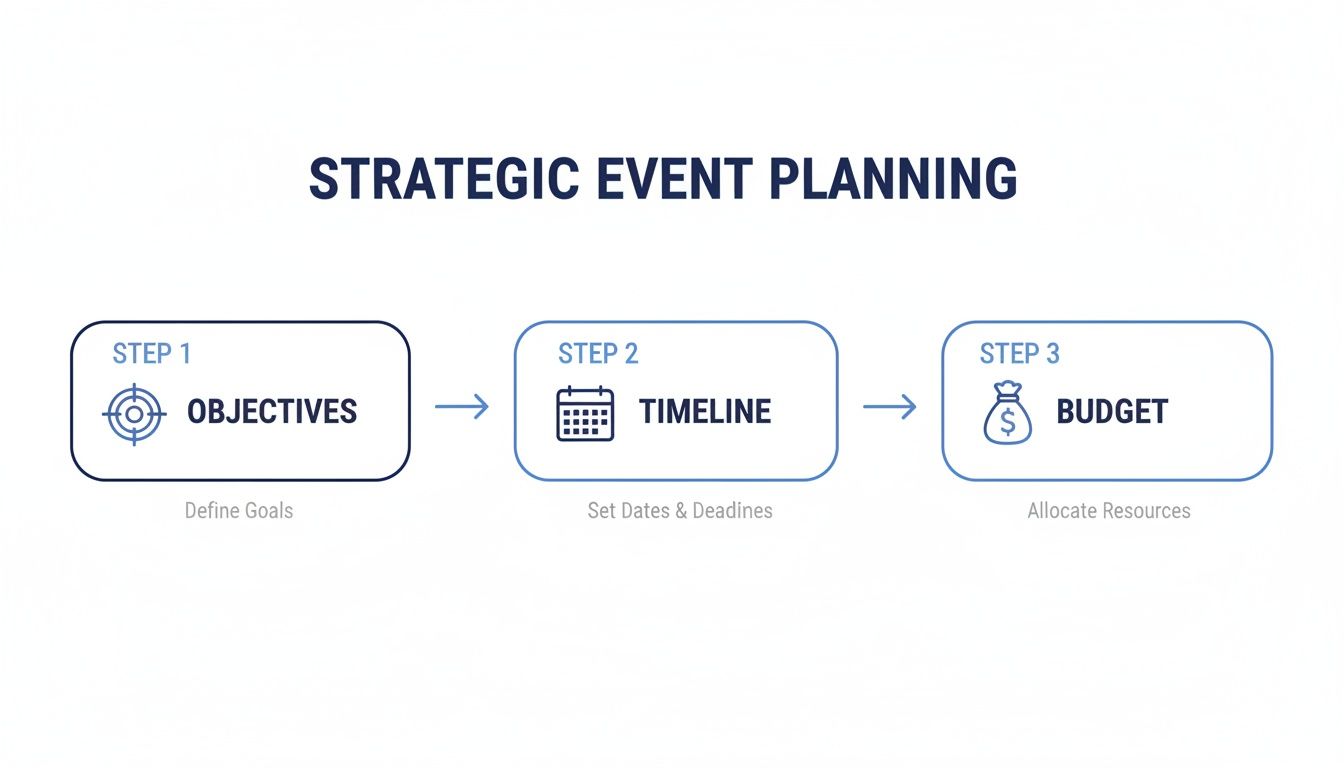
It’s a good reminder that every tactical decision, right down to the design of your registration page, has to align with your core event strategy to actually be effective.
Engineering a Seamless On-Site Check-In
Long check-in lines are one of the fastest ways to kill the mood at an event. The arrival experience should feel welcoming and efficient, not like a chaotic bottleneck. This is where modern event tech completely changes the game. It frees up your staff from tedious manual tasks so they can focus on high-value, face-to-face interactions.
The goal of check-in isn't just to hand someone a badge. It's to validate their decision to attend and make them feel excited for what's ahead. A fast, friendly, and personalized welcome is your first opportunity to deliver on the event's promise.
Consider on-demand badge printing. Instead of pre-printing thousands of badges—which always leads to a frustrating search for names—attendees can just scan a QR code from their phone. A perfectly printed badge pops out instantly with all their correct information. This simple workflow can slash check-in times from several minutes down to under 30 seconds per person.
Platforms like TalkValue are built for this kind of automation, helping teams reduce their on-site staff needs by as much as 70%. That’s a massive saving in both time and budget.
To truly streamline the on-site experience, it’s critical to map out how each piece of your tech stack talks to the others. This ensures data flows smoothly from registration all the way to post-event follow-up, creating a unified journey for both you and your attendees.
Mapping Your Event Tech Stack
Event Phase | Registration Platform (e.g., Eventbrite) | Data Hub (e.g., TalkValue) | Engagement App (e.g., Whova) | Desired Outcome |
|---|---|---|---|---|
Pre-Event | Captures initial attendee data & payment. | Syncs registrant data for segmentation. | Pushes agenda & speaker info to app. | A smooth, branded registration and early access to event content. |
On-Site | Generates unique QR codes for tickets. | Manages QR code scanning & on-demand badge printing. | Facilitates check-in, networking & live polls. | A frictionless check-in and an interactive in-person experience. |
Post-Event | Holds final attendance list. | Consolidates check-in & engagement data for ROI analysis. | Sends post-event surveys & hosts session recordings. | A complete dataset for measuring success and nurturing leads. |
A well-integrated stack isn't just about efficiency; it's about creating a single, coherent experience where every touchpoint feels connected.
Building Pre-Event Excitement and Engagement
The time between when someone registers and the day of the event is a golden opportunity. Don't let the conversation go quiet. A smart communication sequence keeps your attendees engaged and informed, making them feel like valued members of a community long before they even arrive.
Use this time to send out a "know before you go" email series. Share helpful content like:
Speaker Spotlights: Introduce your keynotes and link to some of their previous talks or articles.
Agenda Highlights: Point out specific sessions or networking events you think would be relevant based on their registration info.
App Download Instructions: Get attendees to download the event app early so they can start building their schedule and connecting with others.
Logistical Information: Provide crystal-clear details on parking, public transport, and venue maps.
This steady drumbeat of communication does more than just share information. It transforms the attendee journey from a simple transaction into an ongoing experience, laying the groundwork for a much more engaged and satisfied audience on event day.
Crafting High-Value Sponsor and Exhibitor Partnerships
Your sponsors and exhibitors are way more than just a revenue line on a spreadsheet. They're critical partners who can genuinely elevate the entire event experience for everyone. A solid partnership is a two-way street: they get real business value, and you get the resources to create something unforgettable.
The days of just selling a logo on a banner are long gone. Today's sponsors expect a clear return on investment (ROI). That means your job is to build opportunities for them to generate qualified leads and forge meaningful connections. It all starts by treating your sponsorship prospectus less like a menu and more like a strategic partnership proposal.
Instead of generic "Gold, Silver, Bronze" packages, build your tiers around specific business outcomes. What do your sponsors actually want to achieve? A scrappy startup is probably hunting for brand awareness, while an established enterprise is laser-focused on connecting with a handful of high-value accounts.
Building Sponsorship Tiers That Deliver Real Value
To put together packages that people actually want to buy, you need to get creative with the unique assets your event offers. Think beyond basic visibility and start focusing on access and engagement.
Here are a few high-value offerings to consider:
Sponsored Networking Sessions: Host an exclusive, curated networking breakfast for a top-tier sponsor. This gives them a chance to connect with a hand-picked group of attendees in a relaxed setting.
Targeted Introductions: Use your attendee data to play matchmaker. Pre-schedule a few one-on-one meetings between sponsors and their ideal customer profiles. It’s a huge value-add.
Content Integration: Offer a sponsor the opportunity to lead a non-promotional workshop or panel on a topic where they have legitimate expertise. This positions them as a thought leader, not just another vendor hawking a product.
By focusing on tangible outcomes, you shift the entire conversation from cost to investment. A sponsor is far more likely to sign on the dotted line if they see a direct path to filling their sales pipeline. If you want a deeper look at what leaders in the exhibition space prioritize, you can learn more about the differences between top industry events.
Streamlining Exhibitor Logistics with Technology
Once your partners are on board, the next challenge is making their experience as seamless and productive as possible. This means you need an airtight process for managing everything from booth assignments to lead capture.
Your event tech stack plays a huge role here. A centralized platform can automate so many of the tedious manual tasks that bog down both your team and your exhibitors. Think about an exhibitor portal where partners can upload company info, order booth furniture, and register their staff—all in one place.
An exhibitor’s on-site experience directly impacts their perception of your event's value. If their lead scanner doesn’t work or their booth location is wrong, they won't remember the great sessions—they'll remember the frustration.
Modern lead retrieval technology is an absolute must-have. Forget those clunky old barcode scanners that just collect contact info. Today’s solutions, often baked right into the event app, let exhibitors scan an attendee’s badge with their own smartphone. They can add notes, qualify the lead on the spot, and sync that data directly into their CRM.
This creates a frictionless process that delivers high-quality, actionable data to your exhibitors in real-time. It’s a powerful selling point that proves you’re invested in their success.
Proving ROI and Nurturing Long-Term Partnerships
The work isn’t over when the exhibition hall closes. The final, critical step is to provide your sponsors and exhibitors with a clear, concise report that shows them the value they received. This is your single best tool for securing their partnership for future events.
Your post-event report should include key metrics that tie directly back to their original goals:
Total leads captured through their booth or sponsored sessions.
Audience demographics of the people they connected with.
Engagement data from the event app, like how many attendees added their company to a personal schedule.
Brand impressions from their logo placements across the website, emails, and on-site signage.
Presenting this data proves that partnering with you was a smart business decision. This data-driven approach transforms a one-time transaction into the foundation for a lasting, mutually beneficial relationship that can grow stronger year after year.
Using Technology to Automate Workflows and Drive Engagement
Modern event planning isn't just about getting people in a room anymore. It’s about creating smart, connected experiences, and technology is what makes that possible. The goal isn't just to add more tools to your plate; it's about building a unified system that turns manual, soul-crushing tasks into automated workflows.
This frees up your team to focus on what actually matters: creating high-impact moments for attendees.
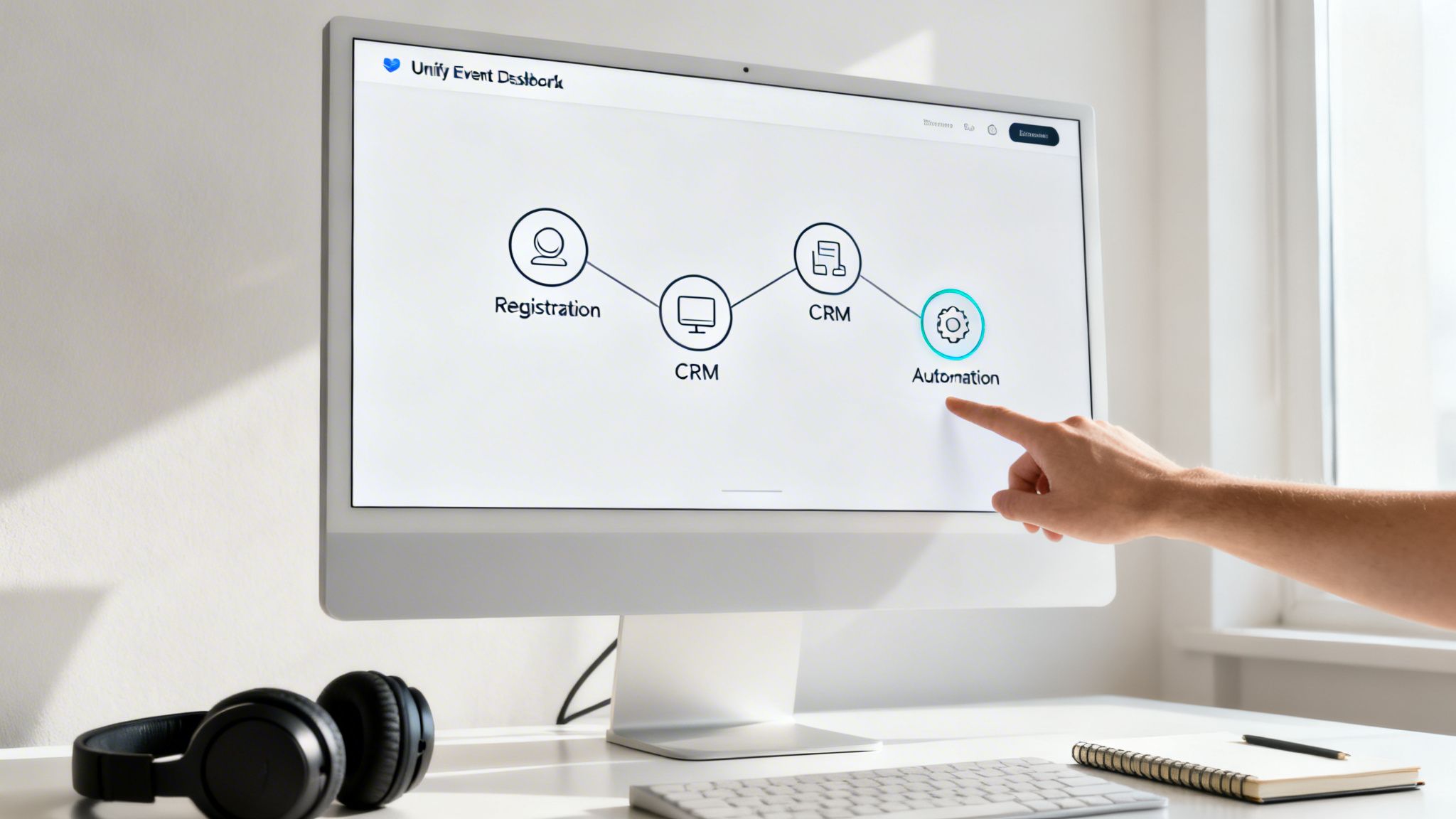
The foundation of any modern event tech stack is a central data hub. Think of it as your event's brain. This is where your registration platform (Eventbrite, Whova, etc.), CRM (HubSpot, Salesforce), and marketing tools all plug in, creating a single source of truth. When data flows freely between these systems, you can unlock some seriously powerful automations.
Building Your Centralized Event Hub
A central hub solves the age-old problem of siloed information. No more registration data stuck in one system while attendee engagement data lives somewhere else. When everything is connected, you can deliver personalized communication at a scale that would be impossible otherwise.
Imagine this: an attendee uses the event app to check into a specific session. That single action can trigger an entire workflow. An hour later, an automated email hits their inbox with a link to the session recording and a prompt to connect with the speaker on LinkedIn. That kind of immediate, relevant follow-up is a game-changer, and it's something you simply can't do manually for thousands of people.
This is why automation is a core part of any modern step by step event planning guide. It shifts your team from being reactive to being proactively helpful.
Using AI and Apps to Get Attendees Talking
Your event app is so much more than a digital agenda. It's your main line of communication and your best tool for getting people to actually interact with each other.
The best event platforms are now using AI to make those interactions smarter. For instance, AI can analyze an attendee's profile, the sessions they've favorited, and their stated interests to suggest people they should meet. Instead of leaving networking to chance, the app can facilitate an introduction: "Hey, you and Sarah both work in SaaS marketing and attended the lead gen session. You two should connect!"
The real goal here is to use technology as a bridge, not a barrier. By automating intelligent suggestions, you help attendees achieve the one thing they came for: making valuable new connections.
This tech-forward approach is quickly becoming the norm. The industry has changed, with 74.5% of planners embracing hybrid models in 2026. This shift is happening because 78% of organizers still see in-person conferences as their most impactful marketing channel. On top of that, AI is being adopted at an incredible pace, with 50% of professionals planning to build it into their events. You can read more about the rise of AI in event management to see just how fast things are moving.
Taming the Beast: The Hybrid Event Tech Stack
Hybrid events throw a wrench in the works. You’re essentially running two events for two different audiences at the same time, and you need to create a cohesive experience for both. Making remote attendees feel just as included as those in the room is a huge technological lift.
Your tech stack has to bridge the physical and virtual worlds. This means you’ll need:
Broadcast-Quality Streaming: This is non-negotiable. A reliable platform that delivers crystal-clear video and audio is table stakes.
Interactive Tools for Everyone: Features like live Q&A, polling, and virtual breakout rooms need to be accessible to both audiences, usually through the event app.
Unified Networking: Your platform should make it seamless for a virtual attendee in another country to book a video call with someone they met at the venue.
The secret is creating shared experiences. When an in-person attendee asks a question and a virtual attendee can upvote it, you start to break down the walls between the two groups. You’re no longer managing two separate events; you’re fostering a single, unified community. A comprehensive AI tool kit for events can give you the horsepower needed to manage these complex interactions without a hitch.
Ultimately, automation and technology are about scaling your impact, not your team. By building a smart, integrated system, you can cut down on manual work, reduce errors, and focus on creating personalized experiences that deliver real value to everyone involved.
Executing Flawlessly and Measuring What Matters
All the careful planning and late nights come down to this—the live experience. This is where your strategy hits the ground, and flawless execution is the only thing that matters.
But the job isn’t over when the last person leaves. In fact, the most important part is just beginning. Measuring the real impact is just as crucial as running a smooth show.
The day of the event is pure performance. Your team needs to move like a single, well-oiled machine, handling everything from a projector failing mid-keynote to a lost attendee, all with professional calm. The secret? Crystal-clear communication channels and empowering your staff to solve problems on the spot.
Mastering On-Site Operations
A final, full run-through is non-negotiable. Don't skip it.
The day before the doors open, get your entire on-site team together—staff, volunteers, key vendor contacts—and walk through the whole event flow from start to finish. This isn't just another meeting; it's a dress rehearsal for showtime.
Check every single critical system and process:
AV and Tech: Go into every session room and test every microphone, projector, and live-stream feed. Don't just see if it turns on. Run a full audio and video test to make sure the quality is actually good.
Registration Workflow: Process a few test attendees through the entire check-in and badge printing system. Are the scanners working? Is the internet connection stable enough for on-demand printing? Find out now, not when you have a line of 100 people.
Team Communication: Make sure everyone is on the same channel, whether that's a dedicated Slack channel or a radio system. Define simple, clear codes for common issues (e.g., "Code Blue in Hall A" for a medical incident) so you can communicate quickly and discreetly.
This last check transforms potential chaos into a controlled, professional response. It ensures everyone knows exactly what to do when—not if—things go sideways.
The Art of Measuring True Event Success
Once the event wraps, your focus has to shift immediately from execution to analysis. Proving your event’s value is how you secure the budget for the next one and confirm your strategy actually worked.
This means looking past simple vanity metrics like attendance numbers and digging into the data that connects directly back to your business goals.
The real measure of success isn't just a packed room; it's a full pipeline. Your post-event data should tell a clear story about how the event moved the needle for your business, your sponsors, and your attendees.
Start by pulling data from all your sources—the event app, your registration platform like Eventbrite or Whova, and your CRM like HubSpot—into a single dashboard. Look at session attendance, dwell times at exhibitor booths, and how many people engaged with polls and Q&A. This data paints a rich picture of what actually resonated with your audience.
Translating Data Into Business Impact
The ultimate goal is to calculate a clear return on investment (ROI). This means you have to track the journey from an event lead all the way to closed business.
Work with your sales team to tag every lead generated from the event in your CRM. Over the next few months, you can attribute new revenue directly back to your efforts, building an undeniable case for the event's bottom-line impact.
For your sponsors, give them a detailed post-event report that offers more than just a list of scanned badges. Include metrics on brand impressions, attendance numbers for their sponsored sessions, and demographic data of the people they interacted with. This kind of transparency builds trust and turns one-time sponsors into long-term partners.
This intense focus on measurement is becoming a real competitive advantage. By 2026, 66% of organizations plan to schedule more events, a huge jump from just 41% in 2023. That confidence is backed by hard numbers: 52% of marketers now say event marketing provides more business value than other marketing channels. You can discover more event industry insights to see just how much data is shaping the future of live experiences.
Finally, automate your follow-up. Use your event platform to trigger personalized email sequences based on what an attendee actually did. Someone who went to a session on AI should get different content than someone who spent their time in the startup zone. This thoughtful, automated nurturing keeps the conversation going and helps turn connections into customers long after the event is over.
Burning Questions from the Event Trenches
Even the best playbook can leave you with questions. Modern events are messy, and the real challenges usually pop up somewhere between managing a shrinking budget and trying to explain the event’s value to your boss.
Let's tackle a few of the most common questions I hear from other organizers.
A classic pain point? The budget. Specifically, how to handle costs that seem to appear out of nowhere. No matter how detailed your spreadsheet is, something unexpected will happen. A last-minute rush job on printing, a surprise A/V fee, or needing more security staff—it’s a given.
The only real defense is to plan for it. Always build a 10-15% contingency fund directly into your initial budget. This isn't just "extra" money; it's a planned buffer for reality. Treat it like any other mandatory line item. Doing this from day one saves you from scrambling for cash or, even worse, cutting corners on the attendee experience later.
How Do I Choose the Right Event Technology?
Picking the right tech stack feels like walking into a maze. There are hundreds of platforms for registration, engagement, and analytics, and they all sound great in a sales demo. It’s easy to get lost.
The secret is to ignore the products at first and focus entirely on your problems.
Before you even think about booking a demo, map out your biggest operational headaches and what a solution would actually look like.
The Problem: Our check-in lines are a nightmare and create a terrible first impression.
The Fix We Need: A system that lets us scan QR codes and print badges on the spot.
The Problem: Our sponsors complain they can't prove the event was worth it.
The Fix We Need: A lead retrieval tool that syncs directly with their CRM.
The Problem: Attendee data is stuck in three different spreadsheets, and we can’t see the big picture.
The Fix We Need: A central platform that pulls all our data into one place.
When you define your needs this clearly, you can immediately filter out 90% of the noise. It turns a confusing shopping trip into a focused evaluation. You’re no longer buying features; you’re buying solutions to real-world problems.
What Is the Best Way to Prove Event ROI?
This is the big one. Proving the return on investment (ROI) is often the toughest conversation you'll have, especially when the C-suite is scrutinizing every dollar. The key is to connect every single metric back to the business goals you set at the very beginning. Vanity metrics like attendee count just won't cut it anymore.
Your ROI story has to be told in the language of business leaders. That means focusing on pipeline generated, customer acquisition cost (CAC), and sponsor retention rates. These are the numbers that reframe an event from a cost center to a revenue driver.
To get there, you have to track the entire lead journey. Use your CRM to tag every single lead that comes from the event. Then, watch those leads for the next six to twelve months. How many converted? What was the total revenue they generated?
This creates a direct, undeniable line from an event handshake to a closed deal. When you can walk into a meeting and say, "We spent X, and it generated Y in new pipeline," you’ve built an airtight case for your event's strategic value and secured your budget for next year.
Ready to unify your event data and automate your workflows? TalkValue provides an AI-native toolkit and agency services designed for modern conferences and exhibitions. Turn your fragmented data into a single growth engine. Learn more at https://trytalkvalue.com.
FAQ