Most agencies say they “use AI,” but for many it’s just a productivity layer on top of the same old workflow. AI-native agencies are built differently—AI becomes the operating system that unifies fragmented data and turns it into continuous strategic direction. The result isn’t more dashboards. It’s faster decisions, clearer navigation, and strategies that actually evolve.
Your agency might use AI. That doesn't make it AI-native.
Over the past two years, "we use AI" has become the default claim of nearly every marketing agency on the planet. It shows up in pitch decks, on homepages, in sales calls. And in most cases, it means someone on the team has a ChatGPT subscription and a Midjourney license.
That's not a transformation. That's a productivity tweak.
Meanwhile, a genuinely different kind of agency is emerging, one that isn't adding AI to existing workflows, but building the entire operating model around it. The difference between those two things is not subtle. It changes how fast decisions get made, how data gets used, and ultimately, whether your strategy actually shifts from year to year.
So what does an AI-native agency actually do differently, and how do you know when you're working with one?
The Problem with "AI-Enabled" Agencies

When a traditional agency says it uses AI, look carefully at where in the process AI actually appears.
Usually, it's at the edges. AI writes a first draft of copy. AI generates visual concepts. AI summarizes a research report. The underlying agency model stays exactly the same: retainer, strategy deck, slow execution cycle, lagging results.
This matters because the bottleneck in B2B marketing was never content production speed. It was always decision quality. It was always the gap between the data your team holds and the strategic clarity needed to act on it.
If you work in event marketing or exhibition management, you already know this problem well. The dashboards get more sophisticated every year. The reports get longer. And yet, as explored in why most event analytics don't change decisions, the strategies those reports produce tend to look remarkably similar to the ones from the year before.
AI layered on top of broken decision infrastructure doesn't fix the infrastructure. It just accelerates the same loop.
That's the core failure of the AI-enabled model, and it's precisely what the AI-native model is designed to solve.
What AI-Native Actually Means
AI-native doesn't mean AI is used more frequently. It means AI is the operating system, not a feature sitting on top of one.
Three structural differences define what that looks like in practice.
Data first, always. In a traditional agency, data comes from the client periodically, gets interpreted by an account team, and surfaces in a deliverable weeks later. In an AI-native model, data is the starting point of every decision: unified, reconciled, and continuously updated rather than snapshotted at reporting time.
Speed by default. When AI is embedded in the operating model rather than bolted on, the time between raw data and strategic direction collapses. Campaigns, briefs, and audience analyses happen in hours, not weeks. This isn't about cutting corners. It's about removing the manual translation layers that slow everything down.
Compounding intelligence. Perhaps the most underappreciated difference: an AI-native system learns. Every campaign, every event, every CSV that gets processed makes the next output sharper. Traditional agency engagements tend to reset. Each new brief starts from scratch, drawing on general experience rather than accumulated client-specific intelligence.
The clearest analogy is navigation. A car with GPS bolted on as an afterthought is still fundamentally designed around the driver's intuition. A car designed from the ground up around navigation, where routing, real-time data, and decision support are core to how the vehicle operates, is a different thing entirely.
AI-native agencies are the second kind of car.
Why This Matters Most for B2B Event and Exhibition Teams
Event and exhibition data is among the most fragmented in B2B marketing. A single event cycle might produce registration exports from one platform, CRM data from another, sponsor target lists in a spreadsheet, community signals from LinkedIn and Slack, and attendance history sitting in CSVs from three years ago.
Traditional agencies look at this and see a reporting problem. So they build dashboards. They surface total registrations, returning vs. new ratios, channel performance. The data becomes visible.
But visibility isn't direction.
An AI-native agency looks at the same fragmented data and sees a decision infrastructure problem. The question isn't how to display the data more clearly. It's how to reconcile it into a single navigational view of your attendee landscape, one that tells you not just what happened, but where the highest-leverage moves actually are.
This is the distinction that matters for exhibition leaders managing complex, multi-year audience relationships, hybrid data streams, and increasing sponsor pressure. Choosing between events like SISO CEO Summit vs. ECEF isn't just a prestige question. It's a strategic alignment question. And you can only answer it clearly when your data is reconciled, not scattered.
The teams that grow fastest aren't the ones with the most data. They're the ones with the clearest picture of where their revenue actually lives.
The Agency Model Isn't Broken. The Infrastructure Is.
It's worth being precise here. Traditional agencies aren't failing because of talent. The strategists, creatives, and account managers working in those firms are often excellent. The failure is structural.
Monthly retainers, by design, incentivize activity over outcomes. Deliverables like decks, reports, and campaign briefs are static by nature. They reflect what was true when they were written. They don't update as the market shifts, as audience behavior changes, or as new data comes in.
This creates a compounding problem for event teams. Your audience is dynamic. Loyalty patterns shift. New cohorts emerge. Sponsor priorities evolve. A static deliverable produced in Q1 is often partially obsolete by Q3, but the retainer keeps running, and the agency keeps producing variations of the same output.
AI-native agencies replace this model with always-on intelligence. Instead of periodic deliverables, the output is continuous strategic direction, updated as data updates and responsive to what's actually happening rather than what happened last quarter.
Revenue stagnation, in most cases, is a structural problem. Agencies built on static workflows cannot solve structural problems, regardless of how talented their teams are.
What to Look for in an AI-Native Agency Partner
Not every agency claiming to be AI-native is one. The language has already started to be diluted, the same way "data-driven" became meaningless five years ago. So rather than taking the label at face value, use these four questions to assess what's actually underneath it.
1. Where does your data come from, and how is it reconciled? A genuinely AI-native agency will have a clear, specific answer about how they unify data from multiple sources, not just how they analyze clean data once it's handed to them.
2. How quickly can you move from insight to campaign execution? If the answer involves multiple rounds of internal review, client presentation cycles, and a two-week turnaround, the AI layer isn't changing the operating model. It's just accelerating one step inside it.
3. Does your output improve over time, or does every engagement start from scratch? The compounding effect is one of the clearest signals of an AI-native model. If the agency can't point to how their outputs for you specifically get sharper over time, they're not operating natively.
4. Can you show me decisions your work changed, not just metrics it produced? Dashboards produce metrics. AI-native agencies change decisions. Ask for examples of both and see which one they're more comfortable answering.
Red flags to watch for: vague AI language without operational specifics, no clear data integration story, slow onboarding timelines, and deliverable-based pricing with no connection to outcomes. These are signals that AI is being used at the edges, not at the core.
If you're thinking about what execution actually looks like when data and decision-making are aligned from the start, how to organize a marketing event that actually drives results offers a useful framework for what that looks like in practice.
AI-Native vs. Traditional Agency: What Changes in Practice
The differences aren't abstract. They show up in how work gets done, how fast decisions move, and whether strategy actually shifts over time.
Dimension | Traditional Agency | AI-Native Agency |
|---|---|---|
Data model | Client-provided, periodic | Unified, continuously reconciled |
Speed to insight | Weeks | Hours |
Primary output | Decks and reports | Decision frameworks and maps |
Learning curve | Resets each engagement | Compounds over time |
Cost structure | Activity-based retainer | Outcome-oriented |
Strategic role | Executional | Navigational |
The column that matters most is the last one. Executional agencies tell you what to do based on what they've been briefed. Navigational agencies tell you where to go based on what the data actually shows.
That shift, from execution to navigation, is what replacing the traditional B2B event marketing agency model actually requires. It's not about swapping one vendor for another. It's about changing the infrastructure that decisions are built on.
Stop Optimizing. Start Navigating.
If your agency produces reports but hasn't meaningfully changed your strategy in the past two years, that's not a vendor problem. It's a structural signal.
A signal that visibility isn't enough. That faster content production isn't the bottleneck. That another dashboard isn't what's missing.
The teams growing fastest right now aren't working with the most sophisticated analytics. They're working with the clearest direction, because their data is reconciled, their decisions are grounded, and their agency is built to navigate, not just report.
TalkValue is not a traditional agency with an AI add-on. It's decision infrastructure for event and exhibition teams who are done running the same strategy on a slightly updated spreadsheet.
If you'd like to see what that looks like in practice, how fragmented CSVs become a unified revenue map and how that map changes what you do next, book a call with TalkValue and we'll walk through exactly how it works for your event portfolio.
Because analytics shouldn't end at a dashboard.
They should start with a decision.
Learn more about us
Growth AI Toolkit
Unify Eventbrite, Luma, Whova, HubSpot and more with AI.
Automate workflows and turn event data into growth.

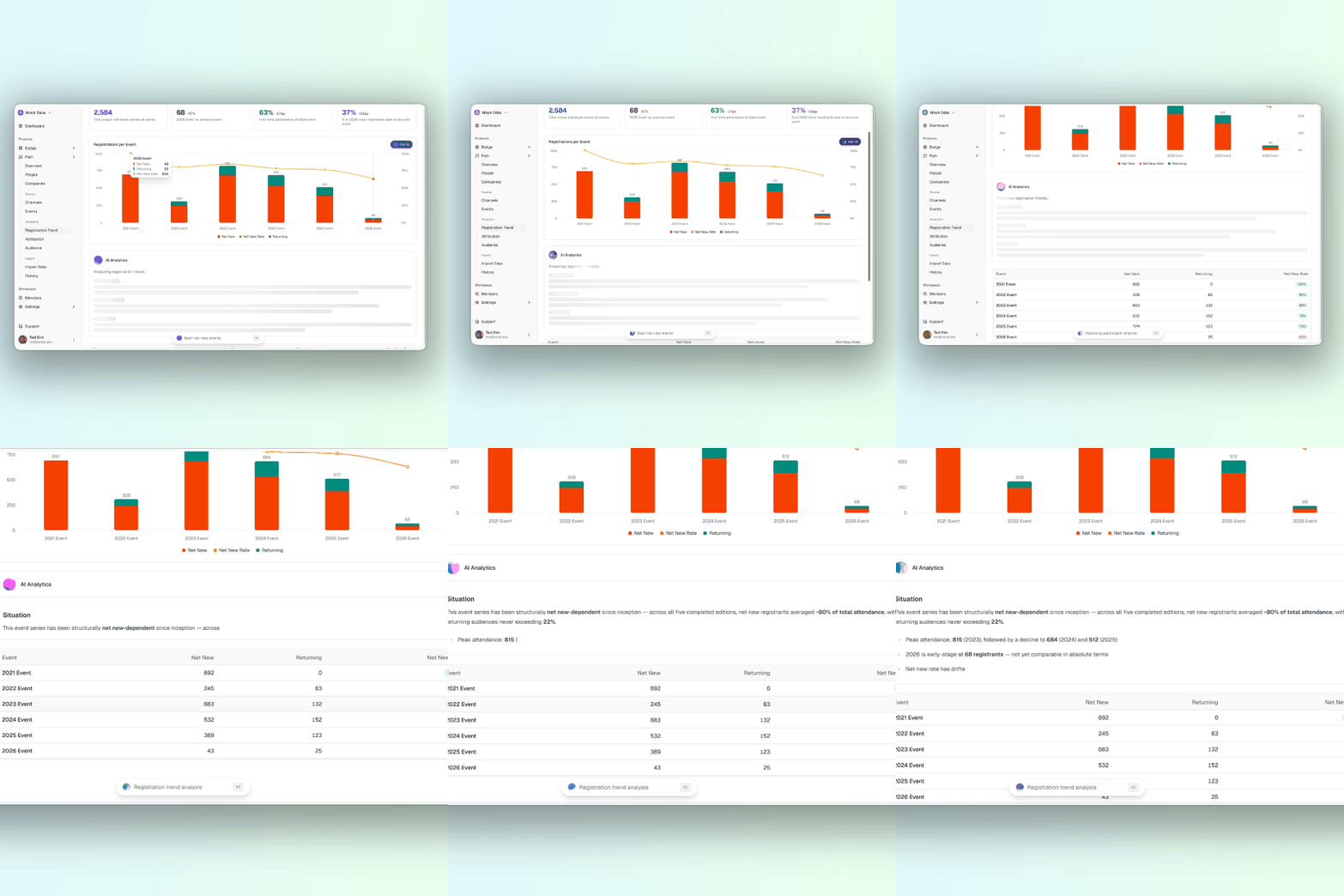

Full Service
AI-Native Agency
We combine event expertise with AI-driven execution to improve operations, grow revenue, and scale communities.