
The share of consumers saying brand AI improved their buying experience rose while the share saying it made things worse fell sharply. Resistance is receding, but it comes with a condition attached, and the condition costs nothing to meet. Distrust tracks to opacity about data far more than to the presence of automation.
Most organisations are still making a defensive calculation about AI in customer-facing touchpoints. Deploy it quietly, do not draw attention to it, hope nobody minds.
The 2026 data suggests that calculation is backwards on both halves. Buyers mind less than you think about the automation. They mind considerably more than you think about not being told.
Resistance is receding, and it is measurable
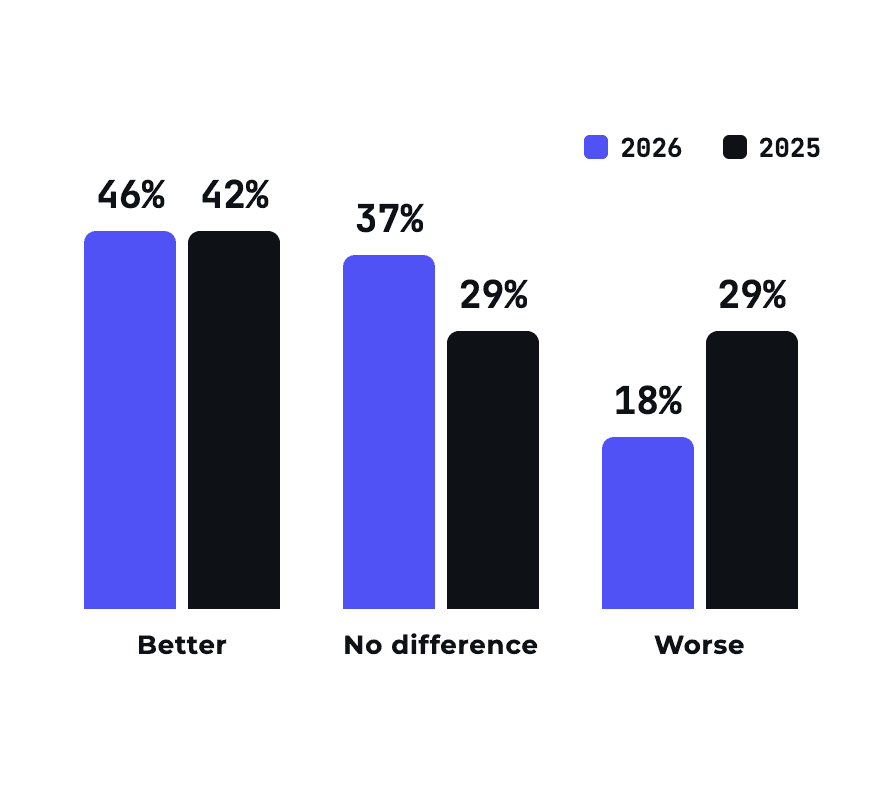
MarTech's reporting on consumer readiness found 46% of US consumers saying brand AI improved their buying experience, up from 42% the year before.
The more striking movement is on the other side. The share saying brand AI made things worse fell from 29% to 18%.
An eleven-point drop in active dissatisfaction inside a single year is a substantial shift in public patience. It is easy to read the first number and conclude the change is modest, since 42 to 46 is small. The second number is where the story is. The people who were actively annoyed largely stopped being annoyed.
That reflects something simple. Early implementations were bad. Chatbots that could not answer anything and would not hand over to a human. Recommendation systems that recommended what you had just bought. As implementations improved, the objection they generated faded, which is what you would expect if the objection was to the quality rather than to the category.
The condition attached
Alongside that warming sits a specific expectation, and it is close to unanimous.
Invoca data in the same coverage found nearly three quarters of consumers preferring an AI agent over a human when the AI resolves their question faster. Speed wins. People are not sentimental about who answers if the answer arrives quickly and is correct.
But over 80% expect that AI to identify itself as AI.
Those two findings sit together and they are not in tension. The preference is for resolution. The expectation is for honesty about what is doing the resolving. Buyers are not asking you to use fewer machines. They are asking you not to pretend.
That is a considerably easier requirement to satisfy than most organisations assume, because it costs nothing. It is a sentence.
The complaint was never the automation
The research that explains why goes a level deeper. Work from the Nuremberg Institute for Market Decisions, reported by MarTech, found that distrust tracks to opacity about data use more than to the presence of AI itself.
Read that carefully, because it relocates the problem entirely. When someone says they do not trust a brand's AI, the underlying objection is usually not "a machine handled this." It is "I do not know what you did with what I told it."
That distinction matters operationally, because the two objections have completely different remedies. If the problem were the automation, the fix would be expensive: fewer machines, more staff, slower service. If the problem is opacity, the fix is disclosure, which is nearly free.
Most organisations have been paying for the expensive remedy to a problem they did not have, by limiting automation in places where buyers would have welcomed it, while continuing to be vague about data in ways that generate the distrust they were trying to avoid.
What this means for an event's touchpoints
Events have more of these touchpoints than most businesses, and they cluster at exactly the moments when speed matters most.
The exhibitor with a question at two in the morning, three days before build, in a different timezone from your team. The attendee trying to work out whether a session is relevant to their role. The sponsor asking what the delegate breakdown looks like by seniority. The registrant who cannot find their confirmation email.
Every one of those is a case where a fast machine answer beats a human answer that arrives in eleven hours. The Invoca finding applies directly. Nobody in that position wants to wait for a person on principle.
So the automation is not the risk. The risk is the presentation of it. A bot that says it is a bot, answers well, and hands over cleanly when it cannot is a service improvement. The same bot presented as a member of the team is a trust problem waiting for the moment someone notices.
The second category is subtler and more common in events. The automated follow-up after a session, written to read as a personal note from a named person who did not write it. The "I noticed you attended my talk" message that nobody noticed anything about. These are not usually thought of as AI disclosure issues. They are exactly that, and they carry the same downside, which is that the recipient eventually works it out.
Disclosure is cheap and most teams still skip it
The reason teams skip it is worth naming, because it is not laziness.
The fear is that saying "this is an AI assistant" reduces the perceived quality of the interaction, or signals that the organisation is cutting corners. That fear was reasonable in 2023, when the disclosure genuinely lowered expectations because the average implementation was poor.
The data no longer supports it. When 46% report improved experiences, and nearly three quarters actively prefer the machine when it is faster, disclosure is not a confession. It is a description of a service most people are content to receive.
There is also an asymmetry worth weighing. The cost of disclosing is a small reduction in the illusion of personal attention. The cost of not disclosing, and being found out, is a specific and durable kind of damage, because the discovery reframes every previous interaction as having possibly been fake. That is expensive to repair and it lands hardest on exactly the relationships you most want, since the people paying close attention are the engaged ones.
The sponsor-facing version of the same problem
There is a second audience for disclosure that gets almost no attention, and for organisers it carries more money than the attendee-facing one.
Sponsors and exhibitors now receive reports that are increasingly assembled by machine. Attendance breakdowns, engagement scores, lead quality assessments, attribution claims about what the sponsorship delivered. The analysis behind those numbers is often automated, and the report frequently arrives without any indication of that.
The exposure here is different from the attendee case. An attendee who discovers a chatbot was a chatbot is mildly irritated. A sponsor who discovers that a confident-sounding engagement metric was generated by a process nobody on your team can explain has a commercial problem with you, at renewal, with a number attached.
The protective move is the same as everywhere else in this piece, and it is specificity. State what was measured directly and what was inferred. Badge scans at the stand are a direct measurement. Estimated brand exposure is a model. Both are legitimate to report. Presenting the second with the same confidence as the first is where the trouble starts, because the sponsor will eventually test one of those numbers against their own CRM. The discipline behind that distinction is the subject of why most event analytics don't change decisions.
Organisers who label the difference find it strengthens the relationship rather than weakening it. A report that says plainly which figures are hard and which are estimates reads as competence. A report where everything is presented as equally certain invites the sponsor to discount all of it once they find one number they can disprove.
The end of "we use AI" as a claim
There is a finding in the same research that most organisations have not fully absorbed. 100% of surveyed marketers now use AI.
All of them. Which means any positioning built on the fact of using AI has no differentiating content whatsoever. Saying it is like saying you use email.
This has a direct consequence for how event organisations and their partners talk about themselves. The claim that carries information is no longer "we use AI." It is something narrower and harder to fake. What specifically is automated. What specifically is not, and why. What happens to the data that goes into it. Who is accountable when it gets something wrong.
Those are answerable questions, and the ability to answer them cleanly is becoming a differentiator precisely because the generic claim has become worthless. We set out what those answers should look like in what is an AI-native agency.
Designing the disclosure
Four practical points, all cheap.
Say it at the start, not in a policy. The disclosure that works is in the first line of the interaction, in the same voice as the rest of it. A sentence in a privacy page is legally tidy and does nothing for trust, because nobody reads it at the moment they form an impression.
Make the handover obvious. The single biggest driver of frustration with automated support is being trapped. An AI that offers a clear route to a person, early and without a fight, converts most of the residual objection.
Be specific about the data, not reassuring. "We take your privacy seriously" reads as evasion. "Your question and your registration record are used to answer this, and are not shared with exhibitors" reads as information. The research says the second one is what actually moves trust.
Stop attributing automated messages to named humans. If a person did not write it, do not sign it as though they did. Send it from the event, from the team, from a role. This is the cheapest single fix on the list and the one most frequently ignored.
Buyers have largely made their peace with AI doing the work. What they have not made their peace with is being unable to tell. That is a design decision, it is free, and it is currently the least expensive trust available to any event organisation.
If you want a review of where AI touches your attendee, exhibitor and sponsor communications, and what should be disclosed, book a call with TalkValue.


FAQ