
The bench thinned through attrition and unfilled seats rather than announced redundancies, which is why the aggregate is larger than the industry news suggests. The work those people did has not gone anywhere. Understanding which half of it actually moved to AI is the difference between a team that copes and one that quietly breaks.
There was no announcement. That is the part worth sitting with.
Over the last twelve months, a substantial share of B2B marketing capacity left the industry without a single press release, restructuring memo, or town hall. Somebody resigned and was not replaced. A maternity cover ended and the role quietly closed. A budget line for a coordinator was reallocated to software.
Each of those decisions looked small and locally reasonable. In aggregate they describe one of the fastest workforce changes marketing has been through, and most teams are still operating as though it has not happened.
The cuts did not look like cuts
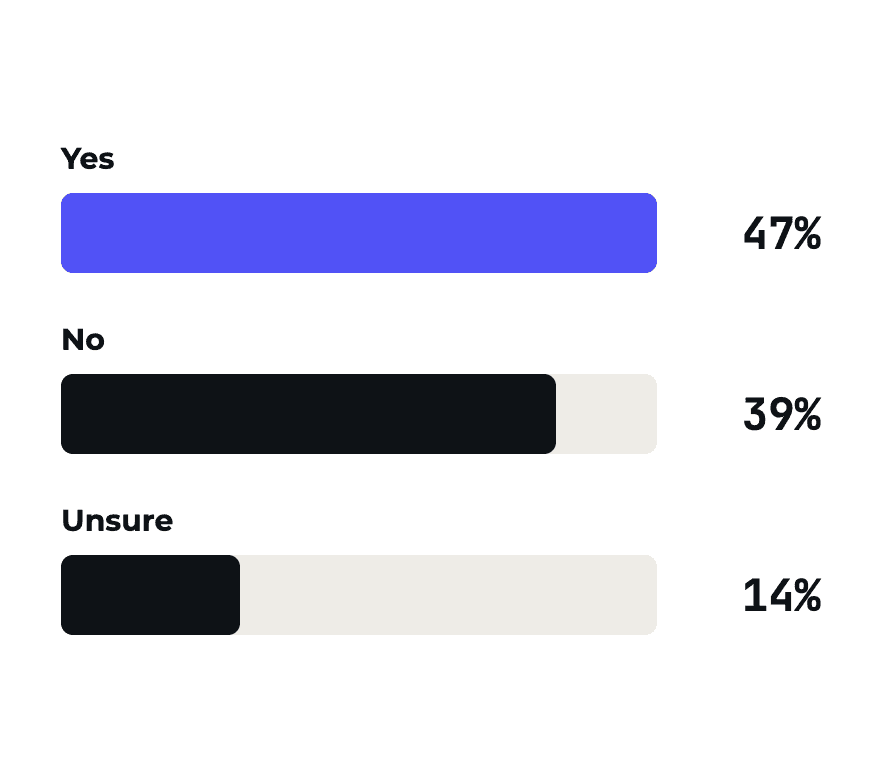
Wynter research reported by MarTech in August found that 47% of B2B companies have eliminated, reduced, or stopped backfilling marketing roles because of AI in the last twelve months. Nearly half. And 60% of leaders named content and copywriting as the most exposed functions.
A Stanford study discussed by Social Media Examiner puts the sharpest edge of this on the youngest cohort, with roughly a 20% reduction in headcount for sales and marketing roles held by 22 to 25 year olds.
Read the language in that first finding carefully, because the wording is the finding. Eliminated, reduced, or stopped backfilling. Only the first of those three is a layoff. The other two are absences, and absences do not generate news coverage.
This is why the number feels higher than your sense of the market. You have not read about 47% of companies cutting marketing. You have read about a handful of announced restructurings. The rest happened one unfilled seat at a time.
It also explains a specific experience many event teams have had this year: the sense that everyone seems busier without anyone being able to point at what changed. Nothing changed visibly. The team simply got smaller by subtraction while the calendar stayed the same size.
Why content went first, and why that was predictable
The 60% naming content and copywriting as most exposed is not a surprise, and it is worth being precise about why.
Content work has an unusual property: the output is inspectable in seconds. You can read a paragraph and know whether it is usable. Compare that to a strategy recommendation, where you may not know if it was right for six months, or a supplier negotiation, where the quality of the outcome is entangled with a relationship.
Work whose quality can be judged immediately is work that can be safely delegated to a machine, because the review loop is fast and the cost of a bad output is a redraft rather than a lost quarter. That is the actual selection criterion. Not difficulty, not seniority, not creativity. Inspectability.
Which is why the pattern generalises in ways that matter for events. The exposed work is not simply "writing". It is any task where a competent person can look at the result and immediately tell whether it is right: session descriptions, exhibitor listings, confirmation emails, social copy, agenda summaries, translated signage, follow-up sequences.
That is a large fraction of what an events marketing coordinator actually does in a week.
The work stayed exactly where it was
Here is the part that gets missed in most coverage of this shift.
The roles were reduced. The work was not. Exhibitor chasing, registration cleanup, pre-show communications, speaker wrangling, badge data reconciliation and post-show follow-up all still have to happen, on the same dates, to the same standard, for the same show.
What actually moved was the production half of each of those jobs. Drafting the exhibitor email moved to AI. Deciding which exhibitors need a different email, and what is really going on with the three who have gone quiet, did not.
So the shape of the job changed rather than its volume. A coordinator who used to spend six hours writing and one hour deciding now spends one hour reviewing and six hours deciding, supervising, and cleaning up edge cases. That is a harder job, not an easier one, and it is being done by fewer people.
The failure mode this creates is specific. Teams that treat AI as a way to produce more of everything end up with more artifacts and less attention. More emails sent, less noticing which sponsor has stopped opening them. More reports generated, less reading of them. The output volume goes up while the judgment capacity, which was the actual constraint, goes down.
What this looks like on an event team specifically
Events surface this faster than most marketing functions, because events have immovable deadlines.
A software team that falls behind ships next sprint. A show that falls behind opens anyway, on the date on the badge, with whatever state the exhibitor list happens to be in. The deadline does not negotiate, which means capacity problems become visible in public rather than in a project tracker.
The failure tends to appear in the same three places. Exhibitor communications go out on schedule but stop being tailored, so the ones who need a different conversation get the same one as everybody else. Registration data stays messy because cleaning it is unglamorous, un-automatable in the parts that matter, and always less urgent than the thing due tomorrow. And post-show follow-up, which is where the commercial value of the whole exercise actually gets realised, is the first thing to slip when the team is thin, because nobody outside the team notices it did.
That last one should worry any organiser. The follow-up window is where a show converts into next year's renewals. It is also the work with the least external pressure attached, which makes it the first casualty of a smaller bench.
The half of the job AI did not take
If the production half moved, it is worth being exact about what remains, because that is what you are now staffing for.
Reading a sponsor who has gone quiet. Deciding whether a session is underperforming because of the topic, the time slot, or the speaker. Knowing which exhibitor complaint is a real problem and which is a negotiating position. Sensing that a registration curve is flattening for a reason that is not seasonal. Catching the thing that feels wrong before anyone can articulate why.
These share a property, and it is the inverse of the one that made content vulnerable. The quality of the judgment cannot be inspected quickly. You find out whether the call was right later, sometimes much later, and often only by what did not go wrong.
Event professionals tend to be unusually good at this category of work, because the job selects for it. Running a show is years of practice at reading rooms, absorbing ambiguity and making decisions with incomplete information under a fixed deadline. That is not a soft skill. It is the actual expertise, and it happens to be the part that has not been automated. It is the same argument we made about why the AI-native agency is emerging now, seen from the staffing side rather than the market side.
The strategic error would be to under-value it precisely now, when it has become the scarce input, simply because it is harder to put on a slide than a productivity metric.
Smaller teams now run more systems
There is a second-order effect that compounds the first.
The teams that absorbed these cuts did not simplify. They added tools. Each departure was often backfilled with software, which means the remaining people now supervise more systems than the larger team they replaced ever did.
The competitive intelligence data in the same Wynter research shows this pattern arriving: 21% of product marketers now run competitive intelligence through a chatbot, ahead of the 14% using dedicated tools built for the purpose, while 47% of battlecards go stale within three months. The general-purpose tool displaced the specialist one, and the underlying artifact still decayed, because keeping it current was never a tooling problem.
MarTech's reporting on the first martech category being replaced by AI describes the same substitution happening at the category level.
Apply that to events. The exhibitor tracker, the registration platform, the email tool, the CRM, the survey tool, the badge system, and now three or four AI assistants sitting beside all of them. Fewer people, more surfaces, and every handoff between those surfaces still performed by a human moving data around.
What to protect deliberately
The teams handling this well are not the ones with the most tools. They are the ones that made an explicit decision about where human attention goes, rather than letting it get absorbed by whatever was loudest that week.
Three things are worth protecting on purpose.
Protect the follow-up window. It has the least external pressure and the most commercial consequence, which is a dangerous combination for a thin team. If it is not on somebody's calendar as protected time, it will be eaten.
Protect the reading of your own data. This is the failure mode behind why most event analytics don't change decisions. Automation makes it trivial to generate reports and no easier to notice what they say. Someone has to actually look at the registration curve, the exhibitor renewal pattern and the session attendance, with enough continuity to spot a change. That is judgment work and it does not survive being squeezed into gaps.
Protect the relationships that carry the renewals. The sponsor conversation that has no agenda is the one that surfaces the problem early. It is also the easiest thing to drop when the team is stretched, because nothing breaks visibly when you skip it. Nothing breaks until renewal season.
The work did not leave. The people who did it did. What remains is a smaller group holding the half of the job that was always the hard part, now with more systems to supervise and the same fixed date on the badge. Being deliberate about where their attention goes is not a productivity question. It is the whole question.
If you are running a show with a smaller team than last year and want a second opinion on where the remaining attention should go, book a call with TalkValue.

FAQ