
AI crawlers read raw HTML and do not run JavaScript, which means a client-side rendered event site returns an empty page to the engines your buyers now ask. The traffic being lost converts at roughly double the rate of organic search. This is a build decision, and it sits with whoever owns the site.
Ask yourself what a first-time attendee actually types when they are trying to find your event.
Five years ago it was a search: the event name, maybe the year, maybe the city. Today, increasingly, it is a question put to an answer engine. Where do I register for this. Who exhibits there. Is it worth going if I work in procurement.
The engine answers. It quotes pages. And if your pages are built the way most modern event sites are built, it may have nothing of yours to quote.
This is not a content problem. You can write the best exhibitor prospectus in the sector and still be absent from the answer, because the issue happens one layer below the words, in how the page is delivered.
The crawler and the browser see different pages
Here is the mechanic, and it is simpler than it sounds.
When a human visits a modern web application, the server sends a mostly empty HTML file plus a bundle of JavaScript. The browser runs that JavaScript, which then fetches the content and assembles the page. This is called client-side rendering, and it is the default in a great many site builders and frameworks because it makes for fast, app-like navigation once loaded.
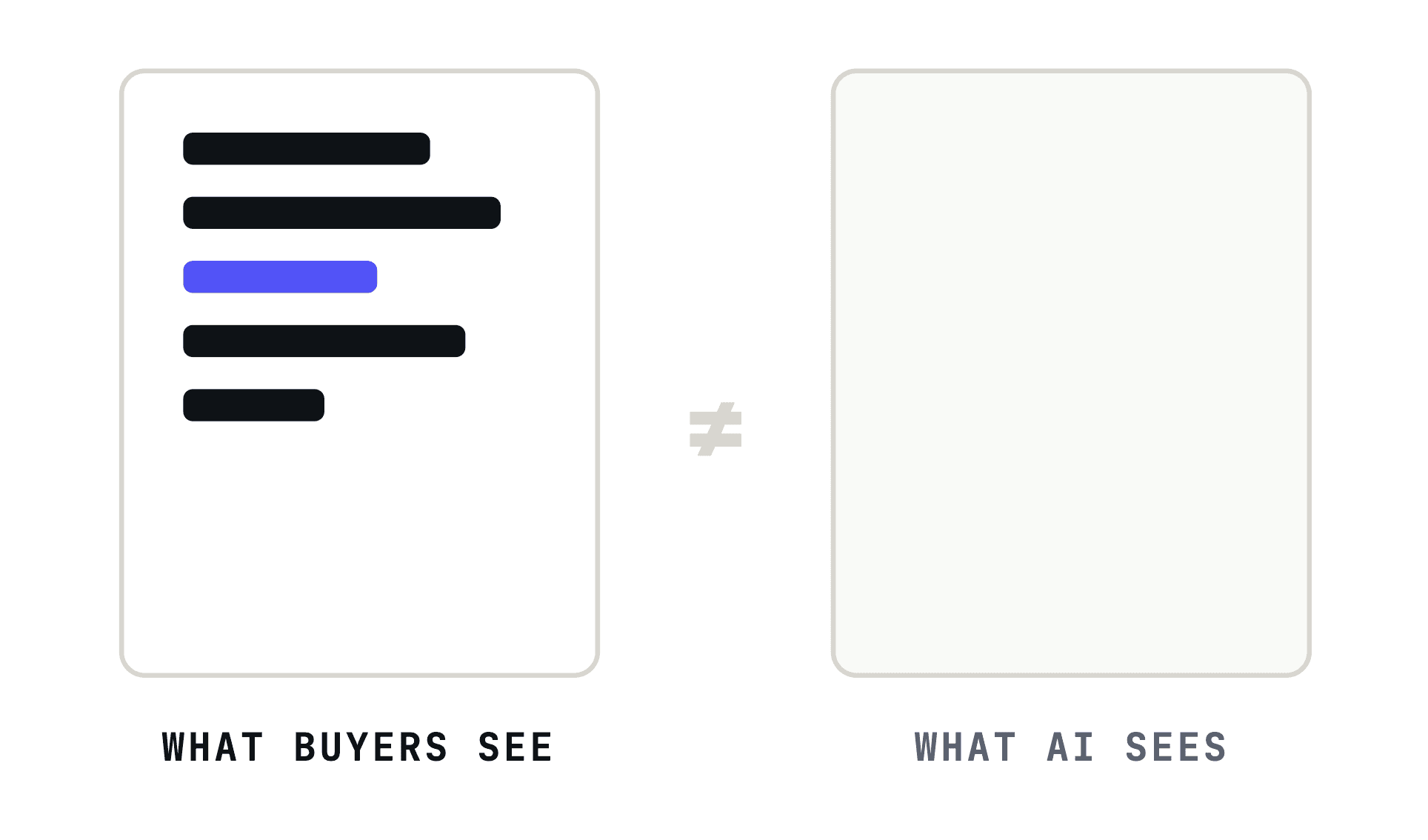
AI crawlers do not do this. As MarTech reported in July, they read raw HTML and do not execute JavaScript. GPTBot, ClaudeBot and PerplexityBot request the page, receive the empty shell, and move on. There is no content there because the content was never in the file. It was going to be assembled later, by a browser that these crawlers do not have.
Googlebot is the exception. It runs JavaScript. Which is precisely why this problem stays hidden: your search rankings look fine, your analytics look fine, and the channel where you are missing does not appear in any report you currently read.
You are not being penalised. You are being skipped, silently, by a reader you did not know you had.
The traffic you are missing is the traffic you want
It would be easier to ignore this if the audience in question were marginal. It is not, on two counts.
The first is growth. Contentsquare data cited in the same reporting put the rise in AI-referred traffic to brand sites at 632% over roughly ten months. Very few channels in event marketing move at that rate in either direction.
The second matters more. This traffic converts unusually well. Figures from Microsoft Clarity and Similarweb, reported by HubSpot, show ChatGPT referrals converting at 11.4% against 5.3% for organic search. HubSpot's own State of Marketing data has 58% of marketers reporting that AI referral traffic arrives with higher intent than traditional search traffic.
The reason is structural rather than magical. Somebody who arrives from a search result is often still deciding what they want. Somebody who arrives from an answer engine has already described their situation in a sentence, had it interpreted, and been sent to you as a recommendation. The qualifying happened before the click. That is one half of a larger shift in how buyers assemble their options, and the other half is that most event analytics never change a decision even when the traffic does arrive.
So the fastest-growing and highest-converting inbound channel in your mix is the one routed through a reader that a large share of event websites cannot serve.
Being readable is not the same as being quotable
Fixing the rendering gets you into the room. It does not get you named in the answer, and the difference is worth understanding before anyone declares the project finished.
An answer engine is assembling a response from many sources. It favours text that states things plainly, in a form that can be lifted and attributed without ambiguity. A page that says "the leading gathering for innovation professionals" gives it nothing usable. A page that says the show runs on specific dates, at a named venue, for a named industry, with a stated number of exhibitors, gives it four things it can quote with confidence.
Event sites are unusually prone to the first kind of writing, because the prospectus voice rewards atmosphere. Energy, connection, the room where the industry gathers. That language works on a human who is already on your page and deciding how they feel. It is close to useless to a machine trying to establish a fact.
The practical translation is that your most commercially important pages need a layer of plain declarative statement somewhere in them. Not instead of the atmosphere. Underneath it, in text rather than in an image or a graphic, saying what the event is, who it serves, when and where it happens, and what a visitor will find there.
The same logic applies to the questions you are not currently answering anywhere. Is this show relevant for a procurement lead. What does a stand cost, approximately. How many attendees are buyers rather than suppliers. If the answer to a common question exists only in a PDF prospectus behind a form, or only in a conversation with your sales team, the engine cannot use it, and it will answer the question from whatever it can find instead. Frequently that means answering it from a competitor's page.
Which of your pages are actually exposed
Not every page carries the same risk, and the exposure maps almost perfectly onto the pages that matter commercially.
Your homepage is usually fine. It tends to be the most carefully built page on the site and often renders on the server for exactly this reason.
The pages at risk are the ones built as interactive tools. Registration flows with multi-step forms. Exhibitor directories with live search and filtering. Session schedules with a day-by-day toggle. Interactive floor plans. Speaker lineups that load from a CMS after the page opens.
Look at that list again. Those are the answers to "where do I register", "who exhibits", "what is on at this show", and "who is speaking". Which are, almost exactly, the questions an answer engine gets asked about an event.
The commercial exposure is inverted from the technical difficulty. The pages easiest to build as dynamic applications are the pages you most need a machine to be able to read.
Why this lands on the build team, not marketing
This is the part that stalls in most organisations, and it is worth naming plainly.
Every instinct says this is a marketing problem, because it looks like a visibility problem, and visibility belongs to marketing. So it gets assigned to whoever owns SEO, who writes better copy, adds structured data, tidies the metadata, and reports back that the work is done.
None of that helps if the page returns an empty shell. Better words in a file the crawler never receives change nothing.
The fix is a rendering decision: server-side rendering, static generation, or pre-rendering for crawlers. Those are choices made by whoever owns the site build, in the platform or the framework, and usually at a level marketing cannot reach through a CMS login. It is also the clearest current example of what an AI-native agency is actually for, which is noticing this class of problem before it costs a cycle.
Which means the useful first move is not a content brief. It is a conversation with whoever controls the build, holding one question: do our registration, exhibitor and schedule pages render on the server?
What to check this week
Three checks, in order of how quickly they can be done.
Read your own page as a crawler would. View the page source rather than the rendered page, or fetch the URL with a tool that does not execute JavaScript. If you see your session titles, exhibitor names and registration copy in that raw file, you are fine. If you see a near-empty document with a script tag, you are not.
Ask the engines directly. Open ChatGPT, Claude and Perplexity and ask the questions your buyers ask. Where do I register for this event. Who exhibits. Is it relevant for someone in my role. Read what comes back. Note what is wrong, what is missing, and where it is being sourced from. This takes twenty minutes and almost nobody does it.
Check the pages in commercial order, not site order. Registration first, because that is the conversion. Exhibitor prospectus second, because that is the revenue. Schedule and speakers third, because that is the reason to attend. Do not start with the homepage simply because it sits at the top of the navigation.
None of these require budget. They require somebody to be assigned the question.
What AI-native means here
There is a version of "AI-native" that means the team uses AI to write things faster. That version does nothing for this problem.
The version that matters is closer to a standing responsibility: somebody owns the question of what machines can read about your event and what they currently say. Not once, as an audit. Continuously, because the answers change as the models change, as your site changes, and as competitors adjust their own pages.
Consider what that role actually watches. Whether the registration page renders on the server after the platform's next update. Whether an answer engine still names your show when asked about your sector. Whether the description it gives is the one you would give. Whether a competitor now appears in an answer where you used to be alone.
None of that appears in a traditional analytics dashboard, because the dashboard was designed for a web where humans were the only readers. That assumption stopped being true, and the reporting has not caught up.
The event teams that will be visible in eighteen months are the ones that noticed this while it was still a build ticket rather than a lost quarter. The work is small. The consequence of skipping it compounds quietly, in answers you never see, to buyers you never meet.
If you want a read on what the answer engines currently say about your event, and whether your pages can be read at all, book a call with TalkValue.

FAQ