
Engaged dwell time on a stand averages under fourteen minutes, measured across 3,000 events and 43.8 million visitors. Everything you put on a stand competes for the same fourteen minutes, which makes clarity a design constraint rather than a copywriting task. One 3x6m stand returned £65,000 by getting this right.
Exhibitors budget in square metres and design in features. Neither is the actual constraint.
The constraint is time, and specifically the amount of attention a single visitor will give you before they move on. Every screen, demo, sample, seating area, giveaway and conversation on your stand is competing against every other element for the same fixed allowance.
Once you know what that allowance is, a lot of stand design decisions that feel like taste turn out to have right answers.
The number that should govern stand design
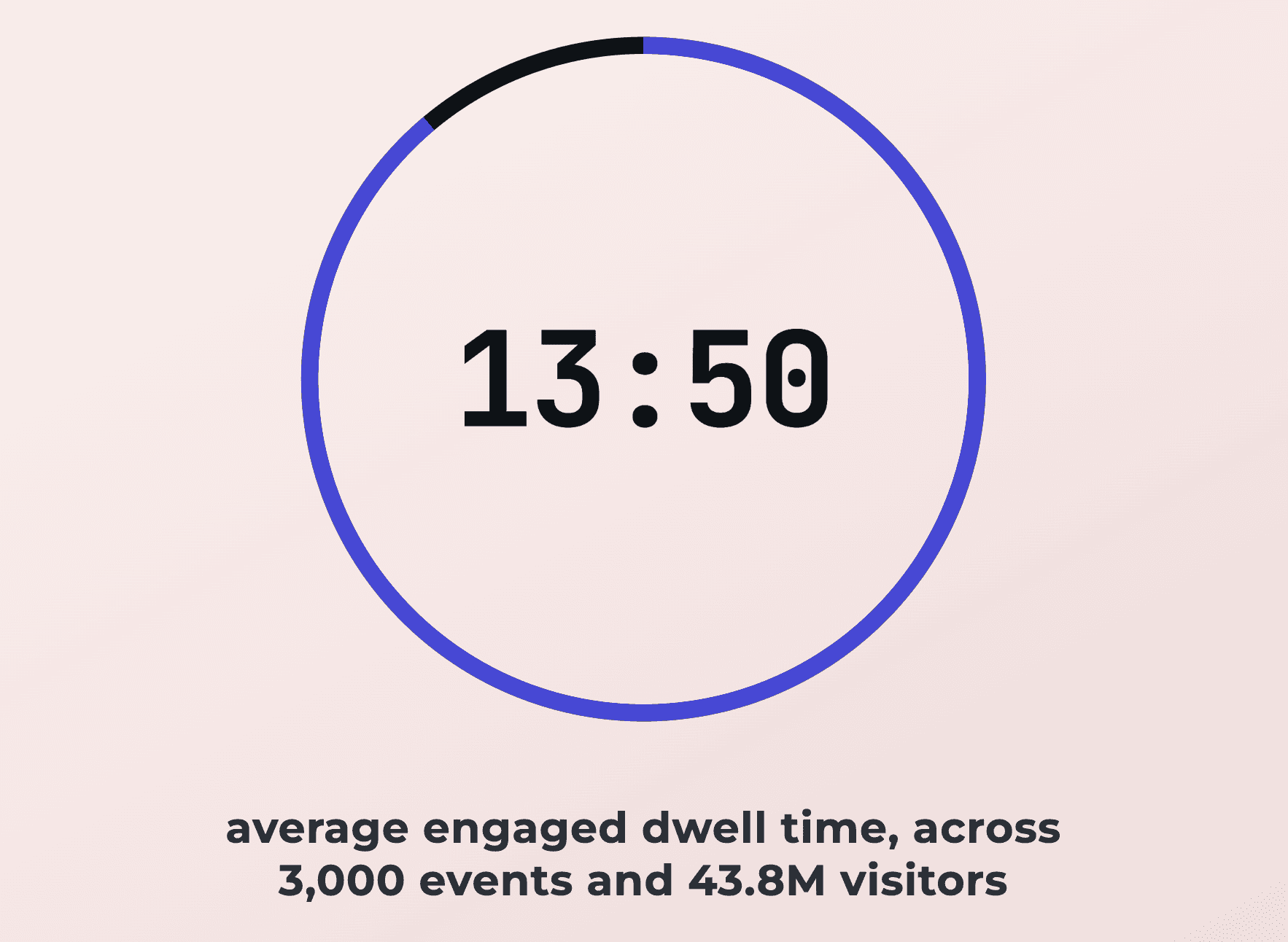
Average engaged dwell time is 13 minutes 50 seconds, measured by Exposure Analytics across 3,000 events and 43.8 million visitors.
That is the whole budget. Not per element. Total.
Sit with the arithmetic for a moment. If your stand has a product demo, a video wall, a coffee point, a brochure table and two staff hoping to have qualifying conversations, those five things are dividing fourteen minutes between them. Give the video ninety seconds and you have spent more than a tenth of your total allowance before anyone has spoken.
Most stands are designed as though attention were abundant and space were scarce. The data says it is the other way round. Space is what you bought. Attention is what you actually have to spend, and it is far more limited than the floor plan implies.
What footfall was hiding
For years the headline stand metric was footfall, and footfall is close to useless as a measure of anything commercial.
It counts people who passed. It does not distinguish someone crossing your corner of the hall on their way to the toilets from someone who stopped, read your sign, and decided you were relevant. Both increment the same number.
Engaged dwell separates those two populations, and that separation is where the useful information lives. A stand with high footfall and low dwell is in a good location and failing to convert attention. A stand with lower footfall and high dwell is being found by the right people and holding them. Those two situations call for completely opposite responses, and footfall alone cannot tell you which one you are in. This is footfall's version of the problem behind why most event analytics don't change decisions.
This matters more than a metrics quibble, because the two failure modes get diagnosed identically under footfall reporting. The team looks at a big number, concludes the show worked, and repeats the same design next year while wondering why the pipeline did not follow.
The £65,000 stand and what it did differently
One 3x6m stand at the Event Production Show generated £65,000 of direct new business, built on craft-led design in a hall dominated by technology-led displays.
Three by six metres is not a large stand. It is a standard mid-tier footprint, the kind most exhibitors actually buy rather than the flagship builds that get photographed for the trade press.
What it did was win on clarity. It said what the company did in one line, legibly, from a distance, before any conversation started.
That sounds almost too simple to be the lesson. It is worth stating why it is not.
The reason clarity converts is that it interacts directly with the fourteen-minute budget. A visitor walking a hall is doing rapid triage, deciding in a second or two whether each stand is worth any of their remaining time. If your stand requires five seconds of interpretation before they can tell what you do, most people will not spend those five seconds. They will keep walking, and you will never appear in their dwell data at all.
So clarity does not just improve the experience of visitors who stop. It determines who stops. It operates before engagement rather than during it.
Clarity is a design constraint, not a copywriting task
The common failure here is treating this as a message problem to be solved late, by asking marketing for better wording on the graphics.
It is a design constraint, and it has to be applied early, because it competes with everything else the stand is being asked to do.
The tension is real and worth naming. Stand briefs usually accumulate requirements from multiple stakeholders. Product wants the demo. Brand wants the visual identity expressed. Sales wants meeting space. Someone wants a screen because last year had a screen. Each request is reasonable and each one consumes both physical space and, more importantly, interpretive bandwidth.
A stand that expresses six things clearly expresses nothing quickly. The visitor cannot triage it in two seconds, so they do not stop, so the other five things never get seen either.
The discipline that produces a £65,000 outcome from a mid-sized footprint is subtraction. One statement of what you do, readable from across the aisle, and everything else arranged to support the conversation that statement earns you.
The most expensive element on the stand is the person standing on it
There is one component of stand design that almost never appears in the build budget and consumes more of the fourteen minutes than anything else.
Staff. Specifically, who is on the stand, what they open with, and whether they can tell in thirty seconds whether a visitor is worth the remaining thirteen.
The common pattern is that stands are staffed by whoever was available, briefed loosely on the morning of day one, and left to improvise. That is a strange allocation of effort when you consider the arithmetic. An organisation will spend months on the build and minutes on the briefing for the people who will actually spend the attention budget.
The opening line matters disproportionately for the same reason the signage does. "Can I help you?" invites a no and costs a visitor nothing to refuse. A question that assumes relevance and offers a fast exit is better on both counts, because it either starts a qualifying conversation or releases the visitor quickly, which preserves your staff's attention for someone else.
The second thing worth briefing is disqualification. Stand staff are usually told how to engage and almost never told how to end a conversation politely. A friendly forty-minute conversation with someone who will never buy is not a success. It consumed three visitors' worth of attention budget, and on a busy stand it is the single most common way a good location produces a poor return.
Where the money is actually decided
None of this is an argument against exhibiting. The commercial case is strong and getting stronger.
CEIR's 2025 research, reported by PCMA Convene, found 362 B2B exhibitors naming trade shows their number one marketing investment at 41% of budget, with 28% planning to add shows.
Forty-one percent of marketing budget is an enormous concentration of spend on a channel whose primary constraint most exhibitors do not measure. That is the gap worth closing. Not spend more, or spend less. Know what you are actually buying.
Because the spend decides what goes on the stand, and clarity decides whether anyone stops long enough to see it. Those are two different budgets and only one of them appears on the invoice.
What AI changes here, and what it does not
It is worth being precise, because this is where a lot of event technology conversation goes wrong.
AI does not change the fourteen minutes. Attention on a show floor is a human constraint and it has been stable for as long as anyone has measured it. No tool makes a visitor give you longer, and any vendor suggesting otherwise is selling something.
What changes is everything on either side of those fourteen minutes.
Before the show, the question is who arrives at your stand at all. Which visitors are worth a pre-show approach, what they are likely to care about, which of last year's conversations never got followed up and should be restarted before anyone travels. That is analysis work on data most exhibitors already hold and almost none of them read. The relationship side of that preparation is covered in conference networking tips that actually lead to business outcomes, and the campaign side in how to organize a marketing event that actually drives results.
After the show, the question is what happens to the conversations. The badge scans, the notes, the half-remembered detail about someone's procurement timeline. This is where the majority of exhibition value is historically lost, not because teams do not care but because the follow-up lands on people who are exhausted and already onto the next thing.
Both of those are exactly the kind of work that has become tractable. Neither of them touches the floor, which stays what it always was: a person deciding in two seconds whether you are worth fourteen minutes.
That division is the useful way to think about AI in exhibiting. It handles the preparation and the aftermath. It does not handle the encounter, and it should not be asked to.
Designing for thirteen minutes
Four practical consequences, if you take the number seriously.
Write the one line first, before the design brief. If the stand cannot be summarised in a sentence a stranger understands, no amount of build quality will fix it. Test it on someone outside your sector and watch how long they take to understand.
Count your attention spend, not your square metres. List every element on the stand and estimate the seconds it demands. If the total exceeds fourteen minutes, you are over budget, and the elements will cannibalise each other rather than adding up.
Measure dwell, not footfall. If your venue or an analytics provider can give you engaged dwell, ask for it. It will tell you which of the two failure modes you are in, which footfall cannot.
Put the effort into before and after. The floor is the smallest part of the exhibition, in time if not in cost. The pre-show targeting and the post-show follow-up are where the return is won or lost, and they are the parts a small team can now do far better than they could two years ago.
Thirteen minutes and fifty seconds is a hard limit. Designing as though it were unlimited is the most common and most expensive mistake on any show floor.
If you want to work on the preparation and follow-up either side of those fourteen minutes, book a call with TalkValue.

FAQ