
The share of marketing job postings mentioning AI went from 8% to 15% across 2025 while marketing spend growth slowed to 1.7%. The role changed considerably faster than the money did, which leaves the same people running more systems on a smaller share of revenue. What got scarce is not the ability to use AI.
Two numbers moved in opposite directions last year, and the gap between them describes most of what marketing teams are currently experiencing.
One is what employers started asking for. The other is what they were willing to spend. When those diverge this sharply, the difference does not disappear. It gets absorbed by the people already in post.
Job postings are the leading indicator
The share of marketing job postings mentioning AI nearly doubled in 2025, from 8% in January to 15% in December, according to MarTech's analysis of the skills AI is making more valuable.
Job postings are worth watching more closely than most industry surveys, for a straightforward reason. A survey asks what people think. A job posting is a commitment of budget to a specific description of work, written by a manager who has to justify the hire and then live with whoever it attracts. It is a statement about what the organisation believes it needs, made at a moment when being wrong is expensive.
Doubling inside twelve months is a fast move for an indicator of that kind. It says the redefinition of these roles is not a forecast. It already happened, in the documents organisations use to build their teams.
For anyone currently in a marketing or event marketing role, that is the number to take personally. The description of the job you hold was rewritten last year for the people applying to it.
The budget went the other way
Set against that, the money did almost nothing.
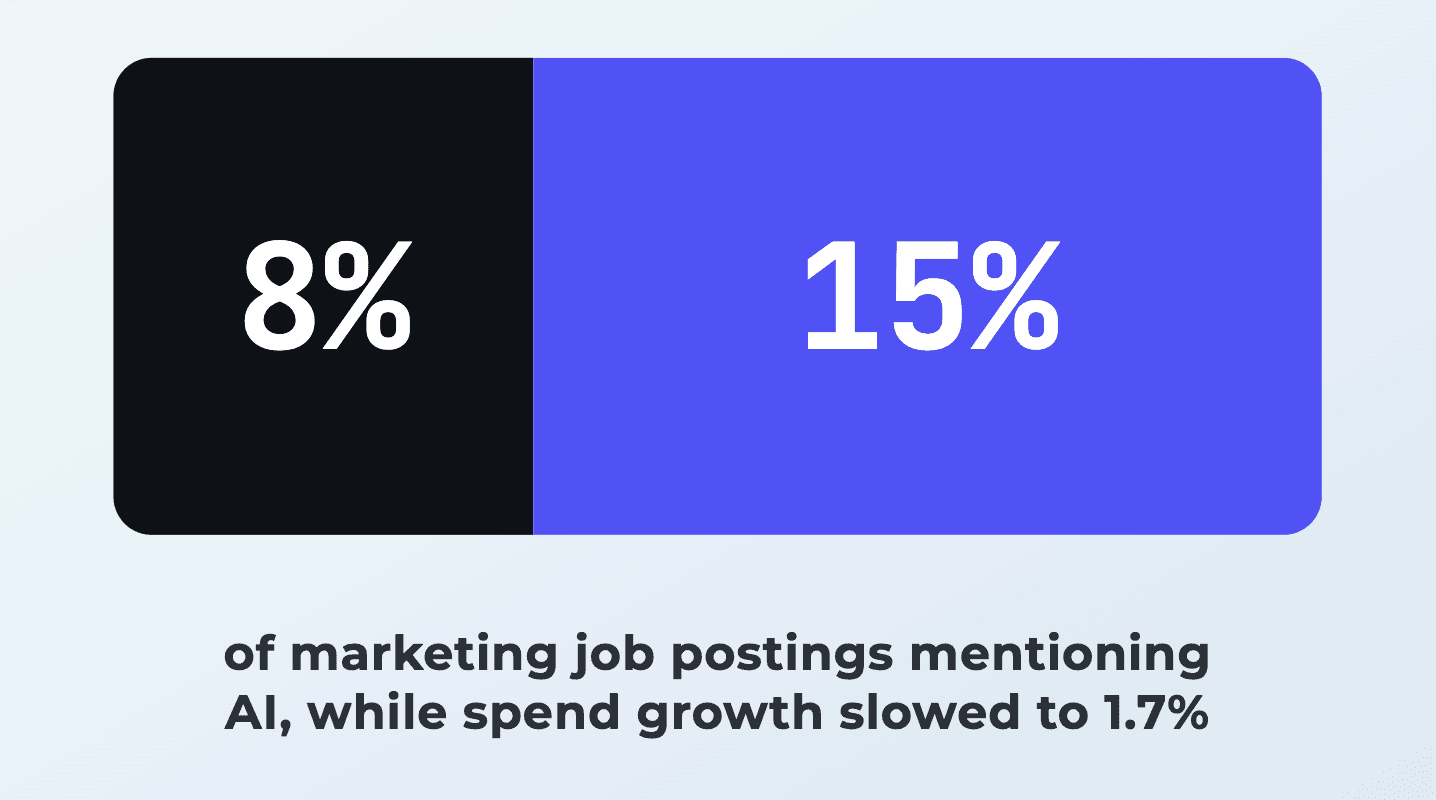
Marketing spend growth slowed to 1.7% over twelve months and budgets fell to 9% of total revenue, as MarTech reported in its analysis of where AI spending goes next.
Nine percent of revenue is a meaningful compression, and 1.7% growth is close to flat once you account for the tools bought during the same period. Those licences came out of the same envelope. So the practical position for many teams is a marketing budget that is flat in nominal terms, smaller as a share of the business, and now carrying software costs that did not exist two years ago.
The role expanded. The resource did not. That gap is not an abstraction. It is absorbed by the individuals holding the roles, in the form of more systems to supervise and less time per system.
What this looks like on an events team
Events amplify this, because the workload is not evenly distributed across the year and the deadlines do not move.
An events marketing function was already running a registration platform, an email tool, a CRM, an exhibitor system and a set of spreadsheets. Add three or four AI assistants and the count of surfaces a single person supervises rises meaningfully, while the number of people supervising them has, for many teams, gone down.
The failure mode is specific and it is not dramatic. Nothing collapses. What happens is that the work with external pressure gets done and the work without it does not.
Exhibitor communications go out, because exhibitors chase. Registration opens on time, because the date is public. What slips is the analysis nobody is waiting for: reading the registration curve, noticing a category has softened, looking at which sessions underperformed and why, following up properly after the show.
Every one of those is judgment work. None of them has a deadline. All of them are where the compounding value of running an event actually lives.
The skill that got scarce is not prompting
There is a natural assumption that the valuable capability in this environment is fluency with the tools. Learn the systems, write better prompts, become the person who knows how to get good output.
That was true for a period and it is decaying quickly, for the obvious reason. Interfaces are getting easier, models are getting better at interpreting vague instructions, and the differential between a skilled user and an average one narrows every release.
What has become scarce is the judgment about what should not be automated at all.
That decision is harder than it sounds, because the tempting candidates for automation are frequently the ones that should stay human. The follow-up note to a sponsor who has gone quiet can be automated. It should not be, because the value of that message is entirely in the fact that a person noticed and thought about it. Automate it and you have preserved the artifact while destroying the thing the artifact was evidence of.
The same applies to speaker relationships, to the judgment call about whether an exhibitor complaint is a real problem or a negotiating position, and to reading whether a session underperformed because of the topic or the time slot.
An organisation that automates all of these will produce more output and less insight. The output is visible on a dashboard. The insight was what actually drove renewals. That gap between output and insight is the subject of why most event analytics don't change decisions.
Deciding where to spend is the next problem
The MarTech framing on the budget side is that the next AI opportunity is deciding where to spend, and for a constrained team that is exactly right.
The instinct under budget pressure is to spread thin: a little of everything, a small allocation to each channel, so that nothing is entirely neglected. That instinct produces the worst outcome available, because most channels have a threshold below which spend does nothing at all.
The alternative requires knowing which parts of your own funnel actually convert, which is an analysis question, and analysis is precisely the work that gets squeezed when the team is thin. Which is the trap. The capability that would let you allocate a smaller budget well is the capability that a smaller budget removes.
Breaking that loop is the highest-leverage thing a constrained team can do, and it does not require new software. It requires that someone is given protected time to read the data the organisation already has.
The 2029 expectation, and the arithmetic it implies
There is a third number in this research that changes how the first two should be read. The same organisations reporting flat budgets expect AI to drive more than half of all marketing activity by 2029.
Take that seriously for a moment and the implication is uncomfortable. If more than half the activity is machine-driven within three years, and budgets are flat or compressing, then the organisation is planning for a marketing function whose output roughly doubles without its cost changing.
That plan only works under one condition: that the human half moves decisively toward the work machines cannot do. If people continue to spend their time on production, they are competing directly with a cost curve going to zero, and the plan fails quietly by producing a great deal of undifferentiated output.
Most organisations have the destination in a strategy document and no route to it. The expectation is stated. The transition, which is the actual work, is not resourced.
For an events organisation the route is more legible than in most sectors, because the division is unusually clean. The production of assets, communications, reports and summaries is on the machine side of the line, and increasingly obviously so. The relationships, the judgment calls under a fixed deadline, and the reading of a room are on the human side, and there is no credible near-term version where they cross over.
The teams that arrive at 2029 in reasonable shape will be the ones that started moving people toward the second category while the budget was tight, rather than waiting for a budget increase that the same research suggests is not coming.
There is also a timing argument worth stating. The transition is easier now than it will be later, because the work currently being automated is the work with the fastest review loop and the lowest stakes. Moving a coordinator from drafting to judgment while the drafting is the thing being automated is a manageable change. Doing it in three years, under pressure, when the gap has widened and the person has spent three more years practising the wrong half of the job, is considerably harder.
What to hire for now
If the role has been rewritten, the hiring criteria should be rewritten with it. Three things are worth weighting differently.
Weight judgment about scope over tool familiarity. In an interview, describing which parts of a process a candidate would leave alone is more informative than describing which tools they know. The first is hard to fake and predicts performance. The second will be obsolete within a year.
Weight the ability to read data over the ability to produce it. Generating a report is now nearly free. Noticing that a registration curve has changed shape, and having a view on why, is not.
Weight domain depth in events specifically. This is the staffing consequence of the shift described in why the AI-native agency is emerging now. The judgment work that survives automation is largely built from pattern recognition in this particular industry. Someone who has run shows knows what an exhibitor's silence usually means. That is not transferable from adjacent marketing experience and it is not learnable from a tool.
The postings moved first because employers noticed the shape of the job had changed. The budgets have not caught up and may not for some time. In the meantime the difference is being carried by people who are being asked to run more with less, and the organisations doing this well are the ones being deliberate about what they refuse to automate.
If you are deciding what to automate and what to protect on a smaller team, book a call with TalkValue.


FAQ