In the world of professional events and exhibitions, we operate on a widely accepted principle: what gets measured gets managed. We meticulously track registration numbers, sponsor commitments, and post-event survey scores. We arm our teams with dashboards, CRMs, and analytics tools, all in pursuit of data-driven decisions. Yet, for many senior leaders, a frustrating gap persists between the volume of data we collect and the clarity of the decisions we can make.
Despite this wealth of information, event portfolios often fail to function as predictable revenue engines. Growth feels reactive rather than engineered. Monetization strategies are based on historical performance, not future potential. We have visibility into individual event metrics, but we lack a unified, strategic view across the entire portfolio—a view that connects operational activity directly to financial outcomes.
This isn't a failure of data collection. It is a failure of reconciliation. We are drowning in data from siloed systems that don’t communicate, forcing our teams into a constant, manual struggle to assemble a coherent picture. This structural gap is the single greatest barrier to strategic decision-making and sustainable revenue growth in the events industry today.
Challenging the Myth of the "Single Pane of Glass"
The industry has long chased the dream of a "single pane of glass"—a centralized dashboard promising a complete overview of our event business. We invest in powerful BI tools and connect them to our core systems, expecting strategic clarity to emerge. However, this approach often treats a symptom, not the underlying disease. The problem isn't the lack of a dashboard; it's the fractured, unreliable data being fed into it.
Most event portfolios operate on a patchwork of disconnected systems: a registration platform for one event, a different one for another, a separate mobile app, various marketing automation tools, and the corporate CRM. Each system holds a piece of the puzzle, but none holds the complete picture. As a result, senior leaders are often making critical decisions based on an incomplete, and therefore misleading, view of reality.
Consider a common scenario: attempting to analyze attendee behavior across multiple events. An individual who attended your flagship conference as "Dr. Jane Smith" from "Global Corp" might be registered for a regional seminar as "J. Smith" from "Global Corporation Inc." To your systems, these are two different people. Your ability to understand her true engagement, calculate her lifetime value, or identify her as a high-potential repeat attendee is immediately compromised. The strategic insight is lost in the noise of data reconciliation. This is not a minor operational headache; it is a profound strategic liability that directly impacts revenue. It prevents accurate cohort analysis, masks retention problems, and obscures opportunities for cross-promotion and monetization.
The True Cost of Data Fragmentation
The consequences of this fragmentation are not merely operational inefficiencies; they are severe financial and strategic limitations. When you cannot get a clean, reconciled view of your audience and their behavior across your entire portfolio, you are fundamentally unable to:
Accurately Forecast Revenue: Without a unified understanding of attendee and exhibitor cohorts, revenue projections become guesswork based on isolated event performance rather than a holistic view of customer lifetime value and retention trends.
Optimize Monetization Strategy: You cannot confidently price tickets, tiered sponsorships, or digital offerings if you don't truly understand the composition and willingness to pay of different audience segments across your portfolio.
Drive Strategic Growth: Decisions about which events to acquire, launch, or sunset are made with incomplete data, increasing risk and reducing the probability of success.
The pursuit of a "single pane of glass" has led us to build beautiful dashboards on top of broken foundations. The real solution lies deeper—in creating a strategic infrastructure that ensures data is clean, reconciled, and unified at its source.
From Disconnected Tools to a Unified Decision-Making Infrastructure
A truly strategic approach to event portfolio management requires moving beyond the mindset of simply buying more software. It demands architecting a unified decision-making infrastructure—a central system of record designed to reconcile data from disparate sources and provide a single, reliable source of truth.
This is not about replacing every tool in your stack. It is about establishing a central nervous system that intelligently connects your registration platforms, marketing automation systems, on-site technologies, and CRM. The objective is to create an environment where data flows seamlessly, is automatically de-duplicated and enriched, and becomes immediately available for strategic analysis.
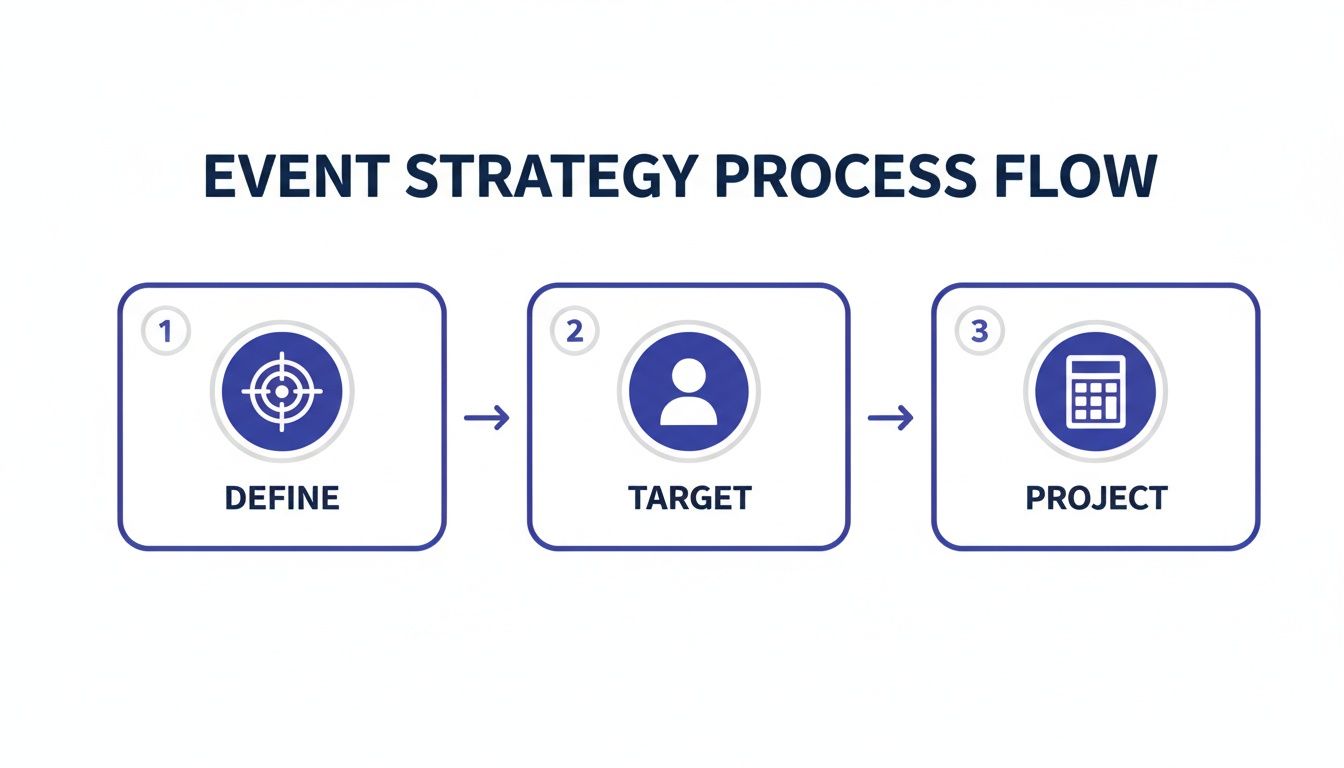
This conceptual shift from a collection of tools to a unified infrastructure has profound implications. It elevates the conversation from tactical execution ("How do we run this event?") to strategic management ("How does this event contribute to the portfolio's overall revenue goals?").
The Pillars of a Strategic Infrastructure
A robust decision-making infrastructure is built on several key capabilities that directly address the challenge of data fragmentation:
Identity Reconciliation: At its core, the system must be able to recognize that "Dr. Jane Smith" and "J. Smith" are the same person. It must automatically merge duplicate profiles, creating a single, golden record for every individual and company that interacts with your brand across any event.
Portfolio-Wide Cohort Analysis: With a unified dataset, you can finally perform meaningful cohort analysis. You can track the behavior of specific segments—such as first-time attendees, VIPs, or sponsors from a particular industry—across your entire portfolio over time. This unlocks critical insights into loyalty, churn, and lifetime value.
Revenue Attribution: The infrastructure must connect event activity directly to financial outcomes. By integrating deeply with your CRM, it can attribute pipeline and closed-won revenue back to specific event touchpoints, proving the direct financial impact of your portfolio.
When these elements are in place, the organization is no longer flying blind. The leadership team gains the clarity required to make confident, forward-looking decisions about pricing, investment, and portfolio strategy. This is the transition from reactive event management to proactive revenue engineering.
Activating Strategic Clarity for Monetization and Growth
With a unified decision-making infrastructure, the focus shifts from data wrangling to strategic action. The clarity gained from a reconciled, portfolio-wide view allows leaders to pull levers that were previously inaccessible, directly influencing revenue growth and long-term value.

The primary benefit is the ability to understand and monetize your audience with unprecedented precision. Instead of treating each event's audience as a distinct entity, you can now see the overarching patterns of behavior. You can identify your most valuable cohorts—those who attend multiple events, spend the most, and are most likely to renew sponsorships. This insight is the foundation of a sophisticated monetization strategy.
For example, you can now create targeted, multi-event sponsorship packages for companies that engage with the same attendee profile across several of your shows. You can develop loyalty-based pricing for attendees who frequent your events, increasing retention and lifetime value. These are revenue opportunities that remain invisible when your data is fragmented.
Engineering High-Value Connections at Scale
This strategic clarity also transforms the value proposition for exhibitors and sponsors. The industry is moving decisively away from a model based on brand visibility toward one based on quantifiable lead generation and ROI. A unified infrastructure is essential to delivering on this promise.
By understanding the precise interests and professional profiles of your attendees across the portfolio, you can facilitate highly targeted matchmaking. Sponsors are no longer just buying booth space; they are investing in pre-qualified, curated connections. The ability to provide sponsors with a real-time dashboard showing qualified leads captured—leads that are automatically de-duplicated against their existing CRM records—is a powerful differentiator.
By using event data to power automated post-event outreach on platforms like LinkedIn, some sponsors have seen reply rates as high as 50%. This is a direct result of sending a timely, personalized message that references a real-world interaction.
This level of integration proves your event’s value in the language that matters most to sponsors: pipeline velocity and cost of customer acquisition. It shifts the conversation from a negotiation over cost to a partnership focused on growth, securing higher-value commitments and long-term loyalty. More detailed strategies on how to create these interactions can be found in our guide on networking event ideas.
Tying It All Together: From Portfolio Visibility to Demonstrable ROI
The ultimate purpose of achieving strategic clarity is to manage your event portfolio as a quantifiable financial asset. The endpoint of this journey is not a more comprehensive dashboard, but a direct and undeniable link between event activities and the company's balance sheet. A unified infrastructure makes this final, crucial connection possible.
When your event platform, on-site tools, and CRM are orchestrated by a central reconciliation engine, you gain the ability to track the complete financial journey. You can move beyond vanity metrics and measure what truly matters to the C-suite and board.
This enables you to answer the critical business questions with confidence:
What is the total pipeline influenced by our event portfolio this year?
Which event generated the highest customer lifetime value (LTV)?
What is the true cost per acquisition for a net-new customer acquired through our events versus other channels?
This level of financial rigor transforms the role of the event leader from a master of logistics to a driver of strategic growth. Budget discussions are no longer about defending costs but about allocating capital to a proven revenue-generating channel.
A key metric you should be tracking is Portfolio-Adjusted Return on Investment. This connects specific attendee and sponsor cohorts to the total revenue they generate across all event touchpoints over time, providing undeniable proof of your portfolio's cumulative impact. For more on this, our guide on how to measure event success offers a deeper dive.
Securing Future Investment with Confidence
This data-driven approach is how you secure investment and mandate for future growth. The industry outlook is already optimistic; by 2026, 74% of event marketers anticipate budget increases, while only 5% expect a reduction. This confidence stems from a growing ability to build a clear business case, a trend highlighted by recent positive event industry statistics.
By closing the visibility gap and building a unified decision-making infrastructure, you are not just optimizing your current operations. You are building a scalable, predictable engine for growth that positions your event portfolio at the very center of your organization's long-term success.
Frequently Asked Questions
You’ve got questions. We’ve got answers. Here are some of the most common things we hear from senior leaders trying to build events that deliver real business impact, not just a full room.
What Is The First Step I Should Take To Create An Event?
The first move isn’t about logistics. Forget the venue, the speakers, and the sponsors for a minute. The most critical step is getting crystal clear on the one primary business goal for this event.
Are you trying to generate a specific number of sales-qualified leads? Is the real purpose to build a loyal community and drive customer retention? Or is this a straightforward revenue play, designed to be profitable from day one through ticket sales and sponsorships?
Once you have that single, measurable objective locked in, your next step is to define your ideal audience with painful precision. Build out detailed personas for the exact attendees and sponsors you want in the room. What are their biggest challenges? What motivates them to show up?
This strategic foundation is everything. It ensures every decision you make later—from the content you program to the marketing you run—is aligned and purposeful.
How Can I Prove The ROI Of My Event To Stakeholders?
Proving event ROI means moving past vanity metrics like attendance and connecting the dots between what happened at your event and what happened in your CRM. You need to track the entire attendee journey, from the moment they register to the moment they become a closed-won customer.
To pull this off, you need an integrated tech stack. Your event platform, like TalkValue, has to talk to your CRM, like HubSpot or Salesforce. That connection is non-negotiable.
This allows you to:
Track lead conversion: See exactly how many attendees turned into qualified leads for the sales team.
Calculate pipeline influence: Put a real dollar amount on the sales pipeline that was directly influenced by event interactions.
Measure long-term value: Analyze the event’s impact on customer retention and the lifetime value (LTV) of the attendees you acquired.
For your sponsors, the data needs to be just as clear. Handing them instant lead retrieval reports showing both the quantity and quality of their connections is no longer a nice-to-have. When you can present this kind of information in a clean dashboard, you stop defending a marketing expense and start documenting a revenue driver.
What Is The Biggest Mistake To Avoid When Using Technology For An Event?
The single biggest mistake we see, time and time again, is creating a "siloed" tech stack. This is where you stitch together a bunch of disconnected tools that don't share data. It’s a recipe for chaos.
This approach always leads to painful manual data entry, endless reconciliation spreadsheets, and a clunky, disjointed experience for absolutely everyone involved—your attendees, your sponsors, and your own team.
Think about it. If your registration system doesn't sync with your check-in app or your networking tool, you're guaranteed to have operational nightmares. Long lines, inaccurate attendee lists, and a total inability to track who actually did what.
The only real solution is to build an integrated event ecosystem. Your goal should be a central platform that serves as a single source of truth for all your data, flowing seamlessly between registration, your CRM, the event app, and your marketing automation tools.
This doesn't just automate workflows; it gives you the complete, holistic data you need to do sophisticated post-event analysis and actually prove your ROI.
How Do I Ensure A Smooth Check-In Process For A Large Conference?
A smooth check-in process creates an incredible first impression and sets the tone for the entire event. Getting it right is a mix of smart automation and even smarter preparation.
First, your pre-event communication has to be flawless. Send every attendee a scannable QR code well ahead of time. Make it impossible to miss.
Second, use a modern check-in system that supports both rapid QR code scanning and on-demand badge printing. This completely eliminates the logistical nightmare of pre-printing and alphabetizing thousands of badges, which is where most of the bottlenecks happen. We've seen systems integrated with platforms like TalkValue cut the on-site staff workload by as much as 70%.
Finally, always plan for scale. Don’t just have one check-in area. Set up multiple stations spread across the entrance. And always have a dedicated "help desk" ready to solve the inevitable registration issues or tech glitches on the spot. This combination of tech and planning is how you get thousands of people in the door with zero friction.
Ready to move beyond disconnected tools and build a strategic, growth-focused event? TalkValue provides the integrated platform and expert guidance to turn your conference or exhibition into a predictable revenue engine.

FAQ