For decades, the event industry has operated on a simple, widely accepted truth: a successful event is a full event. We measure our impact by the scale of our attendance, the volume of social media chatter, and the anecdotal feedback from sales teams. This behavior is deeply ingrained, a legacy from an era when headcount was the only reliable metric available. Senior leaders see strong registration numbers and assume a positive return, creating a cycle of activity without accountability.
But for any modern organization operating under direct revenue pressure, this model is fundamentally broken. It provides a comforting, yet misleading, sense of security. It tells us that people showed up, but reveals nothing about why they were there, what decisions they made, or how their presence translates into measurable business growth. This reliance on surface-level data creates a structural visibility gap—a disconnect between event activity and its true financial consequence. The result is a persistent inability to justify budgets, optimize portfolios, and prove an event’s strategic contribution to the enterprise.
Challenging the Headcount Doctrine: The Real Cost of Flawed Measurement
The core issue with the headcount doctrine is its complete isolation from strategic business outcomes. A sold-out conference might generate positive sentiment, but it fails to answer the critical questions that occupy executive leadership:
Did this event accelerate deals within our existing sales pipeline?
Which accounts demonstrated the strongest buying signals or intent to upgrade?
How can we prove to our key sponsors that their investment yielded a qualified, monetizable audience?
Did attendance strengthen relationships with our most valuable customer cohorts, measurably impacting retention?
Answering these questions requires a fundamental shift away from counting bodies and toward understanding behavior. It demands a framework for measuring meaningful interactions and tracing their impact through the commercial funnel, from engagement to revenue.
Despite a global event market valued at over $1 trillion in 2022, the analytical tools many leaders rely on have not kept pace. Research from CREA's research on event success highlights a startling gap: 19% of companies still admit they cannot effectively track event ROI. This isn't a tooling problem; it's a strategic one. It represents a systemic failure to connect event operations to financial performance, leaving significant revenue opportunities undiscovered.
Focusing on attendance alone provides a false sense of security. It measures presence, not progress. True success is the ability to draw a direct, defensible line from an attendee’s on-site decision to a closed deal in your CRM.
The transition from a tactical to a strategic view of event success involves reframing the very questions we ask. It means moving from a paradigm of vanity metrics to one of actionable intelligence. This isn't just about adopting new KPIs; it's about adopting a new philosophy of value.
Reframing Success: From Volume to Value
To gain a true understanding of how to measure event success, leaders must implement a new decision framework. The objective is not merely to maximize attendance, but to maximize the value generated per attendee. The central question evolves from "How many people came?" to "What was the commercial impact of the right people attending?"
This pivot requires a strategic re-alignment in three key areas:
From Registration to Intent: The analysis must begin long before the event. Instead of just counting ticket sales, a strategic approach involves analyzing registrant data—their firmographics, role, and historical engagement—to forecast potential value and tailor the experience accordingly.
From Attendance to Engagement: On-site, the focus must shift from presence to action. Tracking which sessions are attended, which exhibitors are visited, and which meetings are booked provides a clear map of attendee intent and interest. These are the signals that predict commercial outcomes.
From Anecdotes to Attribution: The most critical step is to connect engagement data back to the central business record—the CRM. This integration is what enables true revenue attribution, allowing leaders to see precisely how an event influenced pipeline growth, accelerated sales cycles, and increased customer lifetime value.
By making this strategic shift, an event portfolio transforms from a perceived cost center into a predictable and defensible revenue engine. Building an infrastructure that reconciles disparate data and aligns with core business goals delivers the clarity needed to make smarter portfolio decisions, prove strategic worth, and drive sustainable growth.
The Strategic Imperative: A Unified Decision Framework
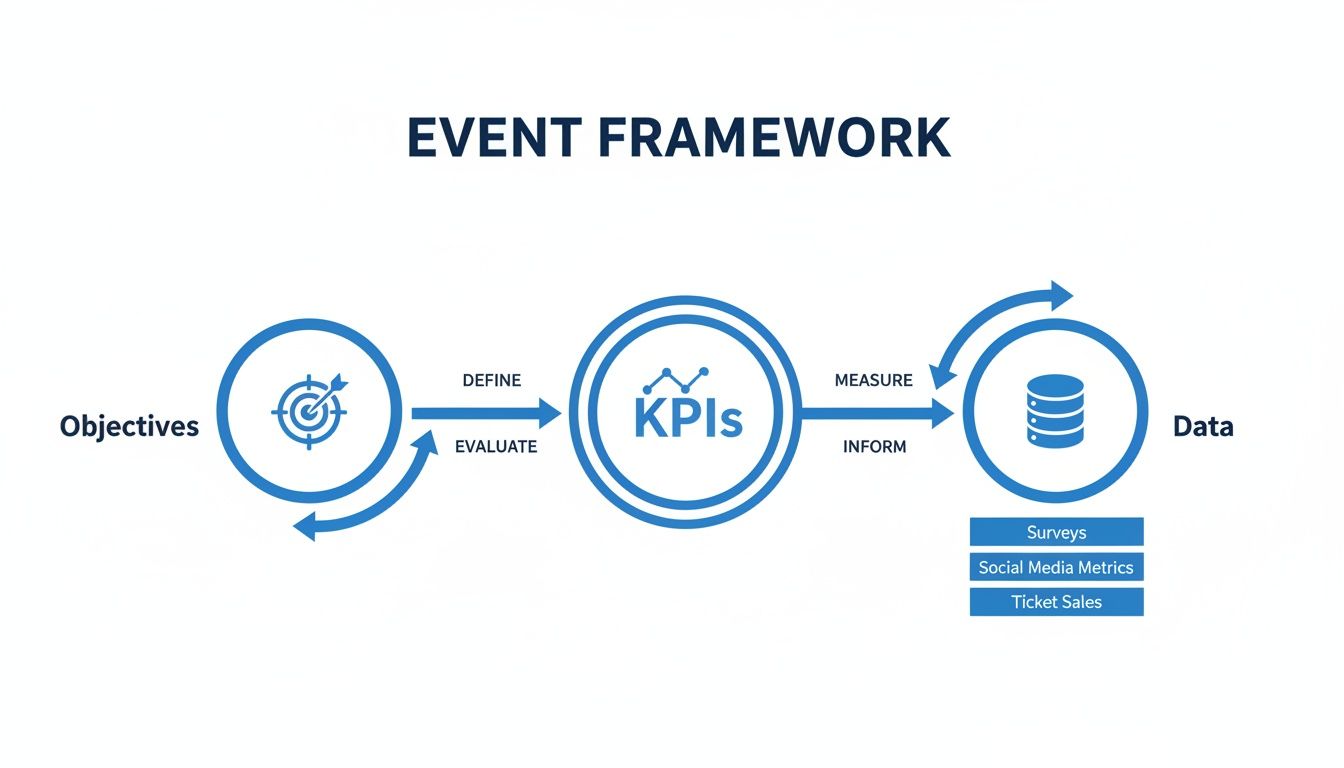
The greatest obstacle to proving event ROI is not a lack of data, but the fragmentation of that data across disconnected systems. For most organizations, critical information lives in silos: registration details in one platform, on-site behavior trapped in an event app, and commercial outcomes logged separately in a CRM. This creates profound blind spots. We can see who registered and attended, but the trail goes cold precisely when it becomes most valuable. We lose the ability to connect an attendee’s session choice to the sales meeting they booked a week later.
Each data point remains an island, making it impossible to construct a coherent narrative that links event investment to financial return. The solution is not another dashboard, but a single source of truth—a unified data infrastructure that provides a complete, chronological view of the entire attendee journey.
Architecting a Single Source of Truth
Creating this unified view is not about replacing existing technology but about ensuring seamless communication between the systems you already operate. A well-architected data pipeline creates a single, reconciled record for every individual, from their first point of contact through to their post-event commercial activity.
The core components of this infrastructure are standard across the industry:
Registration System: The initial source of demographic and firmographic data (e.g., Eventbrite).
Event Engagement Platform: The repository of behavioral data, capturing session attendance, meeting schedules, and exhibitor interactions (e.g., Whova).
CRM System: The definitive record of all commercial activities, pipeline status, and customer history (e.g., Salesforce, HubSpot).
When these systems are integrated using a common identifier (typically an email address), a profound transformation occurs. An anonymous badge scan becomes a known prospect from a target account. A session visit becomes a tangible signal of buying intent. This reconciled view is the foundation of strategic clarity, enabling leadership to move beyond guesswork and into confident, data-driven decision-making.
A single source of truth does more than just organize data; it creates a shared reality for marketing, sales, and event teams. When everyone operates from the same unified attendee profile, strategic alignment ceases to be an aspiration and becomes an operational reality.
This integrated system is the engine that answers the most pressing business questions. It becomes possible to build a report showing which sessions were most popular with C-suite executives from enterprise accounts, or to track precisely how many sponsor-generated leads converted into closed-won business. By connecting these systems, often with tools like Zapier, you replace fragmented spreadsheets with a dynamic intelligence asset. For those looking to further streamline workflows, exploring AI for event planning can provide additional efficiency. It’s the essential infrastructure for anyone serious about understanding the business impact of their events. Check our guide on the step-by-step event planning process to learn more.
From Data to Revenue: The Attribution Challenge
With a unified data framework in place, the final and most critical challenge is attribution. Connecting event activity to financial outcomes—revenue, retention, and ROI—is what distinguishes a tactical event program from a strategic one. Drawing a clear, defensible line from an on-site conversation to a closed deal is what elevates an event portfolio from a line item on a budget to a proven driver of business growth.
For too long, event attribution has been constrained by a simplistic, first-touch model. This approach, which assigns credit only if an event generates a net-new lead, is fundamentally misaligned with the complexities of modern B2B sales cycles. A strategic event does not just source leads; it accelerates existing opportunities, deepens customer relationships, and creates avenues for expansion.
A modern attribution strategy must be multi-touch, recognizing the varied and crucial roles an event plays across the entire customer lifecycle. Consider a prospect who has been stalled in the sales pipeline for months. After attending a technical session and meeting with a product expert at your conference, the deal closes two weeks later. A first-touch model assigns zero credit to the event. A multi-touch model correctly identifies the event as the critical catalyst that accelerated the deal to close.
The most strategic question is not "Did this event create a new lead?" It is "How did this event influence the entire customer journey?" Answering this requires mapping every significant interaction to pipeline velocity, deal size, and revenue outcomes.
This is why the unified data feed from event platforms into the CRM is non-negotiable. It is the only way to build reports that demonstrate how accounts that engaged at an event behave differently from those that did not. It provides definitive proof that attendees from target accounts progress through the sales funnel more quickly and at a higher value. More detail on this can be found in our guides on hybrid event best practices and event management best practices. If you're wondering why this is so often missed, you may find it useful to read why most event analytics don’t change decisions.
Linking Event Performance to Core Business Metrics
The most advanced stage of event measurement is the integration of performance data into fundamental business metrics like Customer Acquisition Cost (CAC) and Lifetime Value (LTV).
By calculating an event-driven CAC, leaders can directly compare the cost-effectiveness of events against other acquisition channels, such as digital advertising or content marketing. This answers the critical question: "Is our event portfolio an efficient engine for acquiring new business?"
Even more powerfully, analyzing the LTV of event-acquired customers reveals their long-term value. By tracking these cohorts, organizations can determine if customers sourced or influenced by events exhibit higher retention rates, larger contract values, or greater expansion potential. Proving that event attendees have a 25% higher LTV than customers acquired through other channels is the kind of strategic argument that secures and grows budgets. Tying event data to these metrics elevates the conversation from logistics to corporate strategy and from tactical execution to demonstrable financial impact. For a closer look at tracking these, this post on capturing event metrics is a great resource.
From Reporting to Decision-Making: The Last Mile of Value
The ultimate purpose of measurement is not to generate reports, but to inform decisions. A wealth of data is useless if it cannot be translated into a clear, compelling narrative that guides executive action. The final step is to transform unified data into focused, strategic insights tailored to the priorities of each key stakeholder. A 50-page data-dump serves no one; clarity is achieved through relevance.
Effective reporting requires understanding that the CEO, the Head of Sales, and the CMO have distinct commercial imperatives. The goal is to provide each leader with the specific intelligence they need to optimize their domain.
For Executive Leadership (CEO/CFO): The focus must be on top-line financial impact. A C-suite dashboard should provide a concise summary of total event-influenced pipeline, overall portfolio ROI, and the measurable impact on customer LTV. The narrative must connect event investment directly to enterprise growth.
For Marketing Leadership (CMO): The marketing view should analyze program effectiveness and efficiency. Key metrics include cost per acquired lead (CPL) by event, lead-to-opportunity conversion rates, and the performance of specific campaigns in attracting high-value attendee segments.
For Sales Leadership (CRO): The sales report must focus exclusively on commercial outcomes. It should highlight the number of meetings booked with target accounts, the deal acceleration rate for event-influenced opportunities, and the specific pipeline generated by sales territories or individual representatives.
This tailored approach transforms reporting from a passive, historical exercise into an active, forward-looking tool for strategic planning. It provides the clarity needed to reallocate resources, refine event strategy, and justify future investments.
A great report doesn't just show what happened; it explains why it happened and prescribes what to do next. It turns measurement from a report card into a roadmap for revenue growth.
By building a narrative that answers the most pressing business questions, you ensure that your insights are not just seen, but acted upon. This is the final, crucial step in closing the visibility gap and establishing your event portfolio as an indispensable engine of business growth.
Ready to unify your event data and turn insights into revenue? TalkValue provides the strategic infrastructure to connect your event activities to business outcomes. Explore a demo to see how our clarity engine can transform your event portfolio.


FAQ