For decades, the event industry has operated on a foundational belief: flawless execution is the key to success. We celebrate the perfectly managed project, the seamless attendee experience, and the budget that comes in on target. This obsession with operational excellence, while necessary, has become a strategic diversion. It masks a deeper, more structural problem that prevents event portfolios from achieving their full revenue potential: a profound lack of decision-clarity across the entire business.
The real challenge isn't executing a single event flawlessly. It's understanding how all events, past and present, connect to create cumulative business value. The industry isn't suffering from a lack of project management tools, but from a critical visibility gap. This gap separates operational data from strategic decision-making, leaving leaders to navigate multi-million dollar investments with an incomplete map. The result is stalled growth, diluted monetization, and an inability to answer the most fundamental question: which parts of our event strategy are actually creating long-term value?
The Illusion of Control: When Operational Dashboards Don't Drive Strategic Growth
Senior leaders are surrounded by data. We have CRM systems tracking customer interactions, marketing automation platforms measuring campaign performance, and event management software reporting on registration numbers and attendance. Yet, for all this information, a clear, unified picture of an event portfolio's financial health and strategic contribution remains elusive. The dashboards we rely on often provide a false sense of security—a detailed view of the trees that completely obscures the forest.
This fragmentation is not a minor inconvenience; it is the central impediment to scalable revenue growth. When registration data is disconnected from marketing attribution, and both are isolated from sponsor revenue and on-site engagement metrics, it becomes impossible to make sound strategic choices. Leaders are forced to rely on intuition and historical precedent rather than a cohesive, data-driven framework.
The Financial Consequences of Disconnected Data
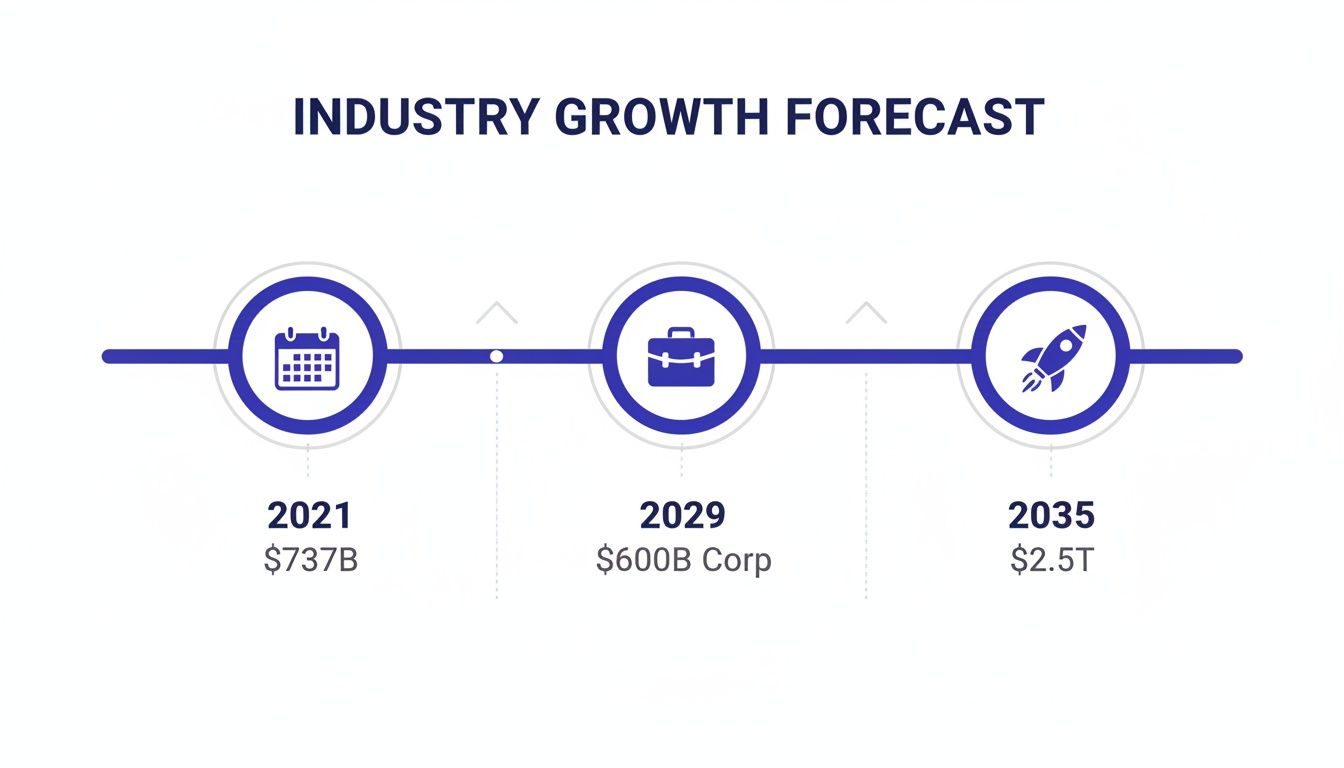
This structural weakness has direct and significant revenue implications. Without a unified view, organizations cannot accurately assess the profitability of different attendee cohorts, the true ROI of specific marketing channels, or the long-term value of a sponsor relationship beyond a single event. The global events market, projected to grow from $736.8 billion in 2021 to $2.5 trillion by 2035, is scaling in complexity far faster than the decision-making infrastructures that support it.
The consequences manifest in several critical areas:
Inefficient Capital Allocation: Marketing budgets are spread across channels without a clear understanding of which ones deliver the most profitable attendees, leading to wasted spend and diminished returns.
Stagnant Monetization Models: Without cohort-level visibility, organizations miss opportunities to create premium pricing tiers, targeted sponsorship packages, or new content formats for their most engaged and valuable audience segments.
Eroding Sponsor Value: When we cannot provide sponsors with concrete data linking their investment to audience engagement and lead generation, the renewal conversation becomes a subjective negotiation rather than a strategic partnership, jeopardizing a primary revenue stream. This is a key reason why this structured approach is replacing traditional B2B event marketing agencies.
The problem, therefore, is not a failure of execution within a single event project. The problem is a systemic failure to connect operational outputs to strategic financial outcomes across the entire portfolio.
From Project Management to Portfolio Intelligence: The Necessary Shift
To close the visibility gap, leaders must evolve their thinking from event project management to event portfolio intelligence. This is not merely a semantic change; it represents a fundamental shift in focus from managing individual timelines and tasks to orchestrating a system that generates cumulative business value. Project management ensures an event doesn't fail. Portfolio intelligence ensures the entire event strategy succeeds and scales.
This shift requires a new kind of infrastructure—one designed not just to execute tasks, but to reconcile data and generate decision clarity. It is about building a central nervous system for the event business that connects every stakeholder and every data point into a single, coherent whole.

This strategic infrastructure must accomplish three core functions that traditional tools were never designed to handle.
1. Reconcile Disparate Data into a Single Source of Truth
The first and most critical function is data reconciliation. An intelligent event infrastructure must automatically ingest and unify data from every corner of the business—registration platforms, marketing campaigns, on-site engagement tools, and CRM systems. The objective is to create a "single source of truth" where operational metrics are intrinsically linked to financial outcomes.
This unified view allows leaders to move beyond surface-level KPIs like total attendance. Instead, they can analyze the profitability of a specific attendee cohort from a targeted marketing campaign or measure the revenue influence of a keynote speaker. This is how you learn how to organize a marketing event that actually drives results at a strategic level.
2. Provide Cohort-Level Visibility to Uncover Hidden Value
With reconciled data, the next step is to gain visibility into specific audience segments, or cohorts. Averages are misleading; true insight comes from understanding the behavior of distinct groups. A strategic infrastructure allows you to isolate and analyze cohorts based on criteria like job title, company size, registration date, or engagement level.
This visibility reveals which segments are most valuable and why. For example, you might discover that attendees who register during a specific campaign window and attend a certain track have a 40% higher lifetime value. This is not an operational insight; it is a strategic directive that should inform all future marketing investment, content programming, and pricing strategy. Without this clarity, such opportunities for revenue optimization remain undiscovered. The ability to manage risk and execute flawlessly, as seen in cases like the Humanic AI Summit, where contingency planning was key, becomes even more powerful when guided by this level of strategic insight.
3. Align Teams Around Shared Strategic Objectives
Finally, a unified decision-making infrastructure dismantles the silos that separate marketing, sales, finance, and event operations. When all teams are working from the same reconciled data, their efforts become naturally aligned. The marketing team no longer focuses solely on generating leads, but on generating the most profitable leads. The event operations team sees how a smooth check-in experience contributes directly to higher attendee satisfaction scores, which in turn correlates with retention and repeat revenue.
This alignment transforms the organizational culture from a collection of functional departments into a single, revenue-focused commercial team. The conversation shifts from "Did we execute our tasks?" to "Did we achieve our shared financial goal?"
The Decision-Clarity Engine in Practice

Implementing this decision-making infrastructure is not about adding another tool; it's about changing the way decisions are made. The focus shifts from managing logistics to orchestrating revenue.
Consider the sponsor relationship. In a traditional model, proving ROI is a persistent challenge. In an integrated model, it becomes a core strength. By connecting sponsor data with attendee engagement data, you can provide partners with a clear report showing not only how many people visited their booth, but which specific attendee cohorts engaged with their brand. This data-driven validation transforms a transactional sale into a strategic partnership, making renewals and upsells a logical next step. It directly answers the question of what makes an event valuable for exhibition leaders.
Similarly, attendee acquisition becomes a strategic exercise in portfolio management rather than a tactical marketing push. By analyzing which channels and campaigns deliver attendees with the highest engagement scores and propensity to upgrade to premium packages, you can reallocate your marketing budget with precision. You stop spending money to acquire low-value attendees and double down on the segments that drive profitability.
This level of intelligent automation and data reconciliation is the engine of modern event growth. It automates low-value operational work and surfaces high-value strategic insights, freeing senior leaders to focus on what truly matters: making the decisions that drive long-term, sustainable revenue. Investing in an AI tool kit for events is not about technology for its own sake; it is about building the capacity for smarter, faster, and more profitable decision-making.
Impact of Shifting from Project Management to Portfolio Intelligence
Strategic Area | Traditional Event Project Management | Event Portfolio Intelligence |
|---|---|---|
Primary Goal | Flawless execution of a single event. | Maximizing the cumulative financial value of an entire event portfolio. |
Core Metric | On-time, on-budget delivery. | Portfolio ROI, cohort profitability, and sponsor retention rate. |
Data Structure | Siloed and fragmented across multiple tools. | Reconciled into a single source of truth connecting operations to revenue. |
Decision-Making | Based on historical precedent and departmental KPIs. | Based on unified, real-time data and cohort-level analysis. |
Team Focus | Functional execution within departments. | Cross-functional alignment around shared commercial outcomes. |
Moving Beyond Execution
The event industry is at an inflection point. The path to growth and market leadership no longer lies in simply out-executing the competition on a project-by-project basis. It lies in building a superior decision-making infrastructure that closes the visibility gap between operations and strategy.
The most forward-thinking organizations are no longer just managing events; they are engineering a clarity engine that connects every action to a financial outcome. They understand that true strategic advantage comes not from a perfect Gantt chart, but from the ability to see their entire event portfolio with unprecedented clarity and make the bold, data-informed decisions that others cannot. The question for every event leader is no longer "How do we execute this event perfectly?" but "How do we build the intelligence system that ensures our entire portfolio thrives?"
At TalkValue, we build the decision-making infrastructure for the world's leading event organizers. Our AI-native platform serves as a clarity engine, unifying your portfolio's data to connect operational execution directly to revenue growth. We provide the strategic visibility required to optimize monetization, deepen sponsor partnerships, and drive sustainable financial performance.
See how a unified data foundation can transform your event strategy. Discover TalkValue.


FAQ