For decades, the event industry has operated on a universal truth: a detailed timeline is the bedrock of success. We build meticulous, 12-to-18-month project plans, breaking down the entire lifecycle into manageable phases. From venue contracts to post-event surveys, this master document is designed to prevent chaos and align teams. It is the accepted blueprint for turning a concept into a smoothly executed reality.
But what if this bedrock belief is flawed? What if the timeline, our most trusted tool, is actually obscuring the single greatest threat to long-term revenue growth and portfolio value? The problem isn't the timeline itself, but our reliance on it as a proxy for strategy. We have become experts at managing tasks—a linear sequence of activities—while overlooking the structural gaps in visibility and decision-making that silently erode profitability. The result is a cycle of executing well-run events that consistently fail to deliver their full strategic and financial potential.
The Illusion of Control: The Gap Between a Timeline and a Revenue Engine
The traditional event timeline provides a comforting illusion of control. It answers what needs to be done and when. It tracks progress against deadlines for venue booking, speaker confirmations, and marketing campaigns. Yet, it fundamentally fails to address the more critical, strategic questions that drive revenue and long-term value. It doesn’t tell you which attendee cohorts are most profitable, why certain sponsor categories fail to renew, or how pricing adjustments would impact registration velocity.
This is the structural gap that plagues even the most sophisticated event organizations. We operate with disparate data systems—a CRM for sales, a registration platform for ticketing, marketing automation for outreach—that create fragmented views of our audience and performance. While dashboards and analytics tools provide retrospective data, they rarely offer a unified, forward-looking decision framework. Leaders are left to connect the dots manually, making high-stakes decisions on budget allocation, sponsor packaging, and audience strategy based on incomplete, lagging indicators. This isn't a failure of execution; it's a failure of infrastructure.
The Foundation of Strategic Clarity: Beyond Early Milestones
The first phase of any major event, typically 12 months out, is rightly focused on securing foundational elements like venue and dates. However, a strategic approach demands that the "why" and "who" are defined with the same rigor as the "when" and "where." It requires moving beyond broad objectives like "grow attendance" to establishing a clear decision framework. Are we prioritizing the acquisition of new enterprise logos for sponsors, maximizing yield per attendee, or deepening engagement with a specific professional cohort?
These are not just goals; they are filters that should govern every subsequent decision. Without this clarity, the budget becomes a simple expense sheet rather than a strategic investment portfolio. Technology choices are made based on features, not on their ability to create a single source of truth for attendee behavior. For instance, connecting a system like TalkValue at this embryonic stage isn't about adding another tool; it's about building the data infrastructure to ensure that every registration, email open, and website visit contributes to a unified strategic view from day one, preventing the data silos that undermine decision-making later. This is the difference between simply planning an event and architecting a revenue asset, a distinction explored in our analysis of leadership events like the SISO CEO Summit vs ECEF.
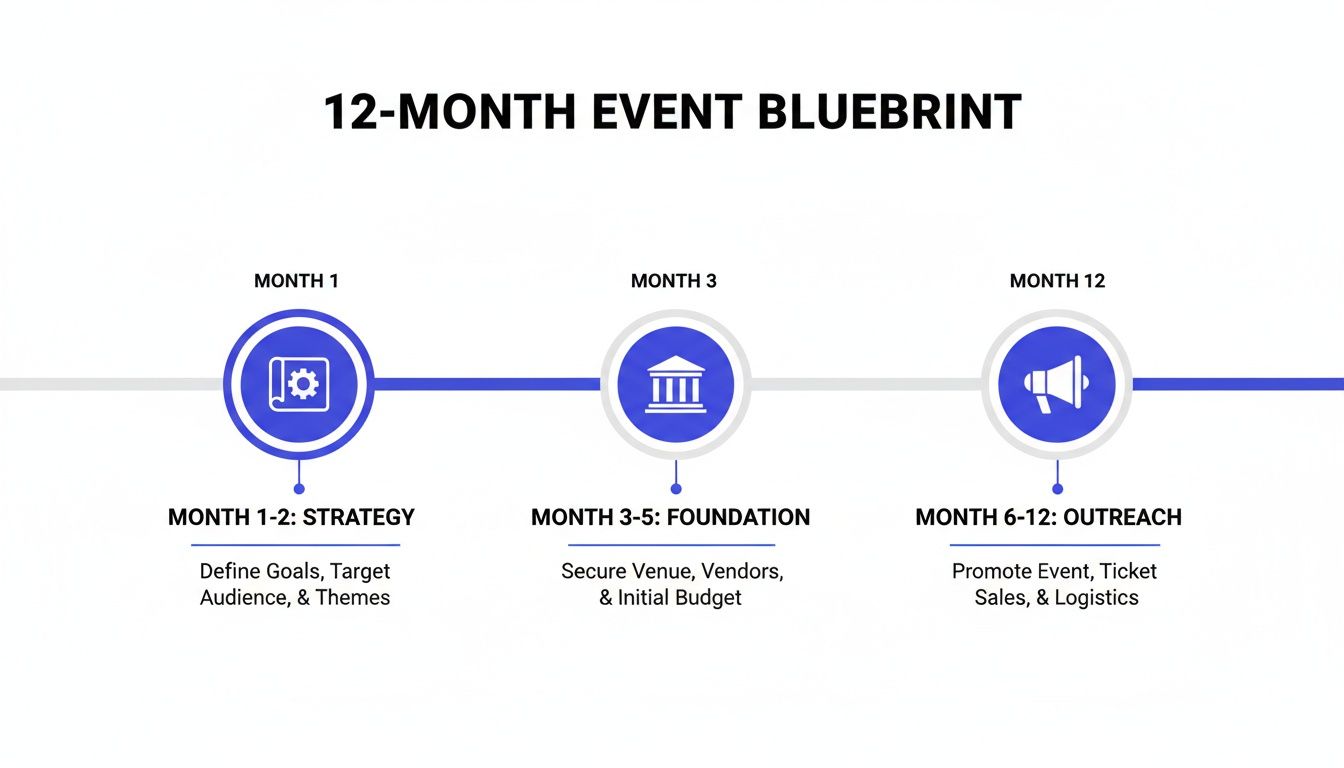
The initial phase is not merely about setting things up. It's about establishing the very intelligence system that will guide the portfolio. When high-level outreach to anchor sponsors and keynotes begins, the conversations are not just about securing names; they are about testing the core value proposition against the market's most discerning stakeholders. The feedback gathered here is crucial for refining the model, but only if it can be integrated into a holistic view of the event's economic engine.
Key Strategic Pillars vs. Tactical Phases
Strategic Pillar | Tactical Manifestation (Timeline) | Revenue Implication |
|---|---|---|
Portfolio Strategy | Define objectives, secure venue & dates, create initial budget. | Sets the financial targets and audience focus that drive all monetization decisions. |
Market Validation | High-level outreach (keynotes, anchor sponsors), develop brand identity. | Validates pricing, packaging, and value proposition with top-tier stakeholders. |
Demand Generation | Launch website, open registration, ramp up marketing campaigns. | Translates strategic positioning into measurable registration velocity and pipeline. |
Operational Excellence | Finalize logistics, intensive promotion, confirm sponsor deliverables. | Protects margins and sponsor ROI by ensuring flawless execution of commitments. |
Experience Delivery | On-site setup, team briefings, run of show execution, live engagement. | Directly impacts attendee retention and propensity for future spend. |
Value Realization | Analyze unified data, execute segmented follow-up, report on ROI. | Converts event engagement into tangible sales pipeline and informs future strategy. |
This reframing moves the focus from a checklist of activities to a series of strategic imperatives, each with direct consequences for revenue and long-term growth.
The Execution Window: From Acceleration to Strategic Reconciliation
The 90-day window before an event is traditionally viewed as a period of intense execution, where marketing, logistics, and operations converge. The focus is on acceleration: driving registrations, finalizing speaker details, and managing a cascade of operational tasks. However, viewing this phase merely as an execution sprint is a critical strategic error. This is the period where the financial and strategic model meets the reality of the market, and the ability to see, interpret, and act on real-time signals is what separates market leaders from the rest.
As marketing campaigns shift from building awareness to creating urgency, the data flowing in is not just operational—it's strategic intelligence. Registration velocity by ticket type, discount code utilization, and engagement with specific content tracks are all leading indicators of market response. A purely tactical approach focuses on hitting registration numbers. A strategic approach uses this data to ask deeper questions: Is our pricing model for a specific cohort misaligned? Is a particular session track underperforming, signaling a need to adjust our content strategy for the next cycle?

The High Cost of Unreconciled Data
During this phase, the lack of a unified decision infrastructure becomes painfully apparent. The team responsible for sponsor deliverables is often disconnected from the marketing team analyzing registration data. Speaker logistics are managed in a separate silo. This fragmentation creates significant revenue risks:
Sponsor ROI Dilution: Failure to reconcile sponsor package commitments with actual on-site execution can damage relationships and jeopardize renewals, which form the backbone of exhibition revenue.
Margin Erosion: Inefficient management of logistics, often caused by poor visibility into final numbers and needs, leads to last-minute overspending on everything from A/V to catering.
Team Burnout on Low-Value Tasks: Without an integrated system, teams spend countless hours manually reconciling data and managing administrative tasks, diverting focus from high-value strategic adjustments and attendee engagement. This is a direct drain on operational efficiency and a hidden cost that impacts profitability.
The solution is not more project management software, but a central nervous system that automates the predictable and provides clarity on the exceptions. When registration and communication workflows are automated, as discussed in how to organize a marketing event that actually drives results, it does more than save time. It liberates senior team members to focus on strategic reconciliation—interpreting data and making adjustments that protect revenue and enhance the attendee value proposition.
With the events industry projected to grow significantly toward $2.5 trillion by 2035 and in-person conferences remaining a top marketing channel, the tolerance for operational inefficiency and strategic blindness is rapidly disappearing. More data from the events industry's projected growth on alliedmarketresearch.com confirms this trend. Leaders who continue to rely on a simple timeline to navigate this complex landscape risk being outmaneuvered by competitors who have built a true decision-making infrastructure.
The Performance Environment: Where Strategy Becomes Tangible
The live event day is the ultimate manifestation of strategy. Every element, from the flow of the registration process to the transitions between sessions, is a tangible touchpoint that either reinforces or undermines the value proposition. A detailed run-of-show is essential, but it is a script, not the performance itself. The performance is guided by real-time data and the ability to manage the attendee experience with seamless precision.
The day begins not with the opening keynote, but with the first attendee interaction. A slow, cumbersome check-in process does more than create a queue; it sends a signal of inefficiency and disrespect for the attendee's time, immediately eroding the premium experience you aim to deliver. Conversely, a frictionless arrival, powered by automated systems, sets a tone of competence and care.
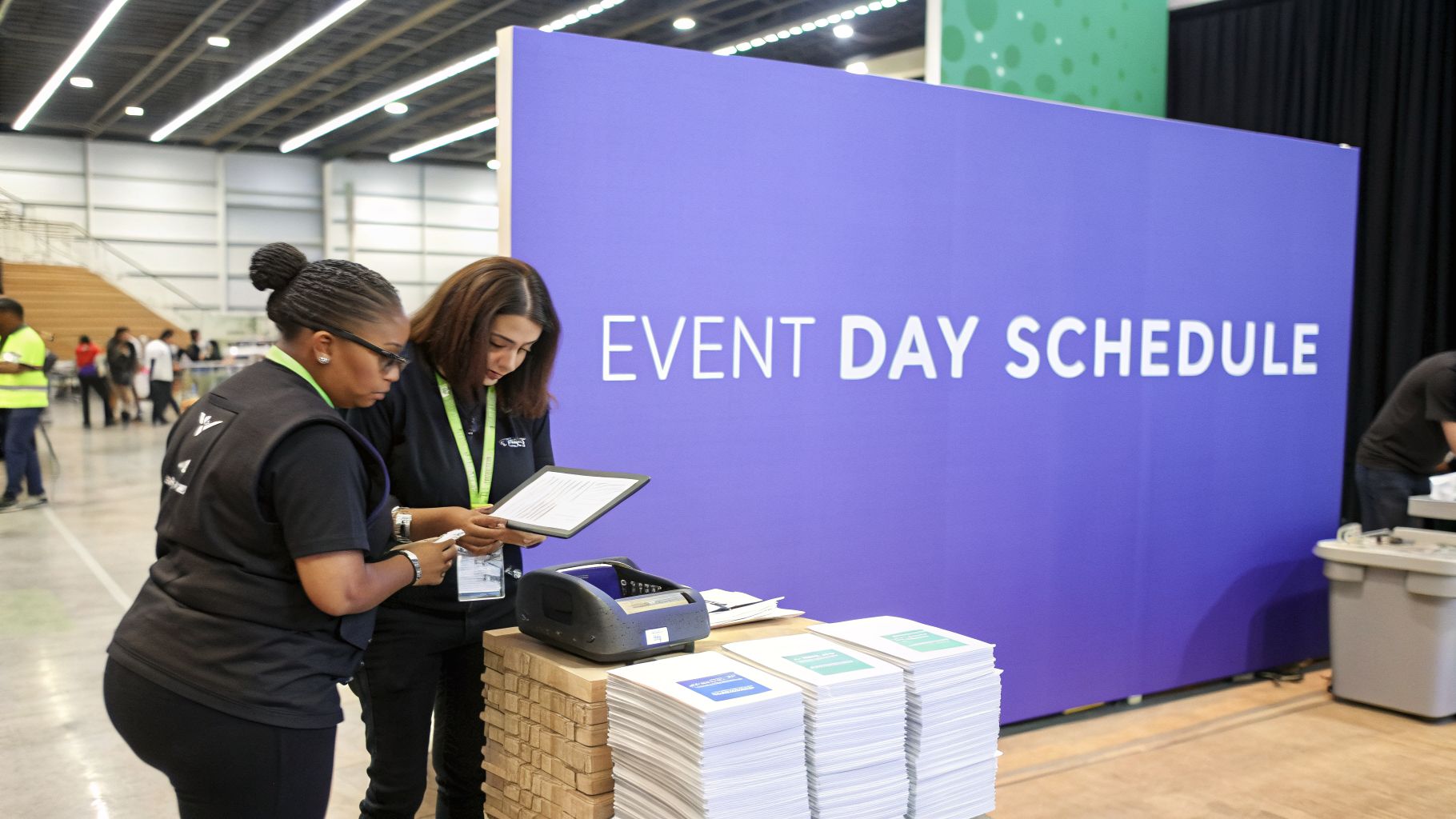
This is where the investment in a unified data infrastructure pays its most visible dividends. In our Humanic AI Summit case study, for example, an integrated check-in system not only created a flawless attendee experience but also reduced the on-site staff workload by 70%. This is a direct impact on the bottom line, converting a significant operational expense into a higher margin.
From Choreography to Real-Time Response
While a detailed hour-by-hour schedule is critical for choreography, a strategic leader is focused on the data being generated in real time.
Session Attendance: Which sessions are overflowing and which are under-attended? This is direct feedback on your content strategy and speaker selection, invaluable for planning the next event.
Dwell Time: Where are attendees congregating? Which sponsor booths are generating the most traffic? This data is crucial for proving ROI to exhibitors and optimizing floor plans in the future.
App Engagement: How are attendees using the event app? Are they connecting with other attendees, engaging with sponsor profiles, or asking questions in Q&A sessions? This is a measure of active engagement versus passive attendance.
Without a system to capture and unify this behavioral data, the event concludes and this wealth of strategic intelligence vanishes. The organization is left with only lagging indicators like final attendance numbers and anecdotal feedback. You’ve successfully executed the timeline, but you have failed to capture the value. The ability to see and interpret these live signals is what allows an organization to move from simply running an event to actively managing a strategic asset.
The transition from a packed afternoon session to the final networking break isn’t just a logistical movement; it’s a critical monetization opportunity. It's the last chance for sponsors to connect with high-value prospects. A team that is unburdened by manual processes can focus on facilitating these high-value interactions, directly contributing to sponsor success and the likelihood of renewal. This is the tangible financial outcome of building a strategic infrastructure rather than just following a plan.
The Engine of Growth: Automating the Decision Framework
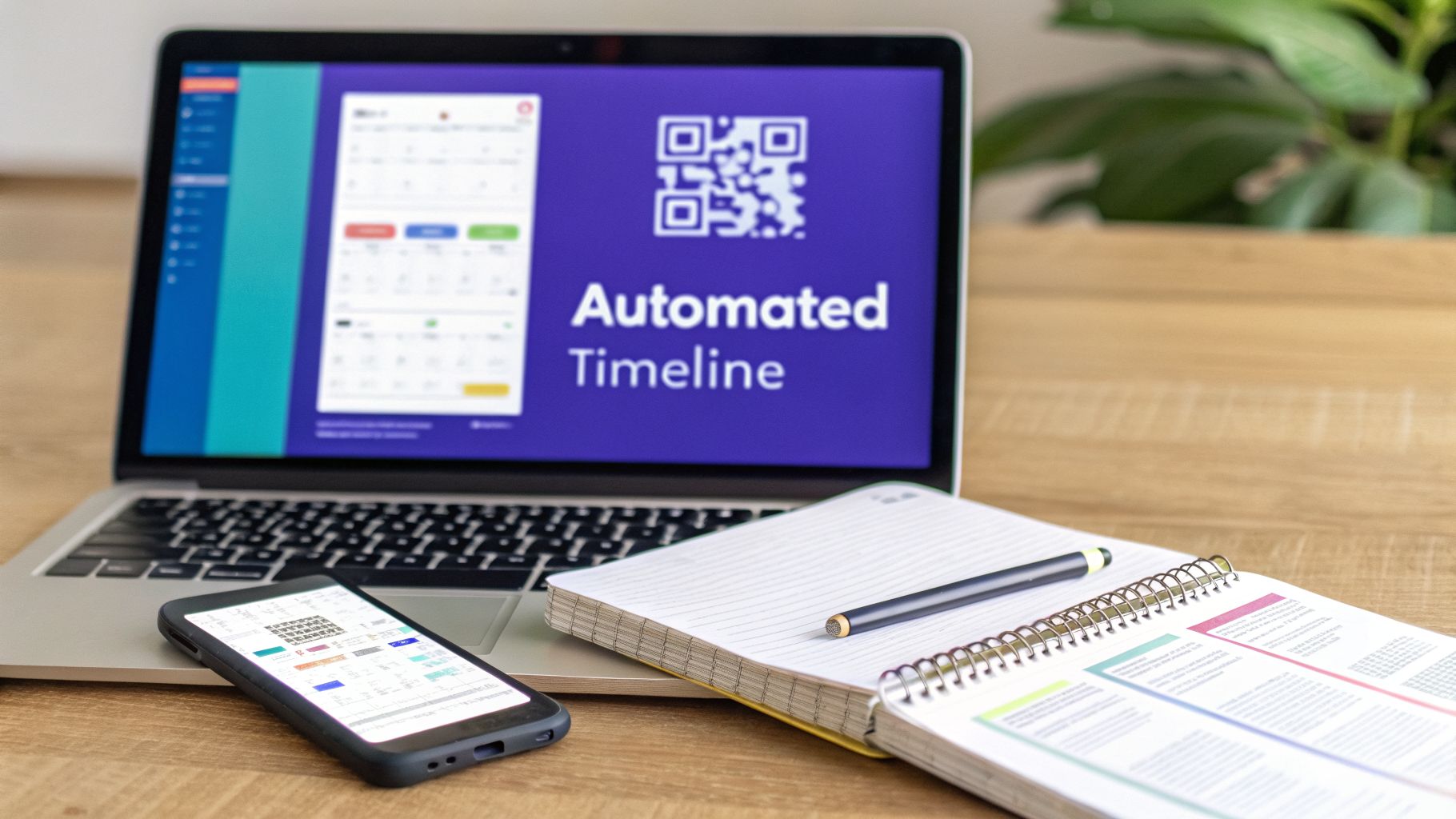
A static timeline managed in a spreadsheet cannot power a modern event portfolio. To achieve scalable growth and sustained profitability, organizations must evolve from managing tasks to automating workflows within a unified decision framework. This is not about replacing human expertise but augmenting it, freeing strategic leaders from the friction of manual data reconciliation to focus on high-impact decisions.
The objective is to create a central nervous system where data from disparate platforms—such as Eventbrite, Whova, and HubSpot—is harmonized into a single, coherent view. This integrated infrastructure is what turns a plan into an intelligent, self-executing system. When a registration occurs, it should do more than just add a name to a list. It should trigger a cascade of automated, intelligent actions: a personalized welcome journey, an update to the master check-in system, and the tagging of that attendee within a specific cohort for future analysis.
From Operational Efficiency to Strategic Advantage
This level of automation creates a powerful force multiplier, enabling lean teams to execute complex events with precision. This is crucial in an environment where budgetary pressures coexist with high expectations for growth, as highlighted in analyses like PCMA's 2026 forecast.
Consider the strategic implications:
Predictive Modeling: With unified historical data, you can more accurately forecast registration curves, model the impact of pricing changes, and predict which attendee segments are most likely to convert.
Dynamic Resource Allocation: Real-time visibility allows for smarter allocation of marketing spend, shifting budget towards channels and campaigns that are delivering the highest-value attendees.
Guaranteed Sponsor Fulfillment: Contractual obligations for sponsor visibility can be automated across digital screens, event apps, and pre-session loops, eliminating human error and ensuring 100% fulfillment, which is the foundation of strong renewal rates.
An automated decision framework transforms an organization from being reactive to proactive. It allows leadership to move from solving problems created by data silos to creating value based on unified intelligence.
This is the core distinction between a tool and an infrastructure. A tool helps you complete a task. An infrastructure provides the clarity to decide which tasks are worth doing. Platforms like TalkValue are designed to serve as this central hub, not as another piece of software to manage, but as the underlying architecture for smarter, revenue-focused decision-making. Deeper insights on this approach can be found in our AI Tool Kit for event professionals.
Ultimately, automating the framework is about building a more resilient and intelligent operational model. It’s how an organization scales its strategic impact without proportionally scaling its costs, ensuring that every event in the portfolio is not just executed flawlessly but is also a powerful engine for measurable growth.
Proving Value: The Post-Event Timeline as a Revenue Mandate
The event does not conclude when the last attendee leaves. For a revenue-focused organization, this is the moment of truth, where engagement is converted into measurable ROI. A post-event timeline that ends with a thank-you email is an admission of strategic failure. The 30-day period following an event is not a wrap-up phase; it is a critical value realization window that proves the event's contribution to the business and secures the mandate for future investment.
The common practice of sending a generic survey and a link to session recordings misses the point entirely. The objective is to leverage the rich behavioral data captured during the event to execute a highly segmented and personalized follow-up strategy. This is only possible if the event platform, CRM, and marketing automation systems are operating from a single, unified data set. Without this, personalization at scale remains an elusive goal.
From Data Reconciliation to Pipeline Acceleration
Imagine the strategic power of a unified post-event workflow:
An attendee who visited the booths of three specific cybersecurity sponsors receives a follow-up email that includes relevant content from those partners and an invitation to a related webinar, with the lead data simultaneously delivered to the sponsors’ CRM.
A participant who attended every session in the "AI in Finance" track is automatically enrolled in a nurture sequence for an advanced workshop on the same topic.
A high-value prospect identified through on-site engagement data triggers an automated, personalized connection request on LinkedIn from a senior executive, turning a passive touchpoint into an active sales conversation.
This is the mechanism that transforms event attendance into qualified pipeline. It demonstrates a sophisticated understanding of each attendee's journey and delivers value far beyond the confines of the event itself. This strategic follow-up is why a reply rate of over 50% on post-event LinkedIn outreach, as seen with the Knowledge Graph Conference, is achievable. It is the direct result of leveraging data to prove you were listening.
This approach is essential in a global industry where economic impact is now a primary KPI for the 1.6 billion annual business event participants. With the market on track to exceed $2.33 trillion, as noted by sources like meetingmentormag.com, the ability to connect event activity to revenue outcomes is no longer optional. It is the core function of a modern event team.
The post-event report should not be a historical document of what happened. It should be a forward-looking business case, proving the ROI of the last event and providing the data-backed intelligence to optimize the strategy for the next one.
This strategic reconciliation of data—from platforms like Eventbrite, Whova, and HubSpot—is fundamental. It provides sponsors with clear, demonstrable value, which is the cornerstone of long-term partnerships. It provides leadership with the evidence needed to justify budget and expand the event portfolio. This is how leading organizations are moving beyond tactical event marketing, as detailed in our analysis of why TalkValue is poised to replace traditional B2B event marketing agencies. By treating the post-event timeline as a revenue-focused operation, they ensure that each event is not an endpoint, but a catalyst for sustained business growth.
The conventional wisdom of relying on a detailed timeline has served its purpose. But to lead in today's market, we must look beyond the plan to the underlying decision infrastructure. True strategic advantage comes from unifying data, gaining clarity across the entire event lifecycle, and making decisions that directly connect activity to revenue.
TalkValue provides the decision infrastructure for ambitious event leaders, unifying data and automating workflows to drive measurable growth.
Explore a demo to see how a unified decision framework can transform your event portfolio.

FAQ