
For several years AI was a session inside somebody else's conference. In 2026 it became an asset class. One London venue reports a quarter more AI events year on year, and two of the largest organisers bought AI shows outright rather than launching their own. That shift changes what an independent AI event is now competing against.
Until recently, AI at business events was a track. A stage inside a martech show, a themed day at a developer conference, a keynote slot that got upgraded each year as the topic got hotter.
Tracks do not get acquired. Categories do.
Three separate events from 2026 suggest the transition has already happened, and the people acting on it are the organisations with the balance sheets to buy rather than build.
The demand signal from a single venue
The QEII Centre in London reported a 25% year-on-year increase in AI-focused events, projected to draw close to 24,000 delegates.
A venue is a useful place to read this from, because a venue has no editorial stake in whether AI is interesting. It sells dates. A quarter more bookings in one category, at one building, in one city, is a demand measurement rather than a forecast.
The delegate figure matters more than the booking count. Twenty-four thousand people at AI events in a single venue is an audience, not an experiment, and audiences at that scale attract organisers who want to own them.
Two organisers chose to buy rather than launch
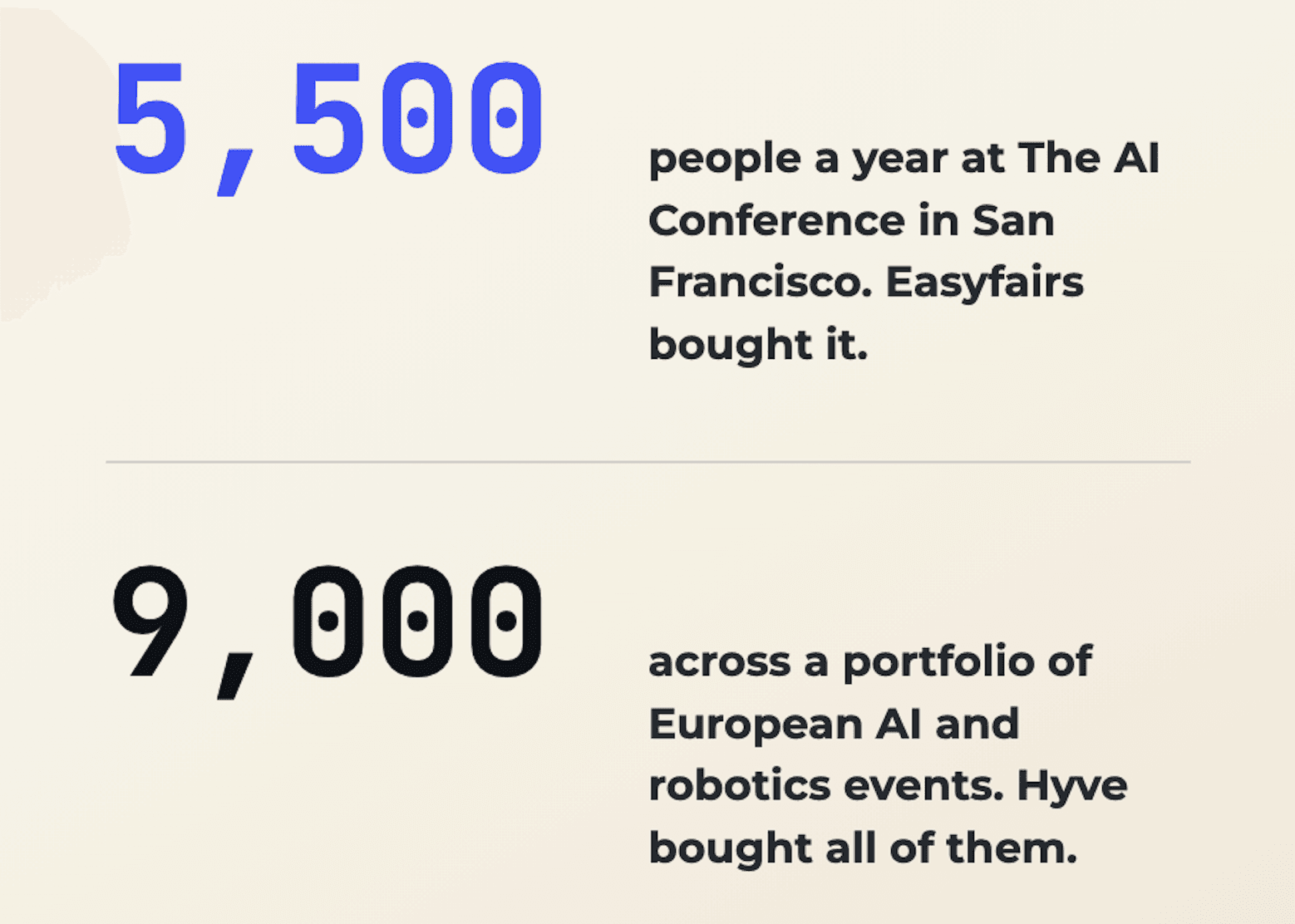
Easyfairs acquired The AI Conference in San Francisco, an event running since 2023 with roughly 5,500 attendees. Hyve acquired a portfolio of European AI, robotics and crypto events, adding approximately 9,000 attendees and 350 exhibitors.
Both organisations are entirely capable of launching a show. Launching is what organisers do. Choosing acquisition over launch is a statement about what they think they are short of, and it is not venue access or operational capacity.
It is time and community. A show that has run since 2023 has a speaker network, a returning exhibitor base and a reputation among the people who decide which one conference to attend. None of that can be assembled in a season, and in a category moving this fast, three years of standing is a real moat.
There is a second reading worth holding alongside that one. Buying is also how a large organiser hedges a topic it cannot confidently forecast. Launching commits to a thesis about where AI events will be in three years. Acquiring transfers that risk to a seller who has already proved the audience exists. That is a less flattering interpretation than conviction, and both can be true of the same transaction.
What being a category actually changes
When AI was a track, an independent AI event competed with other independent AI events. Similar budgets, similar reach, similar constraints.
Once the category is inside portfolios, that changes. The competitor now has cross-promotion across dozens of shows, shared data infrastructure, centralised sales teams and the ability to run a new edition at a loss for two years.
This is the same mechanism reshaping exhibitions more broadly, covered in the consolidation of the exhibition industry, and it is the same structural pattern now visible in software, described in the martech landscape contraction. Scale compounds toward whoever already holds the audience relationship.
The specific risk for AI events is timing. The category became attractive quickly, which means the consolidation window is compressed. Independents in slower categories have years to decide what they are. Independents here have considerably less.
The audience is not one audience
There is a complication that portfolio logic tends to flatten, and it is where an independent event still has room.
"AI events" currently covers at least four distinct audiences. Researchers, who want technical depth. Builders, who want implementation detail. Buyers, who want to know what to purchase. Executives, who want to know what to do about it.
These groups want different rooms. They tolerate each other's sessions poorly. A portfolio operator optimising for total delegate numbers has a structural pull toward the broadest possible version of the event, which is the version that serves all four adequately and none of them well.
The independent that knows precisely which of the four it serves can be a better event for that group than a larger operator can afford to be. That is not a nostalgic argument about small shows. It is an observation about what portfolio economics rewards.
The failure mode is worth naming, because it is the common one. An independent notices growth in an adjacent audience and widens the programme to capture it. The following year attendance is higher and satisfaction among the original group has fallen, usually without anyone measuring the second half of that sentence. Broadening is the move that feels like growth and behaves like dilution, and it is the move a portfolio operator can absorb and an independent generally cannot.
Cross-industry AI events are the harder version
There is a further complication for anyone running an AI event outside the technology sector.
An AI conference for the events industry, or for logistics, or for healthcare marketing, is competing for attention with the general AI conferences at exactly the moment those are getting portfolio budgets behind them. The vertical event has a better claim to relevance and a worse claim to scale.
The defensible position is usually specificity of outcome rather than breadth of topic. Not "AI for logistics", which the large operators can absorb as a track, but a room where a defined group leaves with a defined thing. That is harder to programme and considerably harder to copy.
The test is what a delegate says when a colleague asks why they went. If the answer is the topic, a portfolio event with a bigger budget can take that audience next year. If the answer names the specific people who were there, or a decision the delegate was able to make afterwards, the event owns something that does not transfer with a larger marketing spend.
What the buyers were actually paying for
It is worth being precise about what changes hands in a deal like this, because it is not the event.
An event is a date, a venue contract and a brand. Those are replaceable and none of them justify an acquisition. What is not replaceable is the list: which exhibitors renewed, which speakers said yes, which delegates came back a second and third time, and who introduced whom.
That data compounds annually and cannot be bought separately. It is the same asset underneath the broader wave of exhibition M&A, and it is why the price of a show tracks the durability of its audience rather than the size of any single edition.
For an independent, this reframes what is worth protecting. Not the programme, which competitors can study and approximate within a year. The relationship record, which they cannot, and which most independent organisers hold in a state they would struggle to describe if a buyer ever asked. The question of whether that data is usable is separate from whether it exists, and it is the subject of why most event analytics do not change decisions.
The regional question
Both acquisitions in 2026 were in San Francisco and Europe, and the venue signal came from London. That is a narrow geographic base from which to call a global trend.
Asia is the obvious gap in this picture. AI event activity there is substantial and largely outside the portfolios that made these purchases, which means either the consolidation has not reached it yet or the economics work differently. Both would be worth knowing, and neither is answered by the data currently available.
The practical implication for an independent organiser outside the two centres is that the window is probably longer than the headlines suggest, but not indefinite. Consolidation waves tend to move from the deepest market outward, and the deepest market has already moved.
What we would watch over the next year
Three things will tell you how far this has run.
Whether the acquired events keep their names and their programming teams, or get folded into existing portfolio brands. Retention of both usually signals that the buyer understood what it bought.
Whether AI events start splitting by audience rather than growing broader. Category maturity normally shows up as segmentation.
And whether venues outside London and San Francisco report the same 25%. If the demand is genuinely structural rather than concentrated in two tech centres, the next wave of acquisitions will be regional.
One more signal is worth adding, because it is the one that would change the picture rather than confirm it. If a portfolio operator launches an AI event from scratch and it works, the moat argument above is weaker than it looks, and three years of standing is worth less than the cross-promotion a portfolio can put behind a first edition. Nobody has tested that publicly yet.
For anyone running an event in this category, the question worth answering before the next cycle is not how to grow. It is which of the four audiences you are actually for, and whether your programme currently reflects that answer. If you want a second read on where your show sits, book a call.



FAQ