
Exhibition assets are trading at scale because the sector is growing, not because it is struggling. For independent organisers the consequence is a competitor with capabilities a single show cannot fund on its own. What a portfolio cannot buy is proximity to one audience, and that is the asset worth defending deliberately.
There is a comfortable way to read consolidation news and a useful way, and most organisers default to the comfortable one.
The comfortable reading is that this is finance, happening somewhere above the operating layer, relevant to shareholders and largely irrelevant to whoever is putting a show on in eight months. Deal values are abstract. Show floors are not.
The useful reading is that every one of these transactions changes what your buyer is being offered by somebody else next year. That is not a financial story. That is a competitive one, and it lands on your renewal conversations.
The sector is being bought because it is winning
Start with why the capital is arriving, because it is the opposite of a distress narrative.
Informa reported 7.6% underlying revenue growth in B2B Live Events across five months, with more than $1.5bn already traded and full-year guidance held at 7% or better. That is a large business growing at a rate most sectors would be pleased with, in a format that was widely written off five years ago.
The macro picture supports it. The UK exhibitions sector supported £11.7bn of economic output in 2025 and more than 127,000 jobs, across 1,154 shows.
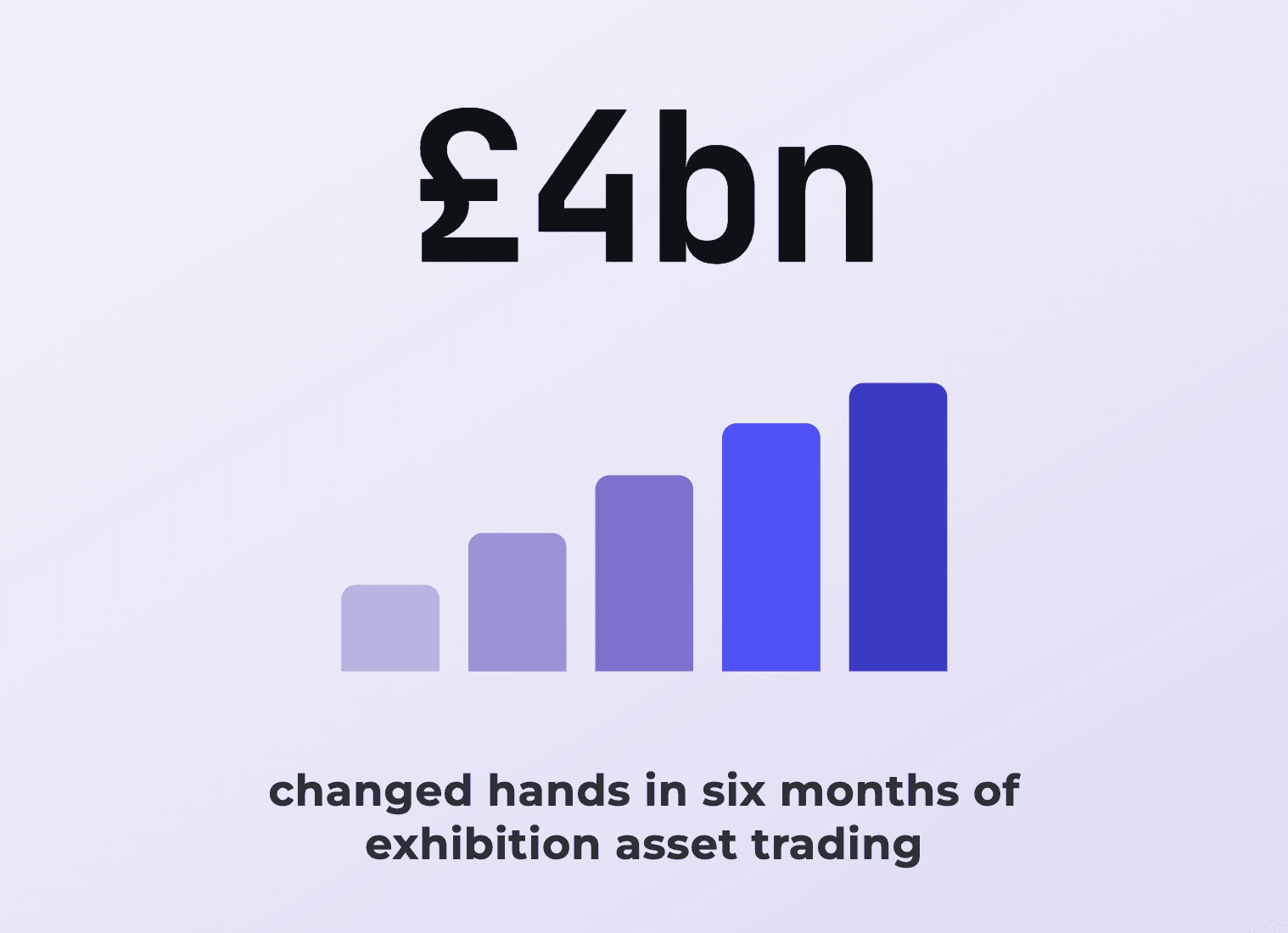
Growth of that quality attracts buyers. More than £4bn of deal value attached to B2B event assets in the first half of 2026 alone, as Exhibition News set out in its analysis of two decades of private equity in events: CloserStill at £1.35bn, Emerald and Questex at $2bn, Hyve at $1.8bn.
So this is not consolidation of a declining industry into fewer survivors. It is capital moving toward reliable, cash-generative businesses with recurring revenue and pricing power. Which is a compliment to the format and a problem for anyone competing against the resulting entities.
What scale actually buys
It is worth being concrete about the advantage, because the abstract version ("they have more resources") is not actionable.
Scale buys three things a single show cannot fund on its own.
Audience data across a portfolio. An operator running forty shows knows which of its attendees appear at more than one, what sequence they move through, and which adjacent events convert. A single show sees only its own list, and cannot tell the difference between a lapsed attendee and one who simply moved to a different part of their career.
Tooling amortised across events. A registration integration, an attribution model, or an exhibitor scoring system costs roughly the same to build for one show as for forty. At forty the per-event cost is trivial. At one it is often the largest discretionary line in the budget, which is why it usually does not get built.
Cross-promotion between shows that share a buyer. The cheapest acquisition channel in events is an audience that already trusts a neighbouring event from the same operator. An independent has to buy that attention. A portfolio already owns it.
Each of those compounds annually. That is the actual mechanism by which the gap widens, and none of it requires the larger operator to run a better show.
The flip became the hold
There is a detail in the private equity analysis that changes what organisers should expect, and it deserves more attention than the headline deal values.
The historic pattern in this sector was acquire, optimise, exit within a familiar horizon. The framing was that ownership was temporary, which meant the operating changes were often cosmetic, aimed at making the asset presentable rather than fundamentally different.
The shift toward holding assets longer changes the calculus. An owner planning to hold will invest in things that pay back over years rather than quarters: platform migrations, data infrastructure, audience systems. Those are exactly the investments that produce durable operating advantage, as opposed to the margin trimming that shows up quickly in a sale document.
For an independent competitor this is worse news than a quick flip would have been. A short-term owner is a distracted competitor. A long-term owner is a patient one, building capability you will still be facing in five years.
What a portfolio cannot buy
This is where the picture stops being one-directional, and it is worth being precise rather than reassuring.
What scale cannot manufacture is proximity to one audience. Knowing the twelve people who actually decide whether a sector shows up. Understanding why a particular category of exhibitor is unhappy this year in a way that has nothing to do with your show. Being able to call someone and get a straight answer about whether a rumoured competitor launch is real.
That knowledge is not in a CRM and does not transfer in an acquisition. It lives in relationships accumulated over years by people who work on one thing.
It is also, quietly, the input that portfolio operators most struggle to replicate. Scale creates distance. A portfolio manager overseeing a dozen shows cannot hold twelve sectors in their head at the depth a dedicated organiser holds one.
So the independent advantage is real. The problem is that it is not automatically decisive, because proximity only converts into commercial outcome if you can act on it faster than the larger operator can act on its data. Knowing your audience better is worth nothing if it takes you six weeks to do something about what you know.
Where independents are actually losing
In practice the gap does not show up where organisers expect it.
It rarely shows up in the quality of the event. Independent shows are frequently better on content, atmosphere and community precisely because of the proximity described above.
It shows up in the operating layer around the event. Anyone weighing which shows to back next year is running the same comparison, which is the question behind SISO CEO Summit versus ECEF and our wider look at which event industry conferences are worth attending in 2026. Response time on an exhibitor query. Whether the renewal conversation happens before or after the exhibitor has already reallocated budget. Whether anyone noticed that a category of attendee dropped 20% this year while total registration held flat. Whether the follow-up after the show went out in three days or three weeks.
Every one of those is a capability question rather than a talent question, and every one is where amortised tooling gives the portfolio operator an advantage that has nothing to do with understanding the sector better.
Closing the capability gap without the balance sheet
The strategic question for an independent is therefore narrower than "how do we compete with a portfolio". It is: how do we get portfolio-grade operating capability on a single-show budget.
That question has a better answer in 2026 than it did in 2021, and this is the part worth taking seriously rather than treating as vendor language.
The capabilities that used to require a platform team are increasingly assemblable. Reconciling registration data against exhibitor records, scoring which sponsors are at renewal risk, drafting and tailoring the exhibitor communications, monitoring which sessions are underperforming while there is still time to act, summarising post-show feedback into something a team will actually read. Those were bespoke build projects. Several are now configuration and judgment.
The constraint has shifted accordingly. It used to be engineering budget. It is now whether anyone on the team is set up to connect these systems and, more importantly, to keep looking at what they produce.
That is what AI-native means in this specific competitive context. We set out the full version of that argument in why TalkValue is poised to replace the traditional B2B event marketing agency. Not that an independent show uses AI to write its emails faster, which changes nothing about the structural gap. That a single show can now run the operating layer a forty-show portfolio runs, without a forty-show budget, and pair it with the audience proximity the portfolio cannot buy.
That combination is genuinely difficult to compete with. It is also not automatic, and the window in which it is available at low cost is open now rather than indefinitely.
What to do before the next renewal cycle
Three moves, in the order they pay back.
Find out what your data can already tell you. Most independent organisers are sitting on several years of registration and exhibitor records that have never been looked at longitudinally. Which exhibitors renewed three years running and then stopped. Which attendee categories are growing while the headline number stays flat. This costs nothing but attention and it is the single highest-yield thing on the list.
Move the renewal conversation earlier. The structural advantage of proximity only pays if you use it before the budget is allocated elsewhere. Knowing an exhibitor well and calling them in November is worth less than knowing them moderately and calling them in July.
Pick one operating gap and close it properly. Not five. The teams that make progress here fix one thing completely, usually the one that costs the most attention per week, and then use the freed attention on the next one. The teams that stall try to modernise everything at once and finish nothing before the next show cycle consumes them.
Consolidation is not a verdict on independent shows. It is a statement that this sector produces reliable returns, which is good news for everyone in it. But it does change who you are being compared to, and the comparison now happens on operating capability rather than on how well you know your industry. That part is winnable, and it is worth being deliberate about winning it.
If you run an independent show and want to talk through closing the operating gap without a portfolio budget, book a call with TalkValue.

FAQ