Adoption is finished as a story. Nearly three in four marketers now use AI every day, and fewer than one in ten were trained by their company. The result is a category of output that looks finished and is not, and the cost of it lands on whoever receives the work rather than whoever sent it.
Most teams still describe their AI problem as an adoption problem. Getting people to use the tools, choosing which licences to buy, persuading the sceptics.
That framing is roughly two years out of date. Adoption already happened, quietly and without most organisations planning it. What did not happen was teaching anyone how to use what they adopted.
The gap between those two facts is now measurable, and it produces a specific and expensive kind of output.
The adoption argument is over
Social Media Examiner's 2026 research on small business AI use found that 73% of marketers now use AI daily. Two years earlier the figure was 37%.
That is close to doubling in twenty-four months, and it puts daily AI use in the same category as email or a browser. Something that is simply present in the working day rather than a project with a rollout plan.
Any strategy that still treats adoption as the objective is solving a problem the market solved on its own.
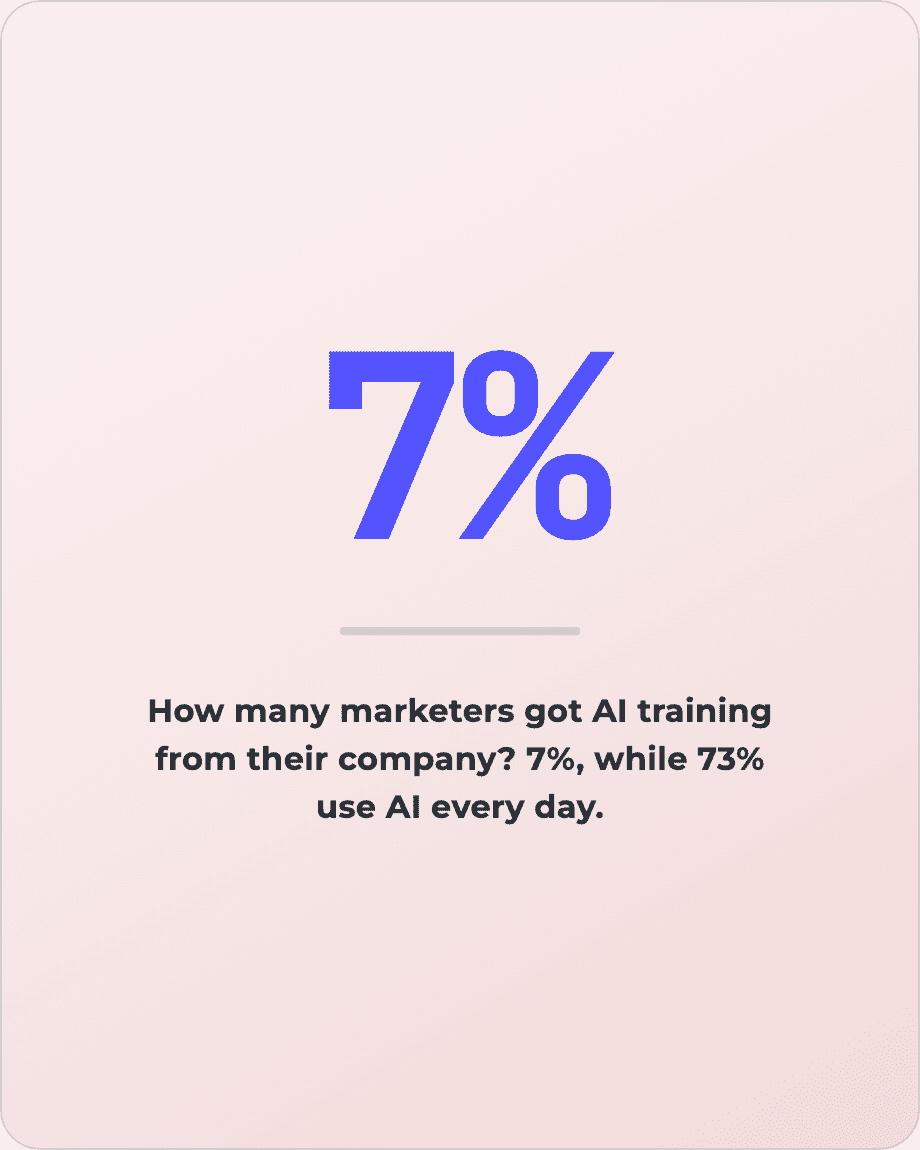
The same research found that 85% of marketers learned to use AI by experimenting on their own. Only 7% received training provided by their company.
Read those two numbers together with the first one. Nearly three quarters of marketers use these tools every working day, and fewer than one in fourteen was ever shown how.
This is unusual. Organisations that would not let someone touch a CRM without onboarding have allowed a far more consequential tool to enter every desk with no instruction at all. The tool arrived through the browser rather than through procurement, so it never triggered the process that normally attaches training to software.
It is worth sitting with how strange that is. Most professional tools carry an implicit contract: the organisation provides the tool and the competence to use it, and in exchange it gets to hold people to a standard. AI broke that contract in one direction. The tool spread without the competence, and because it spread through individual initiative rather than a rollout, no one owns the standard. Ask a marketing team who decides what good AI use looks like in their function and you will usually get a pause rather than a name.
Self-teaching produces confident guessing
Learning by experiment works well for discovering what a tool can do. It works badly for discovering what a tool should do.
MarTech reported in June 2026, citing Asana's State of AI at Work research, that only 19% of knowledge workers say they have clarity on which tasks AI should handle within their role. Four fifths are making that judgement call fresh, every time, with no shared standard and no way to check whether they got it right.
That is the actual skills gap, and it is not a prompting gap. Prompt quality determines how good the output is. Task selection determines whether the output should have existed. A team can be excellent at the first and reckless at the second.
The bill arrives as workslop
The consequence has a name now. MarTech's coverage describes workslop: AI output that looks finished and is not, passed to a colleague who then has to reconstruct it.
The measured figure comes from Stanford research cited in the same piece, first published in Harvard Business Review in September 2025 and followed up in January 2026: 40% of employees had received workslop in the previous month, and each instance cost just under two hours to clean up.
Two hours is not a rounding error. It is most of a morning, spent by someone who did not create the problem, on work that had already been marked complete.
Why this cost stays invisible
Here is the structural reason workslop persists in organisations that are otherwise disciplined about efficiency.
The time saved lands on the sender. The time lost lands on the receiver.
Someone who produces a draft in six minutes rather than forty has a visible, personal, immediately felt gain. The colleague who spends two hours working out which parts of that draft are real absorbs a cost that appears in no dashboard and is attributed to no tool.
Every individual in that exchange is behaving rationally. The organisation still loses. This is the same accounting problem described in the gap between adopting AI and running it, except that here the hidden cost is human hours rather than integration work.
What this looks like on an event team
Event marketing has a particular exposure to this, because so much of the work is assembly rather than authorship.
Exhibitor communications, session descriptions, speaker bios, sponsor one-pagers, attendee segments, post-show reports. These are exactly the tasks that AI handles fluently enough to look complete, and exactly the tasks where being subtly wrong is expensive.
A session description with a slightly wrong time is not a draft. It is a support ticket, repeated by every attendee who read it. A sponsor one-pager that inflates a number is not a draft either. It is a conversation with a sponsor about why the number moved.
The pattern to watch for is not bad output. It is output that is confident, well formatted, and unverifiable at a glance.
There is also a timing effect specific to events. Show cycles compress toward a fixed date that cannot move, which means the weeks when verification matters most are exactly the weeks when nobody has time for it. A rebuild that costs two hours in March costs considerably more in the week before doors open, and that is precisely when the volume of assembled material peaks.
Why prompt training does not fix it
The instinct when a team produces poor AI output is to train them on prompting. It is the visible skill, there is a great deal of material about it, and it is easy to schedule.
It also addresses the wrong failure. A better prompt improves the quality of an output that was already going to be produced. It does nothing about whether that output should have been produced by a model in the first place, and it does nothing about whether anyone checks it before it moves.
Workslop is not usually a prompting failure. It is a handoff failure. The output was plausible, the sender had no way to know it was wrong, and no step existed between the sender and the receiver where the error could surface. Better prompting makes the output more plausible, which in some cases makes the problem worse rather than better, because a more polished artefact invites less scrutiny.
The teams that reduced this did not get better at asking. They got clearer about which outputs required a second pair of eyes before they left the desk.
A test for whether your team has this
There is a quick diagnostic that does not require a survey.
Ask three people who receive work from each other how often they rebuild something they were sent rather than edit it. Rebuilding is the tell. Editing means the artefact was sound and needed adjustment. Rebuilding means the artefact looked sound and was not, which is exactly the two-hour category.
Then ask whether any of them mentioned it to the sender. In most teams the answer is no, because the rebuild is faster than the conversation and the sender is a colleague rather than a supplier. That silence is why the cost never surfaces in any review, and why organisations can carry it for years while reporting that AI has improved their productivity.
Training is the cheapest intervention available
If 7% of marketers have been trained, the marginal return on training is currently enormous, and almost nobody is claiming it.
The useful version is not a prompt library. Prompt libraries answer the question these teams already answer well. The useful version answers the question they answer badly, which is which work should go to a model at all.
That is closer to a decision framework than a course. Which outputs get checked before they move, who does the checking, and what makes a task ineligible for automation in the first place. Teams that have written this down produce less workslop, not because their prompts are better, but because fewer bad candidates enter the pipeline.
The related question of which skills gain value as this settles is covered in what AI is doing to marketing roles and budgets.
The judgement half did not get automated
The through line across all of this is that AI absorbed the production half of marketing work and left the judgement half exactly where it was.
Drafting, formatting, summarising, restructuring, translating. All faster. Deciding what is true, what matters, what a sponsor will react badly to, what has to be right the first time because there is no second time. All unchanged.
The teams struggling right now are the ones that assumed the second category shrank alongside the first. It did not. If anything it grew, because there is now more output flowing through it.
That division is the thing we build around, and it is set out in more detail in what an AI-native agency actually is.
If your team adopted AI without ever deciding which work it should touch, that conversation is worth having before the next show cycle. Book a call and we will go through where the checking should sit.


FAQ