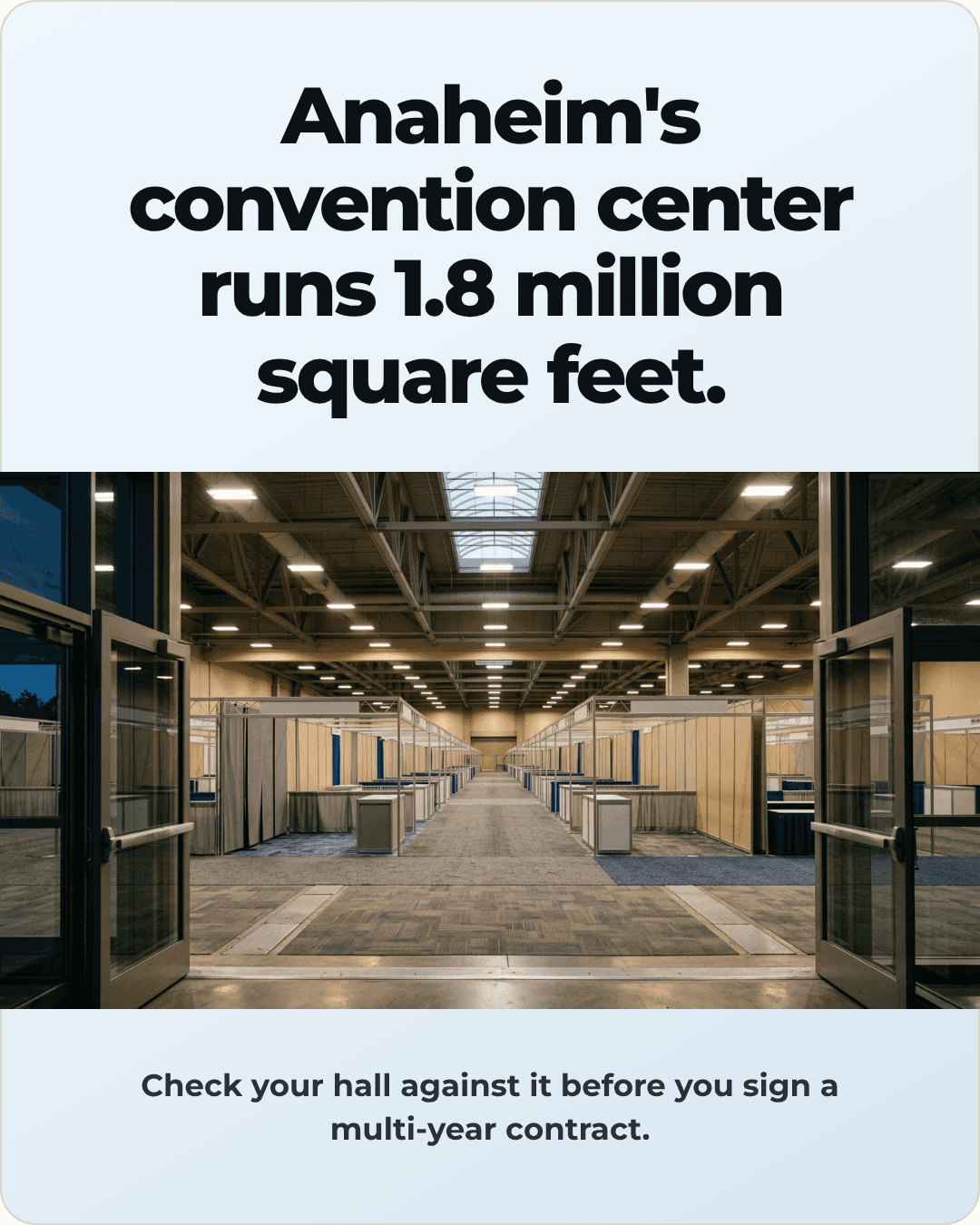
Anaheim's convention center runs 1.8 million square feet with 23,000 hotel rooms within two miles. Toronto's Metro Toronto Convention Centre runs more than 442,000 square feet with two airports serving approximately 200 destinations, and publishes no room count. Austin publishes a $1.6 billion redevelopment reopening in 2029 and a gate expansion that lands around 2030. All three figures come from PCMA Convene, September 2026. You get the three variables to pull for your own host city before a multi-year contract goes to signature.
Most multi-year venue decisions get made on the strength of a site visit and a rate card. The hall looked big. The hotel block cleared. The sales team was responsive. Three years later the show is locked into a city where the exhibit hall caps your floor plan, the hotel supply pushes a third of your attendees twenty minutes out, and the airport has one European connection.
The three destination pitches published by PCMA Convene in September 2026 show what the cities themselves think matters. They do not pitch the same three things. Anaheim leads with hall size, hotel rooms and airports together. Austin leads with air access and a redevelopment budget. Toronto leads with hall size and air access, and names no hotel count at all. Read across the three and you get the actual shortlist of variables a host city can control, and the ones it quietly leaves out.
That omission is the useful part. When a destination marketing organisation writes its own case, it puts forward what it can defend with a number. What it describes in adjectives instead of figures is the part you check yourself, on site, before the contract runs past one cycle.
Anaheim pitches three numbers at once, and that combination is rare
PCMA Convene, September 2026, reporting on Visit Anaheim's white paper Attraction Distraction?, gives the Anaheim Convention Center at 1.8 million square feet, described as the largest convention center on the West Coast and LEED certified. The same piece puts more than 23,000 hotel rooms within two miles, names four convention hotels around the campus, the Westin Anaheim Resort, the Sheraton Park Hotel at the Anaheim Resort, the Hilton Anaheim and the Anaheim Marriott, and names four airports within reach: John Wayne, Long Beach, Los Angeles International and Ontario International.
Convene reports that infrastructure supports more than 140 meetings and conventions annually, and that Anaheim ranks No. 3 on TSNN's Top 10 Trade Show Destinations.
Three variables, all with figures attached, in one pitch. Square footage, rooms within a defined walking radius, and airport count. The white paper's argument, as Convene summarises it, is that a destination built to absorb millions of leisure visitors carries mature transportation, substantial hotel capacity, safety infrastructure and experienced hospitality partners as a by-product. The attraction is not competition for attention. It is the reason the plumbing exists at that scale.
The claim worth testing against your own city is the two-mile radius. Anaheim's figure is not 23,000 rooms in the metro area. It is 23,000 rooms within two miles of the hall. Most cities can produce a large regional room count. Fewer can produce one bounded by a distance that maps to a walk or a five-minute shuttle. When you pull your host city's number, ask what radius it is measured from, and whether the four largest properties sit inside it or outside.
Austin pitches a date and a budget, which is a different kind of promise
PCMA Convene, September 2026, in a sponsored piece from Visit Austin, reports that Unconventional ATX, the $1.6 billion redevelopment of the Austin Convention Center, is on time and on budget for a grand reopening in 2029. The project targets certification as the world's first Zero Carbon Certified convention center, with an all-electric building including the kitchen, powered by 100 percent renewable energy, and is also pursuing LEED Platinum.
Note what is absent from that sentence. Convene's Austin piece gives no square footage for the rebuilt hall. It gives a cost, a target year and two certification goals. For a show signing a 2027 contract, a 2029 reopening is not a venue. It is a construction site with a reopening date.
The air access figures in the same piece are more immediately usable. Convene reports Delta launching a nonstop from Austin to Paris in March 2027, adding to existing direct connections to continental Europe via British Airways, Lufthansa and KLM. On the ground, Delta and Southwest are investing in Austin-Bergstrom International, with a new terminal of 20-plus gates expected around 2030, followed by 12 additional gates planned for 2030 to 2035.
That is a gate count you can hold against your own airport. It is also a timeline that sits past most three-year contract cycles. Twenty-plus gates around 2030 and twelve more between 2030 and 2035 tells you where the city will be at the end of a decade, not where it is when your attendees land next spring.
Convene's Austin piece also lists hotel and off-site capacity in specifics: 1 Hotel Austin with more than 10,000 square feet of flexible meeting space, and Hotel Trinity launching in late 2026 as the city's only downtown Marriott Autograph Collection hotel with 258 luxury rooms. Plus a new AEG arena opening 2027 and Austin City Limits' Moody Theater as off-site options. Those are venue-level numbers, not a city-wide room count. Different scope, different use.
Toronto pitches the hall and the airports, and leaves the hotels in words
PCMA Convene, September 2026, on Destination Toronto's 100th anniversary, reports the Metro Toronto Convention Centre at more than 442,000 square feet of meeting and exhibit space, with 77 meeting rooms, multipurpose ballrooms and a theater. Two international airports connect Toronto to approximately 200 destinations across 55 countries, and more than 135 million people live within a 90-minute flight.
On hotels, Convene's Toronto piece says the MTCC's central location puts attendees within walking distance of hotels, restaurants, entertainment and attractions. No room count. No radius. Walking distance, stated in words.
That is not a failure of the pitch. It is a signal about what Toronto leads with. The city's numbers are the hall, the airports, the destination reach and the catchment population. Convene also reports Toronto hosting six FIFA World Cup 2026 matches and PCMA's CEMA Summit this year, Destination Toronto opening new offices in the U.K., and 6ix, its AI-powered travel tool, alongside the 6ix Stack event-support programme. And it reports that more than half of Toronto's population was born outside Canada, with approximately 250 ethnicities and 180 languages and dialects represented.
If your programme depends on a large contracted room block at walking distance, Toronto's published case does not answer that question for you. You have to ask it directly. The city answered the hall question and the air question with figures. It answered the hotel question with a description.
The three cities disagree on which variable leads, and that tells you what to check
Put the three side by side and the pattern holds. Anaheim: hall square footage, rooms within two miles, four airports. Austin: new nonstop to Paris, gate expansion timeline, redevelopment cost and reopening year. Toronto: hall square footage, two airports serving approximately 200 destinations across 55 countries, 135 million people within a 90-minute flight.
Every one of the three leads with air access in some form. Two of the three lead with hall square footage. One of the three publishes a hotel room count with a radius attached.
That distribution is your checklist, inverted. Air access is the variable every destination expects to be measured on, which means it is the one most likely to be reported honestly and comparably. Hall square footage is the second. Hotel supply at a defined distance from the hall is the one where the reporting thins out, which makes it the one you verify yourself.
Compare the two published hall figures directly. Anaheim's 1.8 million square feet against Toronto's more than 442,000 square feet of meeting and exhibit space, both as reported by PCMA Convene in September 2026. That is roughly a four-fold difference in total space between two cities that both appear in destination coverage as serious business-events hosts. A show that fits comfortably in one has no business assuming it fits in the other. The number is not a ranking. It is a constraint on your floor plan.
Where this lands for your show
Here is the action item for the whole piece: before your next multi-year contract goes to signature, pull three figures for your host city and write them on one page. Hall square footage. Hotel rooms within a stated radius of that hall, with the radius named. Airport count and the number of destinations served. Then hold that page against Anaheim's 1.8 million square feet and 23,000 rooms within two miles, Toronto's more than 442,000 square feet and approximately 200 destinations across 55 countries, and Austin's 20-plus new gates expected around 2030, all as PCMA Convene reported them in September 2026.
You are not looking to find a winner. You are looking for the variable your city does not report. That is the one that will surprise you in year two.
Anaheim's pitch is built for a show that has outgrown its hall and needs the block to stay walkable. More than 140 meetings and conventions annually, per Convene, tells you the operational muscle is exercised constantly rather than seasonally.
Toronto's pitch is built for a show whose growth depends on international attendance. Approximately 200 destinations across 55 countries, and 135 million people within a 90-minute flight, are inbound numbers. If your registration curve is driven by long-haul delegates and regional drive-in traffic in equal measure, those two figures matter more than a hotel count does.
Austin's pitch is built for a show planning past 2029. The $1.6 billion redevelopment with a 2029 reopening, the Paris nonstop in March 2027, the AEG arena in 2027, Hotel Trinity in late 2026. Signing Austin for 2027 and signing Austin for 2030 are two different decisions supported by two different sets of facts, and the Convene piece makes that split visible rather than hiding it.
A contract cycle outruns most of the numbers in a destination pitch
The timeline problem is structural. A multi-year venue contract typically commits you before the infrastructure in the pitch exists.
Convene's Austin figures make the gap explicit. A new terminal with 20-plus gates expected around 2030. Twelve additional gates planned for 2030 to 2035. The convention center reopening in 2029. A show signing a three-year deal in 2027 runs 2027, 2028, 2029, and lands inside the reopening year with none of the gate capacity in place.
That is not an argument against Austin. It is an argument for matching the tenor of your contract to the tenor of the city's published dates. When the pitch is built on what opens in 2029 and 2030, a contract that ends in 2029 buys you the construction and none of the benefit. A contract that starts in 2030 buys the opposite.
Anaheim's and Toronto's figures are present tense. The 1.8 million square feet exists. The 442,000-plus square feet exists. The four Anaheim airports and the two Toronto airports are operating. Anaheim's forward-looking items in the Convene piece, OCVIBE's 100-acre mixed-use district and DisneylandForward, are described as multi-billion-dollar developments without the year-by-year detail Austin publishes. The pitch is weighted toward what is standing.
When you build the comparison page, mark each figure present or future. The page gets shorter and more honest fast.
The services layer is the part with no numbers, and it still decides your on-site week
All three Convene pieces describe a support function. Visit Anaheim, per Convene, acts as an extension of planners' teams with site selection, hotel sourcing, venue recommendations, promotional support and on-the-ground coordination. Destination Toronto supports planners with site visits, venue sourcing and the 6ix Stack, its integrated event-support programme, plus 6ix, its AI-powered travel tool. Visit Austin's piece, sponsored by Visit Austin, describes the developments rather than the service layer.
None of those descriptions carries a figure. No response times, no staffing levels, no volume of shows handled per coordinator. That is not unusual in destination marketing, and it is exactly why the services layer is the part you test in person rather than on paper.
There is a second thread in the Toronto piece worth noting for programme design. Convene reports Toronto's strengths in artificial intelligence, life sciences, financial services, technology and advanced manufacturing, and that Destination Toronto connects planners with local experts, research institutions and business communities. For a show that builds content around a sector, the speaker pipeline in the host city is a real input. It is also one of the few things in these three pitches that touches programming rather than logistics. The same sector logic shows up in how AI has moved from a conference track to a category that gets acquired, which changes who you can put on stage in a city with a dense research base.
What to do with the page once you have written it
The comparison page is worth something only if it changes a decision. Three ways it does.
It sets your floor plan ceiling before you negotiate. If your show needs a footprint that the hall cannot carry without spilling into a second building, you know that from the square footage line, not from a site visit where the hall looked adequate while empty.
It tells you where your attendee travel cost lands. Toronto's approximately 200 destinations across 55 countries and Anaheim's four airports are not interchangeable with a city served by one airport and a hub connection. The difference shows up in your attendees' expense reports, and eventually in your registration numbers.
It exposes the hotel question. Anaheim publishes 23,000 rooms within two miles. Toronto describes walking distance without a count. Visit Austin's piece publishes individual properties, 258 luxury rooms at Hotel Trinity in late 2026, and more than 10,000 square feet of flexible meeting space at 1 Hotel Austin, rather than a city-wide room count. Three different disclosure levels for the same variable. If your city is in the second or third category, the number is obtainable. You just have to ask for it with the radius specified.
Venue spend and venue choice sit next to each other in the same budget conversation. What three venues reported after spending capital on the room itself belongs in the same file as your host-city comparison, because the question is identical: what did the physical space return.
The destinations are competing on measurable infrastructure, which works in your favour
The three PCMA Convene pieces from September 2026 read as marketing. They are also, read together, a disclosure standard forming in public. Anaheim published square footage, a room count with a radius and four named airports. Toronto published square footage, meeting room count, two airports, a destination count and a country count. Austin published a redevelopment cost, a reopening year, gate counts and dates, and named properties with room and meeting-space figures.
Cities that publish get compared. Cities that describe get questions. That dynamic pushes the whole category toward figures, and the shows that benefit are the ones that ask for figures consistently, in the same units, from every city on the shortlist.
The comparison only works if the units match. Square feet against square feet. Rooms within a named radius against rooms within the same radius. Destinations served against destinations served. When a city answers a numbers question with an adjective, that is the answer, and it goes in the column too.
Run the page for every city you are considering, including the incumbent. The incumbent is the one you have never measured, because the relationship predates the question. The broader read on where the event industry's numbers actually sit heading into 2026 gives you the surrounding context for that exercise.
When the page is done and one city is missing the variable that matters most to your show, that is the conversation to have before signature rather than after. If you want a second read on the comparison before it goes to your board, book a call.


FAQ