
For senior event and exhibition leaders, the core challenge is not a lack of data; it is the absence of decision clarity. Most organizations are swimming in metrics from disparate systems—CRMs, analytics tools, and registration platforms—yet they struggle to connect operational activities to strategic revenue outcomes. The prevailing industry belief is that more dashboards or another integration will solve this fragmentation. This leads to a patchwork of technologies that expertly report on what happened but consistently fail to explain why or guide what comes next.
This disconnect is not a minor inconvenience; it is a structural gap that sits at the heart of the modern event business. It obscures the behavior of high-value attendee cohorts, conceals monetization opportunities within sponsor packages, and prevents strategic alignment between marketing, sales, and operations. It forces revenue-focused leaders to make high-stakes decisions based on assumptions and incomplete signals rather than unified intelligence, making it nearly impossible to attribute specific investments to financial results. The consequence is a cycle of reactive planning and missed revenue potential.
This analysis moves beyond surface-level feature comparisons. We will evaluate the best event management software not as mere tools, but as potential decision infrastructures. Our focus is on each platform's capacity to reconcile fragmented data into a single source of truth, thereby translating visibility into decisive action and measurable growth. The goal is to equip leaders with a framework for selecting a strategic partner capable of closing the gap between operational noise and revenue clarity.
The Illusion of Visibility: Why Your Tech Stack Is Hiding the Truth
The modern event portfolio runs on a complex assembly of software. A typical stack might include a registration platform, a mobile app provider, a CRM, a marketing automation system, and various analytics dashboards. Each system generates a torrent of data, creating an illusion of comprehensive visibility. We can track registrations, session attendance, app engagement, and sponsor lead scans. However, these metrics exist in isolated silos, representing disconnected fragments of a larger, more complex picture.
The structural problem is that these systems were not designed to speak the same language. The data from a registration platform may categorize an attendee by ticket type, while the CRM tracks them by sales-qualified lead status, and the mobile app logs their engagement with content. Without a deliberate and sophisticated process of reconciliation, it becomes impossible to build a unified profile of an attendee or an entire cohort. This failure to connect data points has direct and severe revenue consequences. For example, an organizer cannot definitively link a sponsor's high lead count to the specific pre-event marketing campaign that attracted the most relevant buyers, preventing the optimization of future sponsorship packages.
This data fragmentation forces decision-makers into a defensive posture. Instead of proactively identifying which attendee segments are most likely to convert to high-tier tickets next year, teams are left analyzing past performance with no clear path to influence future outcomes. The result is a business that is always looking in the rearview mirror, reacting to trends rather than shaping them. The promise of "data-driven decisions" remains unfulfilled because the underlying data is not structured for decision-making at all—it is structured for reporting.
1. TalkValue
TalkValue emerges as a distinct and powerful choice for conference and exhibition organizers who prioritize measurable growth and operational efficiency. It positions itself not merely as another tool in the event tech stack, but as an AI-native agency and toolkit designed to unify disparate systems and data into a single, actionable growth engine. This approach directly addresses a common, significant pain point for event professionals: fragmented data across platforms like Eventbrite, Luma, Whova, and HubSpot, which often results in missed opportunities and manual-intensive workflows.
By creating a unified source of truth, TalkValue layers on AI-powered automations that address the entire event lifecycle. This extends from registration and check-in to networking, sponsor visibility, and post-event follow-up, turning what are often siloed activities into a connected, revenue-focused operation. It's a platform built for decision-makers who need to move beyond simple dashboards and see concrete returns on their technology investment, making it one of the best event management software solutions available for this purpose.
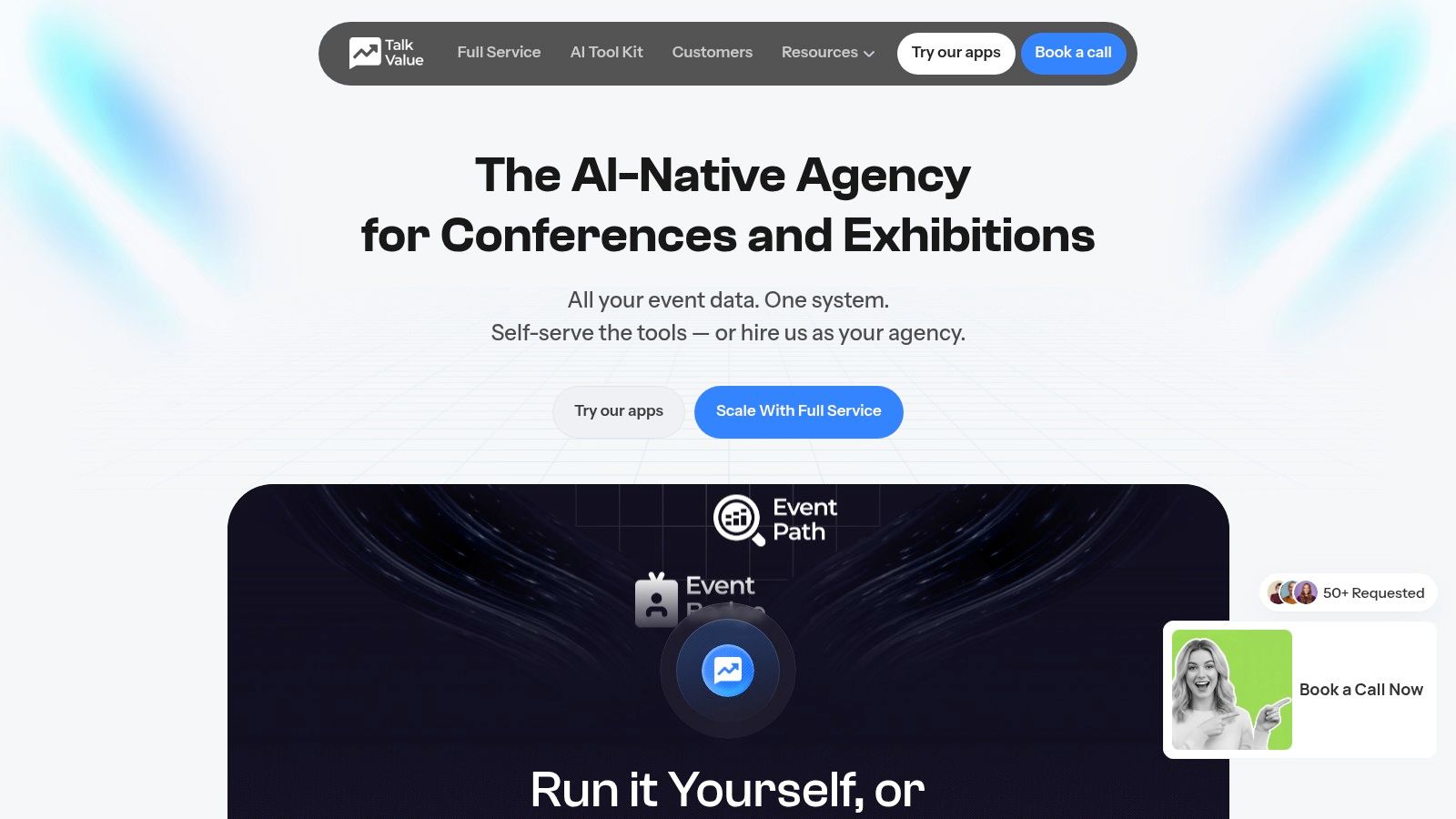
Why TalkValue Stands Out
The core differentiator for TalkValue is its "AI-native" model. Here, AI isn't an add-on feature; it's the fundamental operating system. This structure enables a level of automation and insight generation that bolt-on AI features often cannot match. For instance, its system can automate personalized LinkedIn outreach with a 50% reply rate, as demonstrated at the Knowledge Graph Conference, or eliminate wasted ad spend by optimizing audience targeting, as seen with the Humanic AI Summit.
Another significant advantage is its flexible engagement model. Teams can choose between a self-serve Growth AI Toolkit for hands-on management or opt for the full-service agency for end-to-end planning, execution, and scaling of AI-first events. This dual offering makes its capabilities accessible to organizations with varying levels of internal resources.
Real-World Impact: Customers praise TalkValue for its ability to transform scattered spreadsheets and event data into a cohesive growth engine. The platform's focus on tangible outcomes, such as achieving 40% higher Average Revenue Per Person (ARPP) from repeat attendees and managing over 7,000 frictionless check-ins at KOOM 2025, underscores its practical value.
Key Considerations
Pros:
Unified Event Data + AI: Combines data from major event platforms into one source of truth to automate workflows and surface growth opportunities.
Proven, Measurable Outcomes: Case studies demonstrate tangible ROI, including higher attendee spend, improved outreach reply rates, and significant staff time savings.
Flexible Engagement Model: Offers both a self-serve toolkit and full-service agency support to fit different operational needs.
Practical Enablement: Includes an AI + Events Knowledge Center with playbooks and guides so teams can quickly adopt effective strategies. To better understand these strategies, review their guide on event management best practices.
Cons:
No Public Pricing: Requires contacting TalkValue for a demo and quote, which can slow down the evaluation process for teams with strict budget timelines.
Best for Scale: While powerful, smaller, one-off events might not achieve the same level of ROI without committing to some integration and process adjustments.
Pricing & Access
TalkValue does not publish its pricing online. To receive a custom quote and see the platform in action, interested teams are encouraged to book a call for a personalized demo.
Website: https://trytalkvalue.com
2. Cvent
Cvent is an established, enterprise-grade platform that provides a complete, end-to-end solution for managing complex and high-volume event programs. Its strength lies in handling the entire event lifecycle, from initial promotion and intricate registration paths to onsite execution and post-event analytics. For organizations running large-scale conferences, trade shows, or a portfolio of recurring events, Cvent offers the deep functionality and governance required for professional delivery.
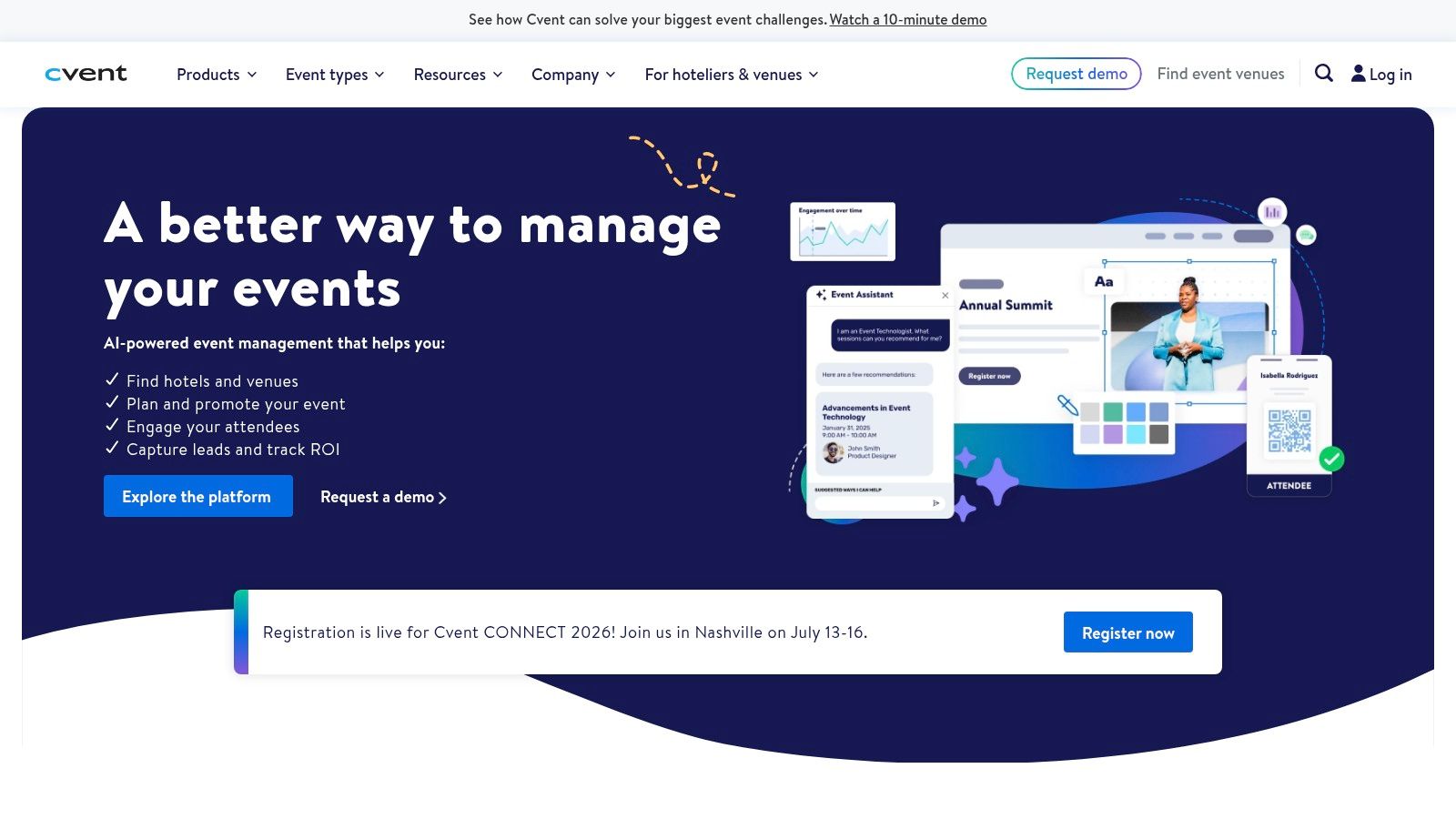
This platform excels where scale and complexity are primary concerns. The registration module supports personalized attendee journeys, complex pricing tiers, and secure payment processing. Its onsite technology stack, OnArrival, is a major differentiator, providing everything from self-service check-in kiosks and on-demand badge printing to lead retrieval for exhibitors and session attendance tracking. The Attendee Hub mobile app keeps participants engaged with networking tools, live Q&A, and gamification.
Analysis & Best-For Scenarios
Cvent is the right choice for large corporations and associations needing a secure, compliant, and all-in-one system with professional services support. It is particularly effective for:
Large, Multi-Track Conferences: Managing hundreds of sessions, speakers, and personalized attendee schedules.
Enterprise Event Programs: When you need to centralize data and maintain brand governance across dozens or hundreds of global events.
Events Requiring Robust Onsite Operations: Its integrated hardware and staffing options (OnArrival 360) ensure a smooth check-in and badging experience for thousands of attendees.
Limitations & Pricing
The platform's extensive capabilities come at a cost. Pricing is quote-based and positioned at the enterprise level, making it a significant investment compared to mid-market alternatives. The admin interface can feel heavy and complex for teams organizing simple, one-off events, potentially leading to a steep learning curve. This focus on enterprise needs makes it less suitable for small businesses or organizations with straightforward event requirements.
Visit the Cvent website to learn more.
3. Bizzabo
Bizzabo positions itself as an "Event Experience OS," designed to support the full spectrum of modern event formats including in-person, virtual, and hybrid. The platform provides a connected ecosystem for organizers to manage event marketing, registration, and execution from a single place. Its key strength is in creating data-rich experiences that connect attendee behavior directly to marketing and sales outcomes, making it a strong choice for revenue-focused teams.
The platform stands out with its deep integration capabilities and onsite technology. Bizzabo’s Klik SmartBadges are a significant differentiator, using BLE wearables for passive attendee tracking, contact exchange, and lead capture. This gives sponsors and exhibitors a clear, measurable view of their ROI. For planners, this hardware provides accurate session attendance data and heat maps of the event floor. These data points flow directly into its native registration, event website, and custom-branded mobile app, which are all part of its unified system.
Analysis & Best-For Scenarios
Bizzabo is an excellent fit for mid-market and enterprise organizations that prioritize data and attendee engagement, particularly those running a mix of event types. It is especially well-suited for:
Hybrid Events: Its unified platform manages both virtual and in-person audiences without needing separate tools.
Data-Driven Marketing Teams: Deep integrations with Marketo, HubSpot, and Salesforce allow for seamless lead and engagement data synchronization.
Events Focused on Sponsor ROI: The Klik SmartBadge system offers exhibitors tangible proof of engagement and lead generation, justifying sponsorship costs.
Limitations & Pricing
While Bizzabo has moved to more transparent, published pricing, its full power comes at a cost that reflects its advanced capabilities. The addition of Klik SmartBadges and associated hardware adds to the overall event budget and introduces operational complexity for setup and distribution. Teams new to such powerful platforms may find that certain features require dedicated enablement and training to use effectively, presenting a learning curve for those accustomed to simpler event management software.
Visit the Bizzabo website to learn more.
4. Stova (formerly Aventri + MeetingPlay + eventcore)
Stova is a full-stack enterprise platform created from the merger of Aventri, MeetingPlay, and eventcore. It is designed to handle complex, multi-faceted event programs with a high degree of customization and service. The platform excels in managing large-scale events that require bespoke registration paths, integrated housing management, and white-glove professional services for execution. For organizations running multi-city roadshows or hosted-buyer events, Stova provides the deep, configurable workflows needed for a seamless attendee and stakeholder experience.
This platform stands out with its ability to manage logistical intricacy. Its registration engine can be tailored for unique attendee journeys and supports global payments in over 40 currencies. A key strength is its integrated hotel and venue management capabilities, offering detailed reporting and room block management within a single system. Furthermore, Stova’s professional services team is a significant asset, offering hands-on support for complex event builds, onsite badge printing, and check-in operations, making it one of the best event management software choices for high-touch programs.
Analysis & Best-For Scenarios
Stova is the ideal solution for global enterprises and associations requiring a powerful, highly customizable platform backed by expert implementation support. It is particularly well-suited for:
Hosted-Buyer and VIP Programs: Creating and managing intricate appointment-setting and personalized itineraries for high-value attendees.
Complex Global Event Portfolios: When you need a single system to manage registration, housing, and onsite logistics across numerous international events.
Events Demanding Bespoke Workflows: Its ability to be configured for non-standard registration and housing requirements is a major advantage.
Limitations & Pricing
The platform's depth and service-oriented model mean it is positioned at the enterprise price point. Pricing is custom-quoted and can become a considerable expense, especially as event volume and complexity increase. While powerful, the admin interface can feel heavier and less intuitive than some newer, mid-market alternatives, which might present a learning curve for teams accustomed to more direct, self-service tools. This makes it less practical for smaller organizations or those with simple event needs.
Visit the Stova website to learn more.
5. Swoogo
Swoogo is a modern event management platform that stands out with its flexible architecture and, most notably, a predictable pricing model. Its core value is offering unlimited events and registrations for a flat, per-user license fee. This approach removes the financial penalty for growth, making it an attractive option for teams that run a high volume of events of varying sizes and need to forecast their total cost of ownership accurately.
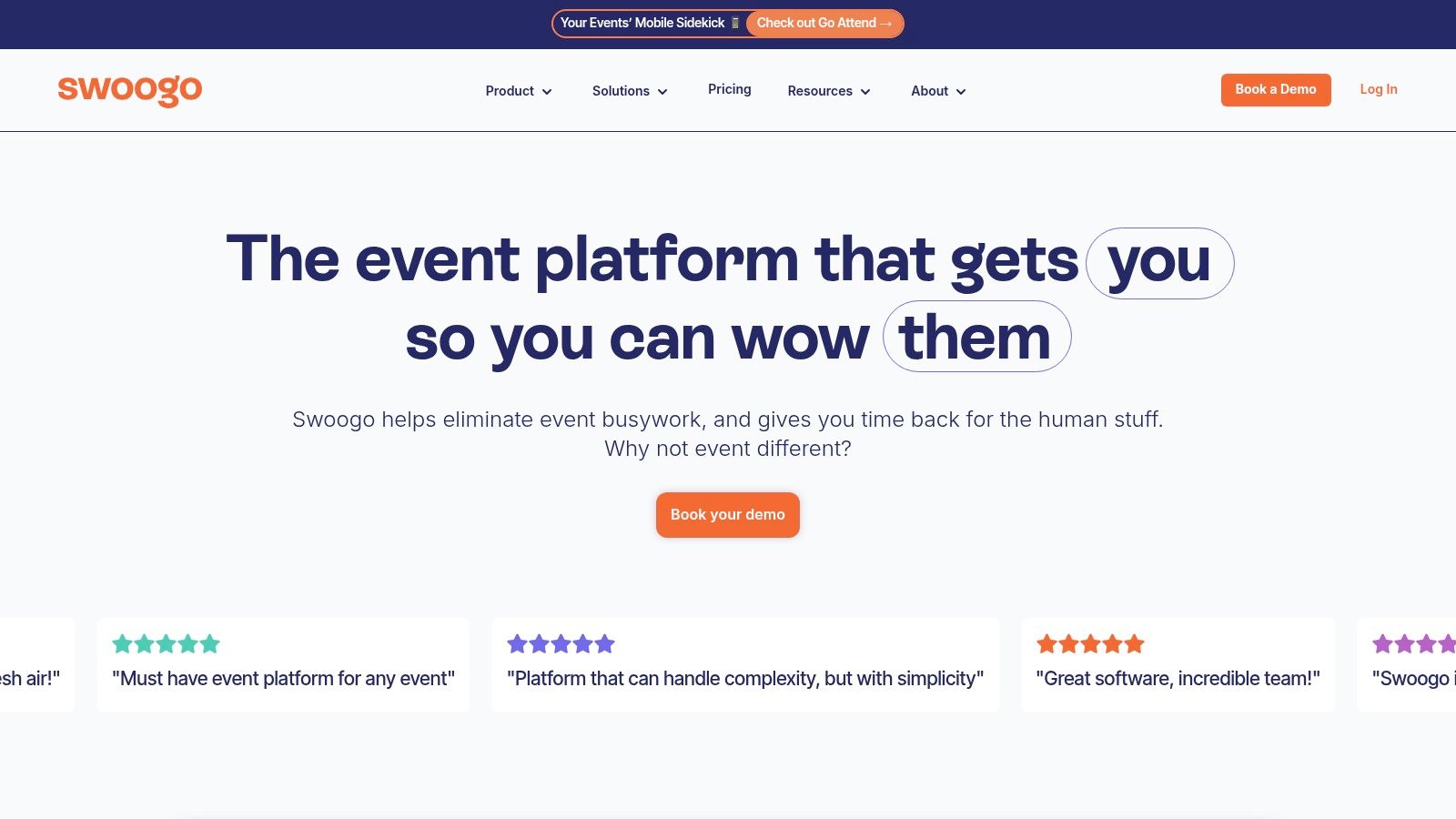
The platform is designed for agility and ease of use, allowing event marketers to build and clone events quickly without deep technical skills. It provides robust registration logic, a drag-and-drop website and email builder, and reliable check-in capabilities. A key strength is its integration-first philosophy; Swoogo maintains over 30 native integrations with major CRM and Marketing Automation Platforms, ensuring clean data flows between systems. Its customer support is also frequently highlighted by users as being exceptionally responsive and human-centric.
Analysis & Best-For Scenarios
Swoogo is the right choice for mid-market to enterprise marketing teams who prioritize budget predictability and operational flexibility over an all-in-one suite. It is particularly effective for:
Teams with High Event Cadence: Organizations running dozens of webinars, field marketing events, and roadshows can scale their activities without incurring per-registrant fees.
Marketers Needing Strong CRM Integration: Its native connections to Salesforce and HubSpot make it a strong component in a best-of-breed marketing technology stack.
Agencies and Internal Teams: The ability to quickly duplicate event templates and maintain brand consistency makes it efficient for teams managing event portfolios.
Limitations & Pricing
While the core platform is powerful, the mobile app is an add-on, meaning teams that require advanced mobile engagement will face additional costs. Its ecosystem for specialized onsite hardware is also smaller compared to enterprise giants like Cvent, which could be a factor for large, complex trade shows. Pricing is quote-based per user license, but it is known for being transparent and predictable, offering a clear alternative to the per-registration models common in the industry.
Visit the Swoogo website to learn more.
6. Eventbrite
Eventbrite is a household name in the event world, acting as both a ticketing platform and a discovery marketplace. Its primary strength is its accessibility and speed, making it an excellent starting point for public, consumer-oriented events like concerts, workshops, and local festivals. Organizers can create a professional-looking event page, set up ticketing, and start selling in minutes, benefiting from Eventbrite’s massive built-in audience.
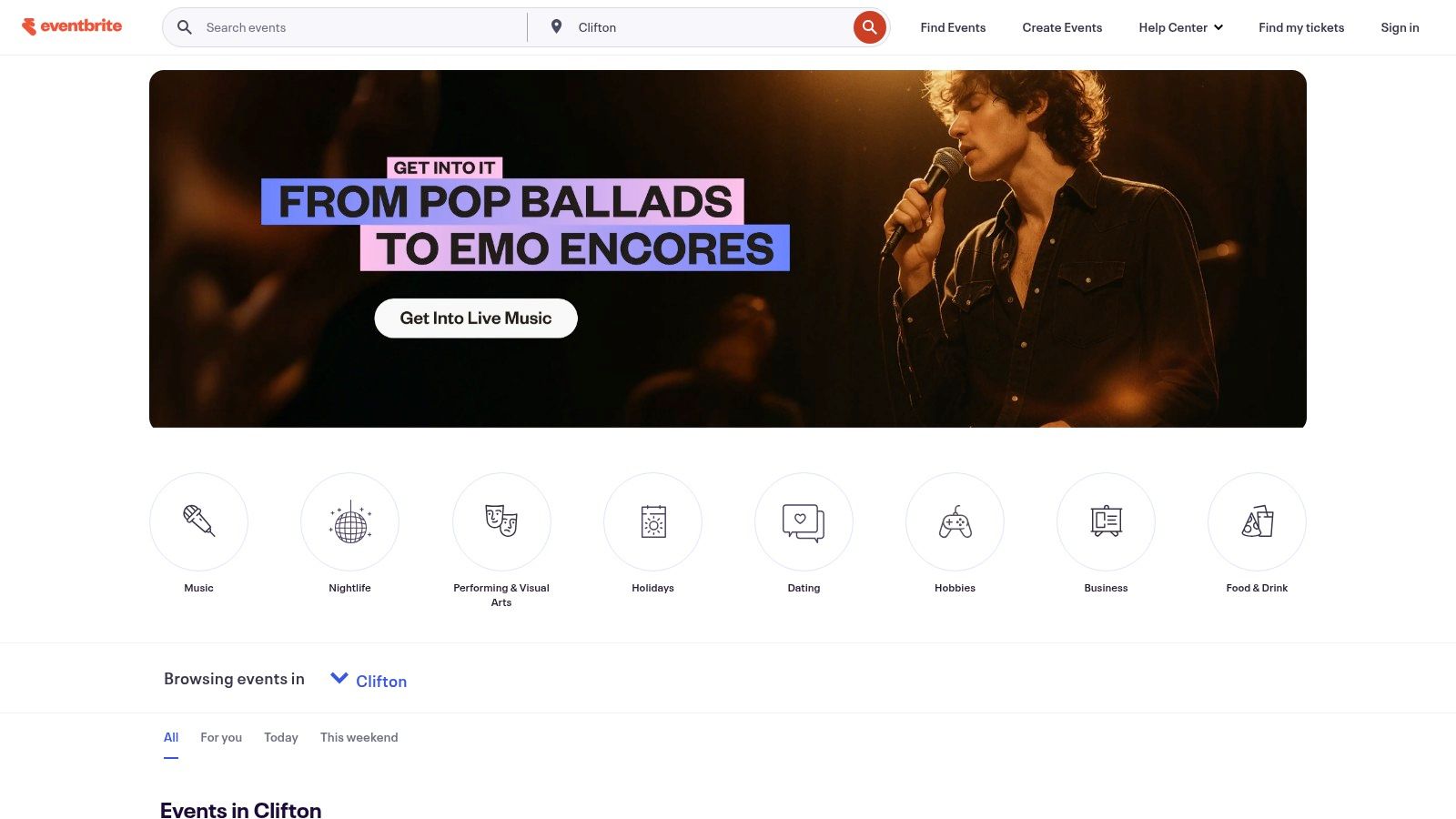
The platform offers core tools needed for straightforward event execution. This includes ticketing with multiple tiers, waitlists, and add-ons; embedded checkout widgets for your own website; and automated email reminders for attendees. The Eventbrite Organizer mobile app provides on-the-go management, including ticket scanning for check-in. For free events, there are no platform fees, which makes it a risk-free choice for community gatherings.
Analysis & Best-For Scenarios
Eventbrite is the go-to solution for organizers who prioritize distribution reach and a quick, simple setup over deep customization. It’s a top contender in the search for the best event management software for specific use cases:
Public-Facing Consumer Events: Its marketplace model is ideal for attracting a broad audience for concerts, food festivals, or charity runs.
Simple Conferences & Workshops: When you need a reliable registration system without complex session tracks or exhibitor management.
Free Community Events: The no-fee structure for free tickets makes it an easy and cost-effective choice for non-profit and community organizers.
Limitations & Pricing
The platform’s simplicity is also its main limitation. It lacks the advanced workflows required for large, complex conferences, such as hosted-buyer programs, detailed speaker management, or intricate approval processes. While straightforward for organizers, its per-ticket fees can become more expensive than some competitors at a larger scale. This makes Eventbrite less suitable for enterprise-level B2B exhibitions or associations needing a more robust, all-in-one system.
Visit the Eventbrite website to learn more.
7. Whova
Whova has become a popular all-in-one event platform, particularly for associations and academic conferences seeking broad functionality without an enterprise-level budget. It delivers a comprehensive toolkit that covers the core event lifecycle, from registration and website creation to an established mobile app and onsite services. Its strength is providing a wide array of features, making it a strong contender in the mid-market.
The platform’s registration module handles essentials like dual pricing for early-bird and regular tickets, along with fee management. However, the event app is where Whova often stands out to organizers, offering networking features, agenda management, announcements, and integrated lead retrieval for exhibitors. A unique offering is the MicroEvents add-on, which allows organizations to manage a series of smaller, recurring events under an annual plan, providing value for groups with a busy event calendar.
Analysis & Best-For Scenarios
Whova is an excellent choice for mid-sized conferences, association meetings, and educational events that need a reliable, feature-rich mobile app and straightforward registration at a competitive price. It is particularly effective for:
Academic and Association Conferences: Its strong networking features and easy-to-navigate agenda are well-suited for this audience.
Organizers Needing an All-in-One Solution: Teams that want a single platform for registration, app, and basic onsite check-in without complex integrations.
Events with Active Exhibitors: The built-in sponsor showcases and lead retrieval tools provide clear value for partners.
Limitations & Pricing
While Whova is often free for free events, its platform pricing for paid events is quote-based and requires a conversation with their sales team. The user experience of the mobile app, while functional, is quite standardized and offers limited deep customization compared to bespoke app development. This makes it a trade-off: you get a broad feature set quickly, but with less control over the final look and feel, which might not suit brands with very strict design guidelines.
Visit the Whova website to learn more.
8. Swapcard
Swapcard is a modern event platform designed for organizations running a portfolio of events, particularly those with a strong exhibition or trade show component. Its core strength is in fostering AI-powered networking and demonstrating clear exhibitor ROI. The platform operates on an annual license model, making it a strategic choice for multi-event programs rather than for single, one-off conferences. This approach encourages long-term community building and data continuity across an event calendar.
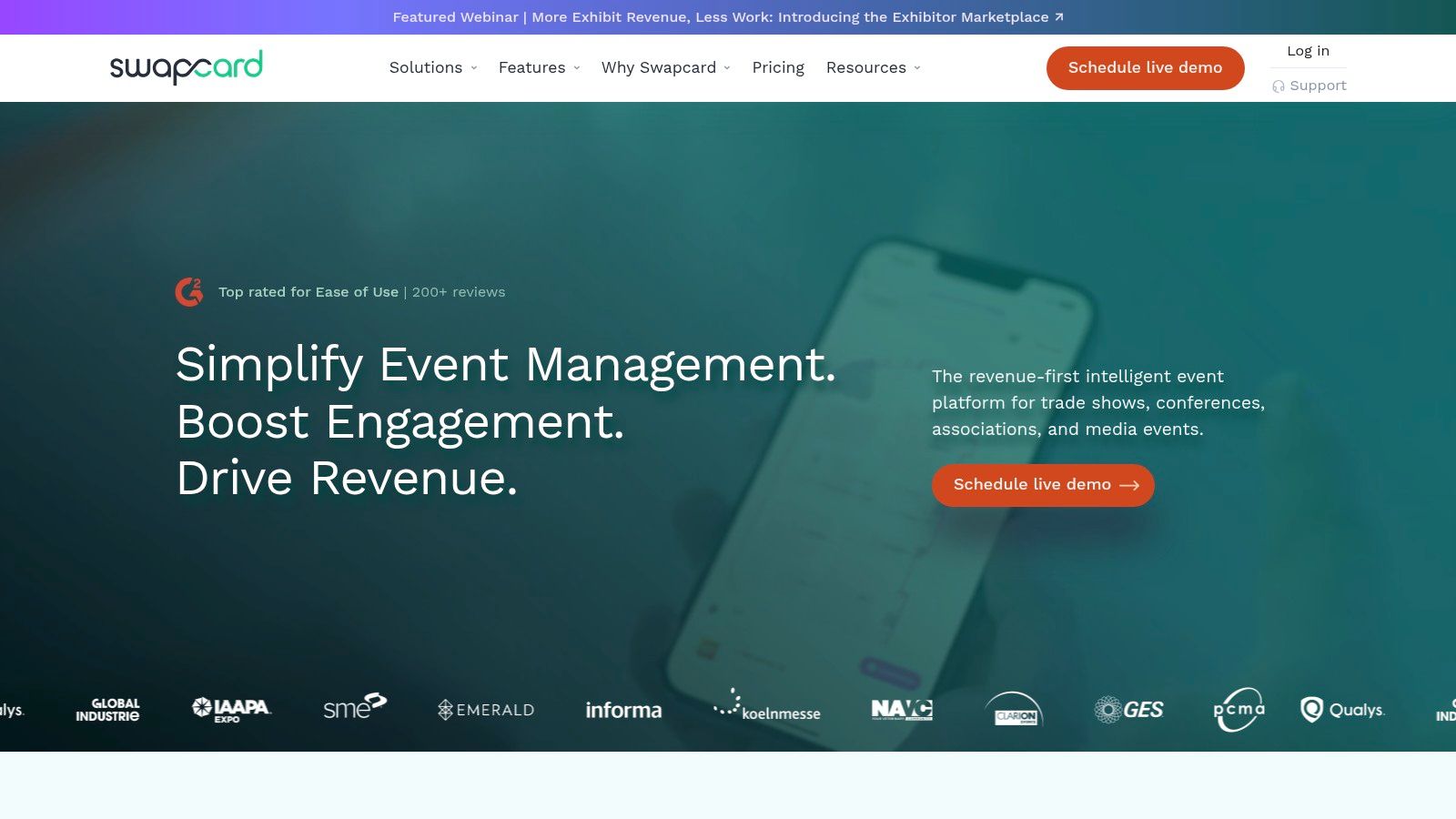
The platform provides an integrated suite that includes registration with native payment processing, a highly-rated mobile app, and a robust set of exhibitor tools. Its matchmaking algorithm connects attendees with relevant peers, sessions, and exhibitors, which is a key driver for participant engagement. For sponsors, the detailed lead capture workflows and analytics dashboards provide tangible proof of their investment's impact, making Swapcard one of the best event management software options for expo-led events where sponsor value is paramount. Organizers can learn more about AI's role in event planning to see how these features deliver value.
Analysis & Best-For Scenarios
Swapcard is the right fit for organizations that prioritize attendee networking and exhibitor success across multiple events per year. It is particularly effective for:
Exhibition-Led Conferences: When the primary goal is connecting buyers and sellers and proving sponsor ROI through qualified leads.
Multi-Event Portfolios: Its annual model provides a cost-effective and consistent technology stack for companies or associations hosting frequent events.
Community-Focused Events: The platform's strong networking features support building and engaging a community that persists beyond a single event.
Limitations & Pricing
The platform's primary limitation is its business model. Swapcard is sold exclusively on an annual subscription basis, with no monthly or per-event pricing available. This makes it inaccessible for organizers planning a single conference. Furthermore, its starter plans have limits on attendee numbers, and unused allotments do not roll over, which requires careful planning. While powerful for its target market, the annual commitment makes it a poor choice for those with infrequent or unpredictable event schedules.
Visit the Swapcard website to learn more.
9. Brella
Brella is an event management platform built around a single, powerful objective: creating valuable B2B connections. Its core strength is its intent-based AI matchmaking, which intelligently pairs attendees for scheduled 1:1 meetings. This focus on networking outcomes and sponsor ROI makes it a standout choice for exhibitions, trade shows, and hosted-buyer programs where the primary goal is generating business opportunities and measurable pipeline.
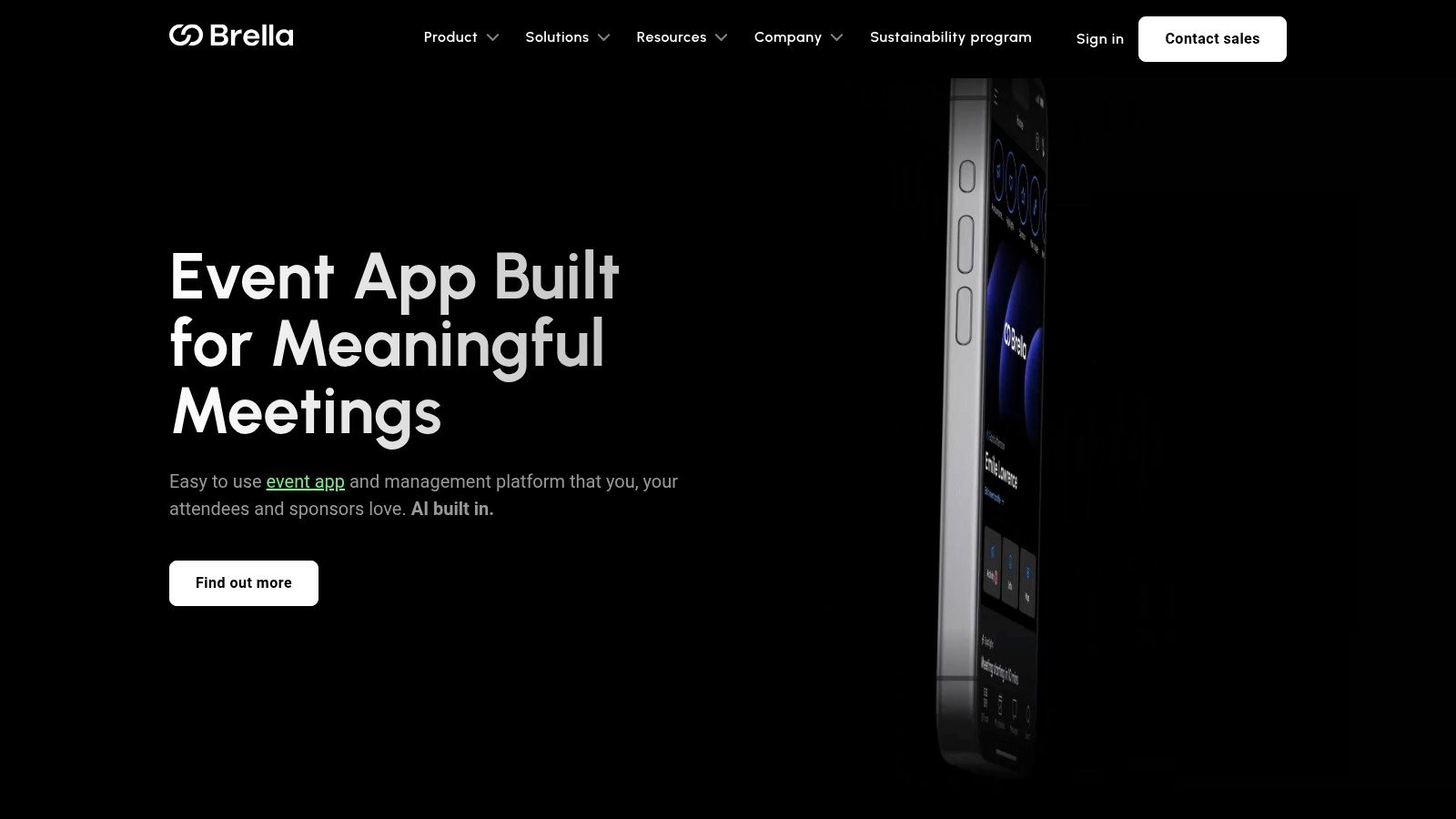
The platform is designed to turn passive attendees into active participants. The AI suggests relevant connections based on pre-defined interests and goals, facilitating a high volume of quality meetings. This is a significant differentiator for sponsors and exhibitors, who can use the lead scanning and post-meeting rating features to track conversations and demonstrate clear return on investment. While it can be used with other registration tools, Brella offers the essential architecture to build an entire event around purposeful networking, as highlighted in many top networking event ideas.
Analysis & Best-For Scenarios
Brella is the ideal solution when the success of your event is measured by the number and quality of meetings booked. It is particularly effective for:
B2B Exhibitions & Trade Shows: Maximizing lead generation for sponsors and exhibitors by connecting them with qualified buyers.
Hosted-Buyer Programs: Automating and managing complex meeting schedules between high-value attendees and suppliers.
Networking-First Conferences: Where the main value proposition is connecting attendees with peers, mentors, or potential partners.
Limitations & Pricing
The platform's deep focus on networking means its native registration and event website features are more basic than all-in-one alternatives. Many organizers use Brella alongside a dedicated registration system. Its value is most apparent at meetings-heavy events; it may be over-engineered for community gatherings or content-focused seminars. Pricing is quote-based, and application fees (typically 2%, but negotiable) apply to transactions processed through the platform, which should be factored into budgeting.
Visit the Brella website to learn more.
10. Accelevents
Accelevents is an accessible, all-in-one platform built for the mid-market, combining the essential tools for virtual, hybrid, and in-person events into a single, cohesive system. It stands out by offering transparent, upfront pricing and a full suite of features that cover the entire event lifecycle, including native registration and ticketing, virtual streaming, a mobile app, and onsite check-in capabilities. This makes it a strong contender for organizers who need comprehensive functionality without the enterprise-level cost and complexity.
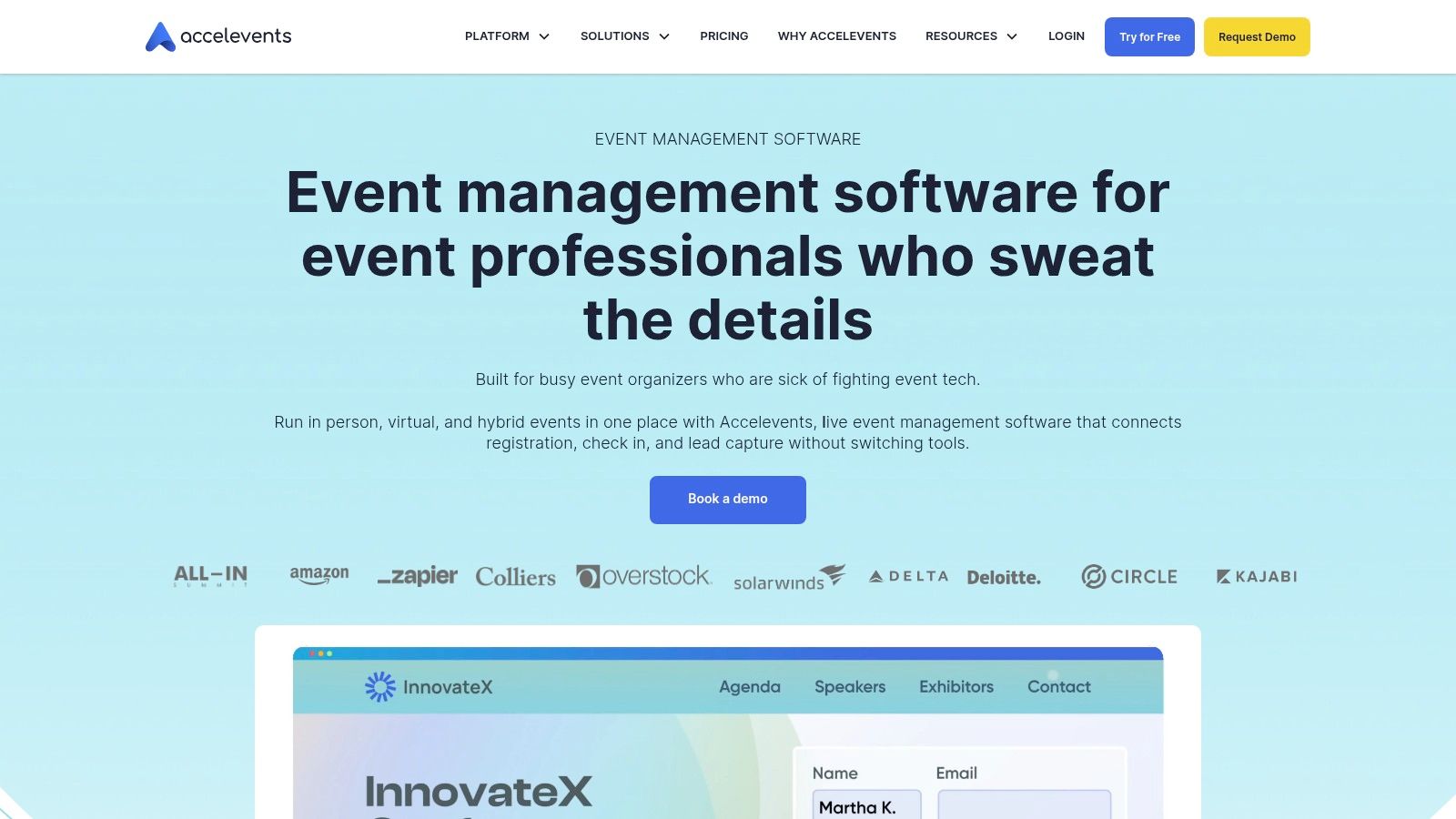
The platform provides a unified experience for both organizers and attendees. Key features include unlimited event creation, flexible registration types, and self-service check-in kiosks with on-demand badge printing. Its integrations with major CRM and marketing automation platforms ensure that event data flows smoothly into existing sales and marketing workflows. A significant differentiator is its built-in support for nonprofits, offering fundraising modules like live and silent auctions, text-to-donate, and direct donation processing.
Analysis & Best-For Scenarios
Accelevents hits a sweet spot for small to mid-sized businesses, associations, and nonprofits that need a powerful, unified tool that is easy to manage. It is one of the best event management software choices for:
Hybrid Events on a Budget: Combining in-person elements like badging with a solid virtual streaming and engagement component without requiring multiple vendors.
Nonprofit Fundraising Galas: Its specialized tools for auctions, donations, and "fund-a-need" campaigns are integrated directly into the event experience.
Multi-Event Programs: The annual plans offer a cost-effective way to manage a series of events under one subscription with predictable costs.
Limitations & Pricing
While Accelevents offers considerable value, its capabilities may not satisfy the intricate governance and customization demands of large global enterprises. Advanced white-labeling and dedicated support are reserved for higher-tier plans. Its partner and integration ecosystem, though growing, is not as extensive as those of larger enterprise suites like Cvent. Pricing is transparent, with tiered plans for single events or annual subscriptions, plus a per-registration fee, making it a predictable investment.
Visit the Accelevents website to learn more.
11. EventMobi
EventMobi offers a well-rounded, end-to-end event platform that is particularly attractive for its transparent pricing and balanced feature set. It effectively covers the entire event lifecycle with tools for registration, onsite operations like check-in and badge printing, a mobile event app, and virtual or hybrid streaming capabilities. This makes it a strong contender for organizations seeking a unified solution without the enterprise-level cost and complexity of larger systems.
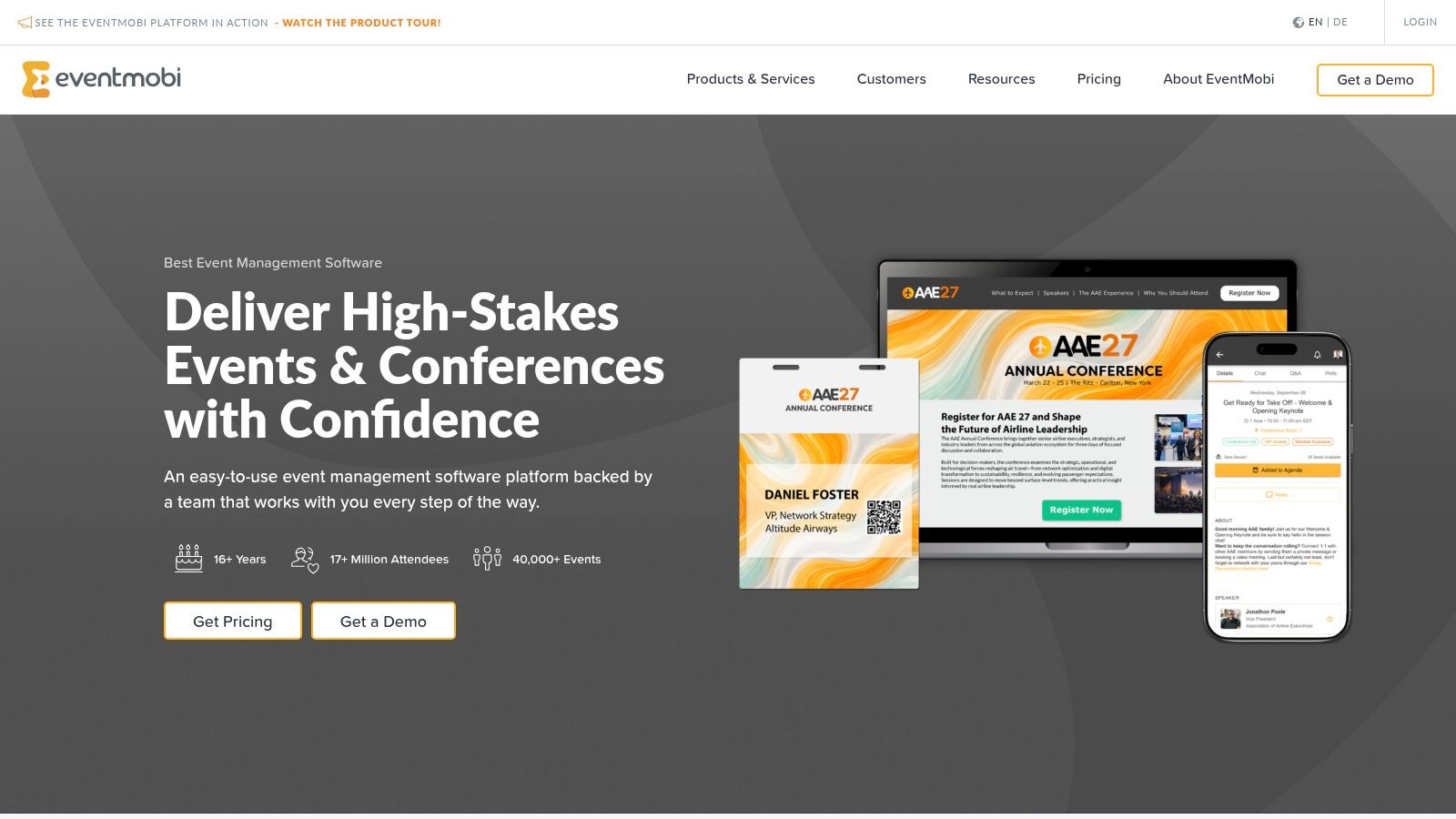
The platform stands out by making professional event technology more accessible. Its registration and ticketing module charges only payment gateway fees, removing platform-specific ticket charges. A key differentiator is its approach to onsite services; EventMobi allows teams to rent or buy hardware for Onsite badge printing and session scanning, a practical option for lean teams who don't want to invest in owning equipment. The mobile app and streaming packs provide solid engagement for attendees, both in-person and remote.
Analysis & Best-For Scenarios
EventMobi is the right choice for mid-market companies, associations, and event agencies that run recurring conferences and need a reliable, all-in-one system with predictable costs. It is especially effective for:
Recurring Annual or Bi-Annual Conferences: The per-event and annual plans are well-suited for organizations that need consistent technology year after year.
Organizers Needing Onsite Flexibility: The option to rent check-in hardware and order pre-printed badges simplifies logistics for teams without large operational departments.
Hybrid Events on a Budget: It provides the necessary tools for both in-person and virtual components without requiring a top-tier budget.
Limitations & Pricing
While EventMobi's pricing is more transparent than many competitors, certain features for virtual events, like streaming and video-on-demand storage, are usage-based add-ons that can increase the total cost. The event app's theme customization is solid and professional but offers less bespoke branding control compared to fully custom-developed applications. This focus on a balanced, off-the-shelf solution makes it less ideal for events requiring deeply unique digital experiences or for very simple, one-off meetings where its full toolset would be underutilized.
Visit the EventMobi website to learn more.
12. Splash
Splash is an event marketing platform built to help B2B marketing teams create, promote, and measure a high volume of branded events. Its core strength is enabling distributed teams to quickly launch on-brand event pages, manage registrations, and analyze performance across an entire event program, from field marketing meetups to VIP dinners and roadshows. The platform is designed for scale and brand governance, making it a favorite among corporate event marketers.
The platform shines by making event page creation fast and consistent. Users can work from a library of approved themes and templates, ensuring every touchpoint adheres to brand guidelines. Splash manages the full guest journey, from customizable RSVP forms and email communications to ticketing via Stripe integration. A key differentiator is its program-level analytics, which rolls up data from hundreds of individual events to give leaders a clear view of their portfolio's impact, all while feeding data back into connected CRM and marketing automation systems.
Analysis & Best-For Scenarios
Splash is the ideal choice for corporate marketing departments that run programmatic, repeatable events and prioritize brand consistency and marketing integration over complex, expo-style logistics. It is particularly effective for:
B2B Field Marketing Teams: Empowering regional marketers to execute on-brand roadshows, workshops, and local meetups without extensive design or development support.
High-Volume Event Programs: When you need to manage and report on dozens or hundreds of events per year and require program-wide visibility.
Brand-Centric Experiences: Creating beautifully designed, mobile-responsive event websites and email campaigns that feel custom-built.
Limitations & Pricing
While excellent for marketing-led events, Splash is less suited for large, multi-day conferences with complex expo-floor needs like exhibitor management or lead retrieval. Its pricing is quote-based and aimed at the corporate market, with advanced features like SSO and deeper integrations often reserved for higher-tier plans. Organizations looking for one of the best event management software options for simple, one-off events may find the platform's focus on programmatic marketing to be more than they need.
Visit the Splash website to learn more.
Top 12 Event Management Software Comparison
Solution | Core features | UX & Impact (★) | Value & Pricing (💰) | Target (👥) | Key differentiator (✨) |
|---|---|---|---|---|---|
TalkValue 🏆 | AI-native data unification + automations; self-serve Growth AI Toolkit + full-service agency | Proven ROI: 40% ARPP↑, 50% LinkedIn reply, 70% staff time↓ ★★★★★ | 💰 Quote/demo required; ROI-focused value | 👥 Conferences, exhibitions, event ops, B2B demand & sponsors | ✨ AI-as-OS + Knowledge Center (playbooks & courses) |
Cvent | Enterprise registration, OnArrival onsite stack, Attendee Hub, broad integrations | Enterprise-grade delivery; heavy admin for simple events ★★★★☆ | 💰 Quote-based; enterprise pricing | 👥 Large enterprises, complex/high-volume programs | ✨ OnArrival hardware + pro services for scale |
Bizzabo | Event Experience OS: registration, websites, mobile app, Klik SmartBadges | Modern UX; strong networking & mobile engagement ★★★★ | 💰 Published pricing; SmartBadges add cost | 👥 Data-driven conferences, martech-integrated teams | ✨ Klik SmartBadges (BLE) + native virtual suite |
Stova | Full-stack registration, housing, onsite, content + pro services | Suited for multi-city/complex builds; heavier admin ★★★★ | 💰 Custom quotes; can escalate with volume | 👥 Multi-city programs, hosted-buyer, bespoke workflows | ✨ White‑glove professional services & global payments |
Swoogo | Unlimited events/registrations on flat user pricing; robust registration | Predictable TCO; fast support culture ★★★★ | 💰 Flat user-based pricing; unlimited regs = predictable TCO | 👥 Teams running frequent multi-format events | ✨ Predictable pricing model + strong human support |
Eventbrite | Ticketing + discovery marketplace; embedded checkout & mobile check-in | Fast to launch; broad distribution but basic enterprise features ★★★ | 💰 Low/no fees for free events; per-ticket fees at scale | 👥 Public/consumer events, smaller conferences | ✨ Massive discoverability & marketplace reach |
Whova | Registration, website builder, event app, exhibitor/sponsor tools, onsite kiosks | Broad feature coverage for mid-market; opinionated app UX ★★★★ | 💰 Competitive registration fees; quote-based for many | 👥 Associations & mid-market conferences | ✨ Sponsor/exhibitor showcases + competitive pricing |
Swapcard | AI-powered networking & exhibitor ROI; annual license model | Strong networking & exhibitor workflows for expos ★★★★ | 💰 Annual subscription; cost-effective for frequent events | 👥 Multi-event programs, exhibition-led conferences | ✨ AI networking + exhibitor-centric tooling |
Brella | Intent-based AI matchmaking; meeting scheduling & lead analytics | Best-in-class for meetings-heavy ROI outcomes ★★★★ | 💰 License + transaction/app fees (~2%) | 👥 Hosted-buyer programs, sponsor-heavy B2B events | ✨ Intent matchmaking & booked-meetings focus |
Accelevents | All-in-one mid-market: registration, streaming, app, onsite badge printing | Clear tiered pricing; good nonprofit features ★★★ | 💰 Transparent tiered plans; competitive fees | 👥 Mid-market teams, nonprofits, single/multi-event users | ✨ Fundraising modules & clear published packages |
EventMobi | Registration, badge printing/rental, app, streaming, 100+ integrations | Balanced feature set; hardware rental eases logistics ★★★★ | 💰 Per-event & annual published entry points | 👥 Recurring conferences, lean teams needing rentals | ✨ Hardware rental + published pricing entry points |
Splash | Branded event pages, ticketing, program analytics, role-based licenses | Fast branded page creation; program-level visibility ★★★★ | 💰 Quote-based; unlimited events on paid plans | 👥 B2B field & corporate marketing teams | ✨ Brand governance + program analytics |
From Reconciliation to Revenue: Choosing Your Strategic Infrastructure
The critical takeaway for senior event leaders must transcend a simple feature-for-feature comparison. The true value of an event platform is not measured by the length of its feature list but by its capacity to deliver decision clarity. It is about selecting a system that acts less like a collection of siloed tools and more like a central nervous system for your event portfolio—a strategic infrastructure that unifies disparate data streams into a coherent, actionable intelligence layer.
The fundamental challenge is a gap between operational data and strategic insight. You may know how many people checked in or which sessions were popular, but can you confidently answer these critical, revenue-focused questions?
Which attendee cohorts delivered the highest lifetime value, and what marketing investments are most effective at attracting more of them?
What is the direct correlation between a sponsor’s package level, their on-site engagement, and their likelihood of renewal?
How do specific content tracks influence attendee retention and future upgrades to premium ticket tiers?
Answering these questions requires moving beyond basic dashboards. It demands a system capable of data reconciliation—the process of cleaning, connecting, and interpreting information from multiple sources to create a single, reliable source of truth. The most advanced platforms provide this visibility, allowing you to see the direct through-line from attendee behavior to monetization, from operational efficiency to portfolio growth, and from sponsor activity to measurable ROI.
Once you have aligned on a platform that offers this level of clarity, the focus must shift to strategic alignment, not just technical setup. Your chosen platform is not merely an operations tool; it is a shared business intelligence asset that requires buy-in across marketing, sales, and finance. Consider a platform like TalkValue, with its AI-native architecture designed specifically for this purpose. It positions itself not as another piece of software to manage, but as a clarity engine that automates the reconciliation of data and surfaces the insights needed for proactive, revenue-driven decisions. This allows leaders to focus on strategy, confident that their technological foundation is built to convert event data into financial outcomes.
Ultimately, selecting the best event management software is a strategic decision about the kind of event business you want to build. Are you building a program based on fragmented reporting and operational execution, or one driven by unified intelligence and strategic growth? The right platform will not just help you run better events; it will provide the core infrastructure to build a more profitable and resilient event portfolio for the future.
Your event data holds the key to predictable revenue growth, but only if you have the infrastructure to unlock it. TalkValue is an AI-native decision engine designed to reconcile chaotic event data into clear, actionable revenue opportunities. Move beyond operational dashboards and discover how a unified strategic framework can transform your event portfolio by scheduling a conversation with our team at TalkValue today.


FAQ