
For event and exhibition leaders, the feeling is universal. You are awash in data, armed with a sophisticated suite of event technology solutions. Registration platforms, engagement apps, and analytics dashboards generate a constant stream of metrics. Yet, despite this flood of information, a fundamental question remains unanswered with confidence: what is truly driving revenue and long-term value?
This is more than an operational inconvenience; it is a structural blind spot at the heart of strategic decision-making. The conventional approach to event technology, focused on accumulating more tools and more data, has created an illusion of insight while obscuring the path to sustainable growth. The industry has reached a point where more data does not equate to better decisions. It is time for a strategic reframing.
Challenging the "More is More" Fallacy in Event Technology
The prevailing belief across the event industry is that a best-in-class technology stack is assembled by acquiring top-rated tools for each individual function. An organizer might invest in a premier registration system, a separate mobile app for engagement, a marketing automation platform, and a powerful analytics tool. Each component performs its task admirably, producing detailed, isolated reports. This is the accepted standard for modern event management.
However, this siloed architecture is the very source of the problem. It creates a fragmented operational view that makes it impossible to connect cause and effect. It is akin to a manufacturing firm attempting to assess profitability by analyzing its supply chain, production line, and sales reports in complete isolation from one another. Each report might be accurate, but without a unified ledger, a true understanding of commercial performance remains elusive.
The Illusion of Control and Its Revenue Consequences
This fragmented ecosystem generates an illusion of control. Leaders can see registration volume, session popularity, and sponsor revenue totals. But this surface-level visibility fails to answer the strategic questions that determine long-term success:
Which specific attendee cohorts deliver the highest lifetime value (LTV) to our portfolio?
What behavioral patterns distinguish sponsors who renew and upgrade from those who churn?
Which marketing investments attract participants who not only attend but also contribute meaningfully to revenue?
Answering these questions requires reconciling financial data with behavioral data at a granular, individual level—a task most event technology stacks are structurally incapable of performing. As a result, critical decisions about pricing, programming, and investment are made with incomplete information. This is not a failure of personnel but a failure of the underlying infrastructure. This is the core reason why most event analytics don't change decisions.
The Strategic Cost of a Disconnected View
The global market for event technology solutions continues to expand, with significant investment flowing into new platforms. Projections show consistent market growth, as noted in recent analyses of event platform market trends here. Yet, this spending often deepens the fragmentation rather than solving it.
The consequence of this fragmented view is a direct and measurable impact on revenue. It manifests as missed monetization opportunities, declining attendee and exhibitor retention, and an inability to forecast future performance with any degree of certainty. Without a unified model, each event is managed as a discrete project, preventing the organization from operating as a scalable, predictable business portfolio.
To break this cycle, leaders must shift their focus from acquiring more tools to building a decision-making infrastructure that unifies them. The objective is not more dashboards, but a single, reconciled source of truth that connects every operational action to a financial outcome.
Building the Decision Infrastructure Your Portfolio Needs
For senior leaders, the primary challenge is not a deficit of data but the absence of a system to translate that data into profitable commercial decisions. The solution is not another standalone application, but a true decision infrastructure—an operating model designed to convert disconnected metrics into unified, actionable revenue intelligence. This is the pivot from merely executing events to engineering sustainable portfolio growth.
Most event technology, while functionally proficient, inadvertently contributes to an illusion of clarity by presenting isolated pieces of a larger commercial puzzle.
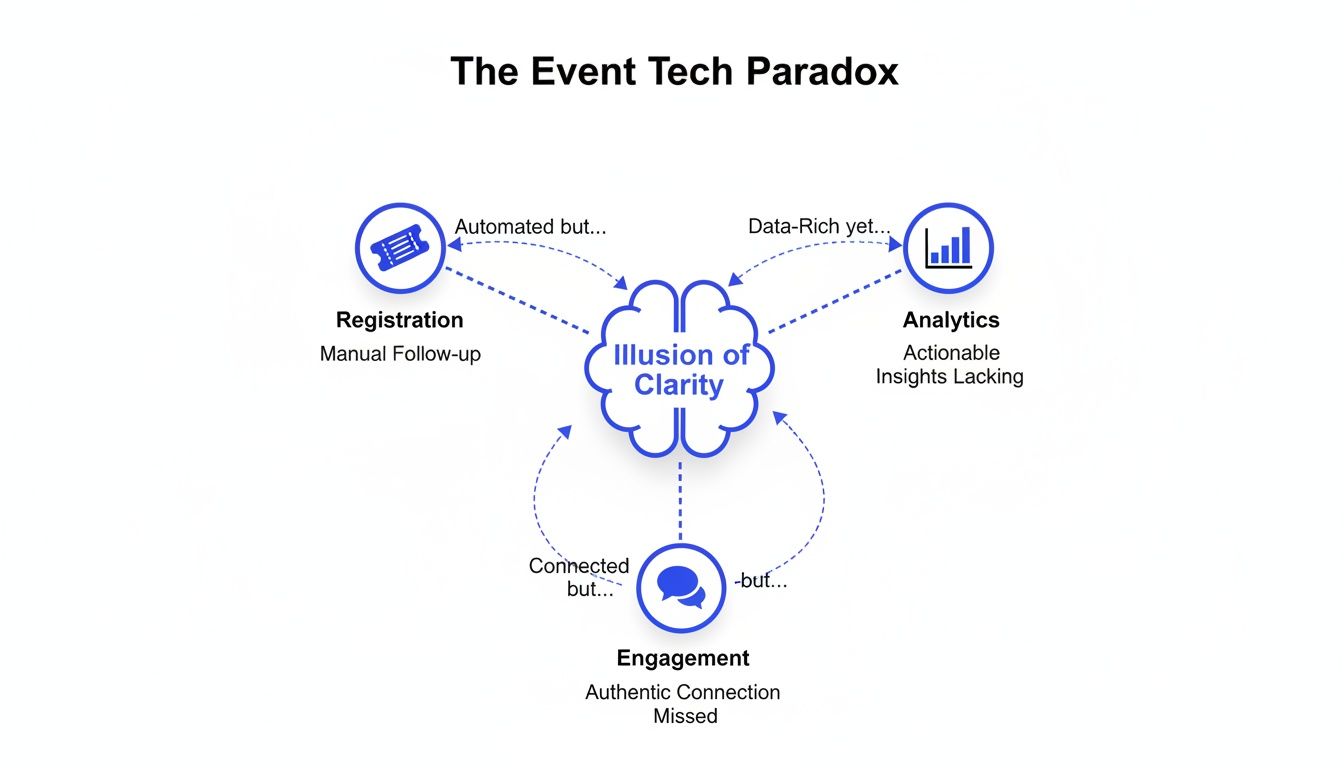
As the diagram illustrates, essential functions like registration, analytics, and engagement often operate as distinct data silos. True decision clarity is only achieved when these operational activities are systematically reconciled with financial outcomes, creating a single source of truth for the entire business.
The Three Pillars of a Coherent Decision Infrastructure
A robust decision infrastructure is defined by three interdependent functions that work in concert to create a unified view of commercial performance. These pillars transform a collection of event technology solutions from operational tools into strategic assets.
Revenue Reconciliation: This is the foundational layer. It involves systematically tracing every dollar of revenue—from ticket sales, sponsorship packages, or ancillary purchases—back to a specific individual or company. This moves the organization beyond high-level financial summaries to a granular, person-centric view of monetization, definitively answering the question: "Who paid for what, and what was their journey?"
Cohort Visibility: Once revenue is reconciled at the individual level, the audience ceases to be a monolith. It becomes a collection of distinct cohorts defined by behavior and commercial value. Cohort visibility enables the segmentation of attendees and exhibitors by meaningful criteria—such as acquisition channel, ticket tier, engagement score, or total spend. This is essential for identifying high-value segments and understanding the drivers of their behavior.
Strategic Alignment: The final pillar ensures that every operational decision is tethered to a financial outcome. With reconciled revenue and clear cohort analysis, decisions regarding marketing spend, content programming, and sales strategy become precise and data-informed. Every choice, from setting registration prices to designing sponsorship tiers, is evaluated against its potential impact on revenue and profitability.
From Answering "What" to Understanding "Why" and "What If"
A conventional dashboard might report that an event generated $500,000 from 1,000 attendees. That is the "what." A decision infrastructure reveals that 20% of those attendees drove 60% of the revenue, as they purchased premium passes and attended two paid workshops after being acquired through a specific partner marketing campaign. That is the "why."
By establishing a single, reconciled source of truth, leadership is empowered to move beyond managing disconnected tasks and begin asking—and answering—the most critical commercial questions. This shift is fundamental for any organization operating under pressure to demonstrate ROI and drive enterprise value.
This integrated view enables leaders to confidently model the financial impact of strategic initiatives before committing resources. One can accurately forecast the revenue uplift from a new VIP package or predict the retention rate of first-time exhibitors from a key industry vertical. This capability transforms the event technology stack from a cost center into the central engine for strategic growth and predictable revenue.
Beyond Automation: How AI Delivers Strategic Revenue Intelligence
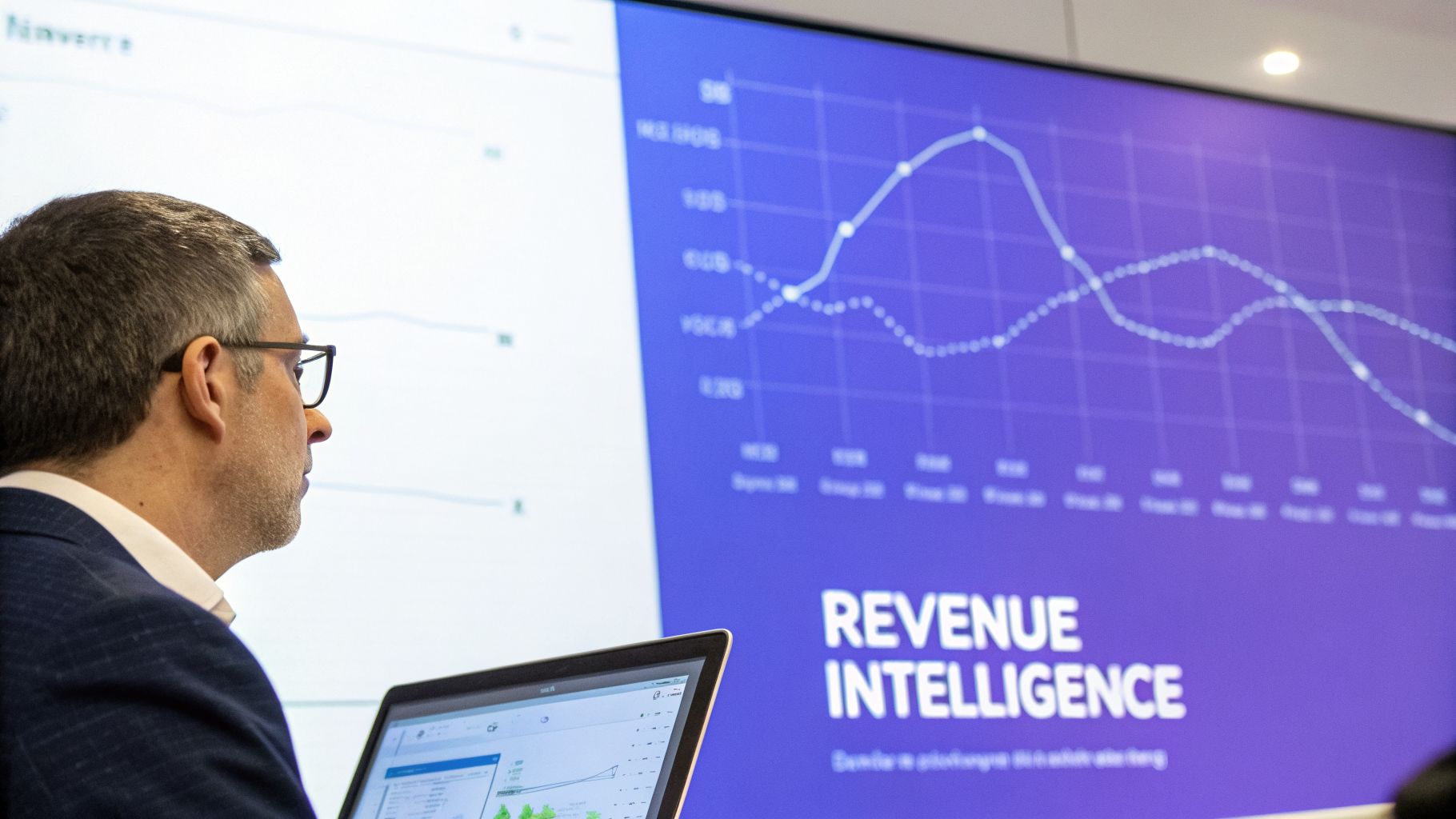
When the conversation turns to AI for event planning, it often gravitates toward tactical applications: chatbots for attendee support, personalized agenda recommendations, or optimized registration flows. While these operational efficiencies have value, they represent a narrow and incomplete view of AI’s strategic potential.
Focusing solely on task automation misses the fundamental transformation AI enables. The true power of an AI-driven system lies in its ability to unlock strategic revenue intelligence that was previously inaccessible. It serves as the analytical engine that powers a decision infrastructure, elevating event technology solutions from a support function to a core component of the business's growth strategy.
From Historical Reporting to Predictive Insight
A standard event dashboard is a historical record. It excels at reporting what has already occurred. An AI-native intelligence engine, by contrast, analyzes that same historical data to predict what is likely to happen next. It is the difference between driving with the rearview mirror and navigating with a predictive GPS that accounts for all variables.
This capability is not about abstract algorithms; it is about delivering clear, defensible answers to high-stakes commercial questions with a level of confidence previously unattainable.
Isolate True Revenue Drivers: An advanced AI engine can analyze the complex interplay of touchpoints—from email engagement to session attendance and networking interactions—to identify the specific activities that correlate with and lead to revenue generation. This provides an unambiguous view of marketing, sales, and programming ROI.
Forecast Cohort Lifetime Value (LTV): By analyzing behavioral and transactional data across multiple events, AI can predict the future value of different audience segments. This might reveal that attendees from a specific industry who engage with innovation-focused content are 30% more likely to return and upgrade to a premium pass.
Predict Sponsor and Exhibitor Churn: A sophisticated intelligence system can detect the subtle behavioral signals of at-risk accounts. It can flag an exhibitor whose team had low engagement with key networking functions or whose lead capture activity was significantly below the benchmark, enabling proactive intervention to preserve the relationship and secure renewal.
These are not incremental improvements. This represents a fundamental shift from managing event logistics to architecting predictable financial outcomes.
Distinguishing Operational Automation from Strategic Intelligence
It is critical for leaders to distinguish between automation that improves efficiency and intelligence that improves decisions. One helps teams execute existing tasks faster; the other empowers them to make entirely new, more sophisticated commercial judgments.
Focus Area | Conventional Automation | Strategic Intelligence | Key Business Impact |
|---|---|---|---|
Data Analysis | Reports on past performance (what happened). | Predicts future outcomes (what will happen). | Moves from reactive reporting to proactive strategy. |
Primary Goal | Increase operational efficiency and reduce manual tasks. | Drive revenue growth and improve decision quality. | Shifts focus from cost savings to value creation. |
User Function | Automates repetitive workflows (e.g., email sends). | Automates complex analysis (e.g., LTV forecasts). | Frees up leadership to focus on high-level strategy. |
Business Questions | "How many people registered this week?" | "Which registrant segments are most likely to churn?" | Enables targeted interventions that protect revenue. |
Strategic intelligence does not replace skilled teams; it equips them with the insights needed to connect their daily activities directly to financial results.
An AI-powered decision framework does not merely accelerate existing workflows; it fundamentally elevates the quality of decisions that leadership can make. It automates the complex, time-consuming work of revenue analysis, freeing senior decision-makers to concentrate on high-level strategy and growth initiatives.
This reframes AI from a feature within the tech stack to the engine that powers a modern, revenue-focused operating model. The organization’s rich historical data is transformed from a static record into its most valuable predictive asset for guiding future growth. This level of intelligence is becoming a prerequisite for any modern event strategy, as detailed in our AI toolkit for event professionals.
Selecting a Partner for Strategic Capability, Not Just Technology
Choosing an event technology solutions provider is a significant capital decision, not a simple procurement exercise. As a leader, you are not merely purchasing software; you are investing in a strategic capability that must deliver measurable growth across your event portfolio.
The right partner functions as an extension of your strategic team, providing not only the core infrastructure but also the expertise required to transform events into reliable revenue engines. This necessitates a shift in the evaluation process, moving beyond feature checklists to an assessment of a provider's fundamental philosophy. Is their objective to sell you a toolkit, or to deliver a decision-making framework engineered for clarity and commercial impact?
Look Beyond the Feature Checklist to a Revenue-Centric Philosophy
It is easy to become overwhelmed by a comparison of features. Nearly any modern platform can manage registration, check-in, and basic reporting. The litmus test for a true strategic partner is their demonstrable understanding of your business model and their ability to articulate a clear path to improving financial outcomes.
Your evaluation should center on strategic capabilities, not just tactical functions. A genuine growth partner can substantiate their value in three critical areas:
Unified Data Reconciliation: How effectively does their platform unify disparate data sources—including your CRM, registration systems, and financial software—into a single, reliable source of truth? A strategic partner can demonstrate, with precision, how they trace revenue from its source to an individual attendee’s journey or a sponsor's engagement history.
Portfolio-Wide Scalability: Does their system provide a consistent framework for analysis across your entire event calendar, regardless of format (in-person, virtual, hybrid), geography, or scale? A strategic platform offers a unified lens for measuring performance across a diverse portfolio, providing the consolidated view that senior leadership requires.
Commercial Fluency: Does the provider speak the language of business strategy or technology support? A true partner engages in discussions about revenue per attendee, sponsor monetization models, and cohort lifetime value. If their conversation is limited to user interface mechanics and feature roadmaps, they are a vendor, not a strategic partner.
Investing In a Capability, Not Just a Toolkit
The event industry invests heavily in technology. A comprehensive event industry report highlights that 73% of companies utilize multiple event tech tools, with a significant percentage making six-figure annual investments. For the majority of demand generation leaders, this software is mission-critical for measuring success.
This level of expenditure demands a commercial return, not just more disconnected spreadsheets. A toolkit helps your team complete tasks. A strategic capability empowers them to make smarter, faster, more profitable decisions. The right partner delivers the latter. Their solution should function as a clarity engine, automating the complex and error-prone work of data reconciliation. This liberates leadership to focus on architecting growth.
The next time you evaluate a provider, move beyond the demo and ask a single, incisive question: "Using our own data, can you demonstrate how your framework will help us increase revenue per attendee or improve sponsor retention?" Their response will reveal whether they are a tactical vendor or a strategic growth partner.
This approach transforms the selection process from a procurement task into a strategic investment, ensuring you align with a provider who not only understands your financial objectives but is equipped to help you achieve them. This distinction is more critical than ever, and it's a core reason why TalkValue is poised to replace traditional B2B event marketing agencies.
Implementing a Revenue-Centric Operating Model for Your Portfolio

Adopting a revenue-centric operating model is a fundamental organizational shift, not a software deployment. It requires aligning your people, processes, and technology around a single objective: measurable portfolio growth. With your event technology solutions serving as the central nervous system, the goal is to evolve from simply running events to managing a scalable, predictable, and profitable business unit.
This transformation is a deliberate, phased process. It provides leadership with unprecedented clarity, enabling high-stakes decisions to be made with confidence, backed by a complete financial and behavioral narrative.
Phase 1: Establish a Single, Reconciled Source of Truth
The foundational step is to dismantle the data silos that obscure performance. It is impossible to achieve a strategic view when financial, registration, and behavioral information reside in disconnected systems. The objective is to create a central data infrastructure where every dollar of revenue is programmatically linked to attendee and exhibitor interactions.
This initial phase focuses on integrating your registration platforms, CRM, and financial software into a single, cohesive data model. This automated reconciliation is non-negotiable; without it, all subsequent analysis remains dependent on manual, error-prone spreadsheet work. The system must draw a clean line from a marketing touchpoint to a ticket purchase to post-event engagement, without human intervention.
Phase 2: Map and Analyze Key Revenue Journeys
With a unified data foundation in place, you can begin to visualize how value is created across your events. This involves tracing the end-to-end journeys of your most important customer segments. For example, you can compare the acquisition path, engagement behavior, and lifetime value of a first-time exhibitor from an emerging market against that of a long-tenured sponsor from a mature vertical.
Mapping these journeys provides answers to critical business questions:
Acquisition Path ROI: Which marketing channels deliver our highest-spending and most-engaged attendee cohorts?
Engagement-to-Value Correlation: What specific content or networking activities are most common among participants who purchase premium offerings?
Retention and Churn Drivers: What behaviors differentiate exhibitor segments with a 90% renewal rate from those with high churn?
This process transforms raw data into actionable commercial narratives, enabling you to optimize resource allocation and focus on activities with the greatest financial impact. Our guide to event management best practices offers further insight into this strategic process.
Phase 3: Institute a Cadence of Strategic Business Review
A revenue-centric model is not a one-time project but a continuous operational rhythm: analyze, decide, measure, and iterate. The final phase is to establish a formal cadence for strategic review, where leadership uses unified insights to steer the portfolio. This is the mechanism that shifts the organization from a reactive, fire-fighting posture to one of proactive, strategic management.
This structured review process, powered by a clear and reconciled data infrastructure, is what transforms an event portfolio from a series of disconnected projects into a predictable and scalable engine for enterprise growth.
Imagine quarterly business reviews evolving from discussions of anecdotal feedback to rigorous analyses of sponsor portfolio yield and attendee LTV. You could model the impact of a pricing change on a specific audience segment or identify at-risk revenue 6-9 months in advance. This is the ultimate objective: transforming your event technology solutions into a command center for strategic growth.
The C-Suite Metrics That Define and Defend Growth
Registration counts and session attendance figures are operational metrics. They describe activity, but they do not articulate value in a language that resonates with the C-suite or the board. To elevate the strategic importance of your event portfolio, you must shift the conversation from logistical outputs to long-term business impact.
Your event technology solutions must serve as the backbone for this new class of measurement, enabling you to prove that the event calendar is not a cost center, but a reliable driver of enterprise growth. When you can directly connect event activities to financial outcomes like customer lifetime value and net revenue retention, you are no longer justifying costs—you are demonstrating returns.
Moving Beyond Vanity Metrics to Business Value KPIs
Most event dashboards are populated with vanity metrics—easy to measure but offering little strategic insight. The true narrative of your program's commercial health is told through KPIs that link event engagement to sustained business results. Tracking these requires a connected data infrastructure that most organizations lack.
These are the metrics that demonstrate strategic value to executive leadership:
Lifetime Value (LTV) of an Attendee Cohort: This moves beyond single-event revenue to measure the total profit a specific group of attendees generates over time—through repeat attendance, cross-portfolio engagement, and purchases of other company products and services.
Sponsor and Exhibitor Portfolio Yield: Instead of focusing on top-line sponsorship revenue, this metric analyzes the performance of the entire partner portfolio. It identifies which sponsorship tiers are most profitable, which partners are achieving the highest ROI (making them prime for renewal and upsell), and which are underperforming.
Net Revenue Retention (NRR): A critical indicator of customer health and product-market fit, NRR measures the recurring revenue from your existing customer base (attendees and sponsors). An NRR over 100% signifies that growth from your loyal customers is more than offsetting any churn, a powerful signal of a healthy, scalable business.
The Imperative for a Unified Data Infrastructure
Attempting to calculate these strategic metrics with disconnected systems is an exercise in futility. One cannot accurately measure attendee LTV if registration data from one conference is siloed from another. It is impossible to analyze sponsor portfolio yield without reconciling financial software with exhibitor engagement data from your mobile app.
This is precisely why a unified data infrastructure is no longer an optional luxury but a strategic necessity. It programmatically reconciles financial, behavioral, and demographic information from disparate sources into a single, reliable analytical model.
Think of this infrastructure as the central nervous system for your event portfolio. It eliminates the need for manual data reconciliation and guesswork, providing the clarity required to make forward-looking strategic decisions based on a complete and trustworthy picture of commercial performance.
This is the ultimate purpose of investing in modern event technology solutions. It is about gaining the strategic clarity to tie every decision—from marketing budgets to content strategy—to a measurable impact on long-term, profitable growth. By focusing on metrics like LTV and NRR, you elevate the event program from a logistical function to a core engine of enterprise value.
Frequently Asked Questions For Event Leaders
As a senior leader evaluating a new technology strategy, you are rightly focused on strategic impact and ROI. Below are answers to the most common questions we hear from decision-makers who are looking to connect their technology investments to demonstrable business growth.
How is this different from a standard Business Intelligence (BI) dashboard?
While a BI dashboard is effective at visualizing what happened, it typically presents data in silos. You might see registration trends in one chart and revenue totals in another, but the causal link between them remains obscure. A revenue intelligence framework is fundamentally different.
It is purpose-built to reconcile every dollar of revenue back to specific customer actions and journeys. This creates a unified view that explains the why behind your numbers, moving beyond reporting to provide diagnostic and predictive insights that a general-purpose BI tool cannot deliver on its own. A BI dashboard reports the data; a revenue intelligence framework explains what it means for the business.
My team is already at capacity. Will this create more work?
This is a valid and critical concern. While any strategic change requires an initial adjustment period, the core purpose of this framework is to eliminate low-value work and automate complexity.
Imagine freeing your team from the endless hours spent manually exporting, cleaning, and stitching together data from multiple systems in spreadsheets. A revenue intelligence framework automates this entire reconciliation process. It provides your team with clear, trusted insights, allowing them to shift their focus from data wrangling to making confident, strategic decisions that drive growth. The goal is to increase their strategic impact, not their workload.
Can this framework be applied to our virtual and hybrid events?
Absolutely. The core principles of reconciling revenue to behavior and understanding cohort value are format-agnostic. Whether an attendee interaction happens in a convention hall or a virtual breakout room, a true intelligence infrastructure captures that journey and quantifies its commercial impact.
This capability is especially powerful for hybrid events. For the first time, you can clearly analyze and compare the distinct monetization patterns, engagement drivers, and ROI for your in-person and digital audiences. This provides the clarity needed to optimize the entire event portfolio, regardless of how participants choose to engage.
Answering these questions clarifies that a unified, strategic approach to event technology solutions is about far more than operational efficiency. It is about providing the decision clarity required to transform your event portfolio into a predictable and scalable engine for enterprise growth.
Ready to move from disconnected data to a unified growth engine? TalkValue provides the AI-native toolkit and strategic expertise to turn your event portfolio into a predictable source of revenue. See how our framework delivers clarity by exploring a demo today.


FAQ