Copy Link
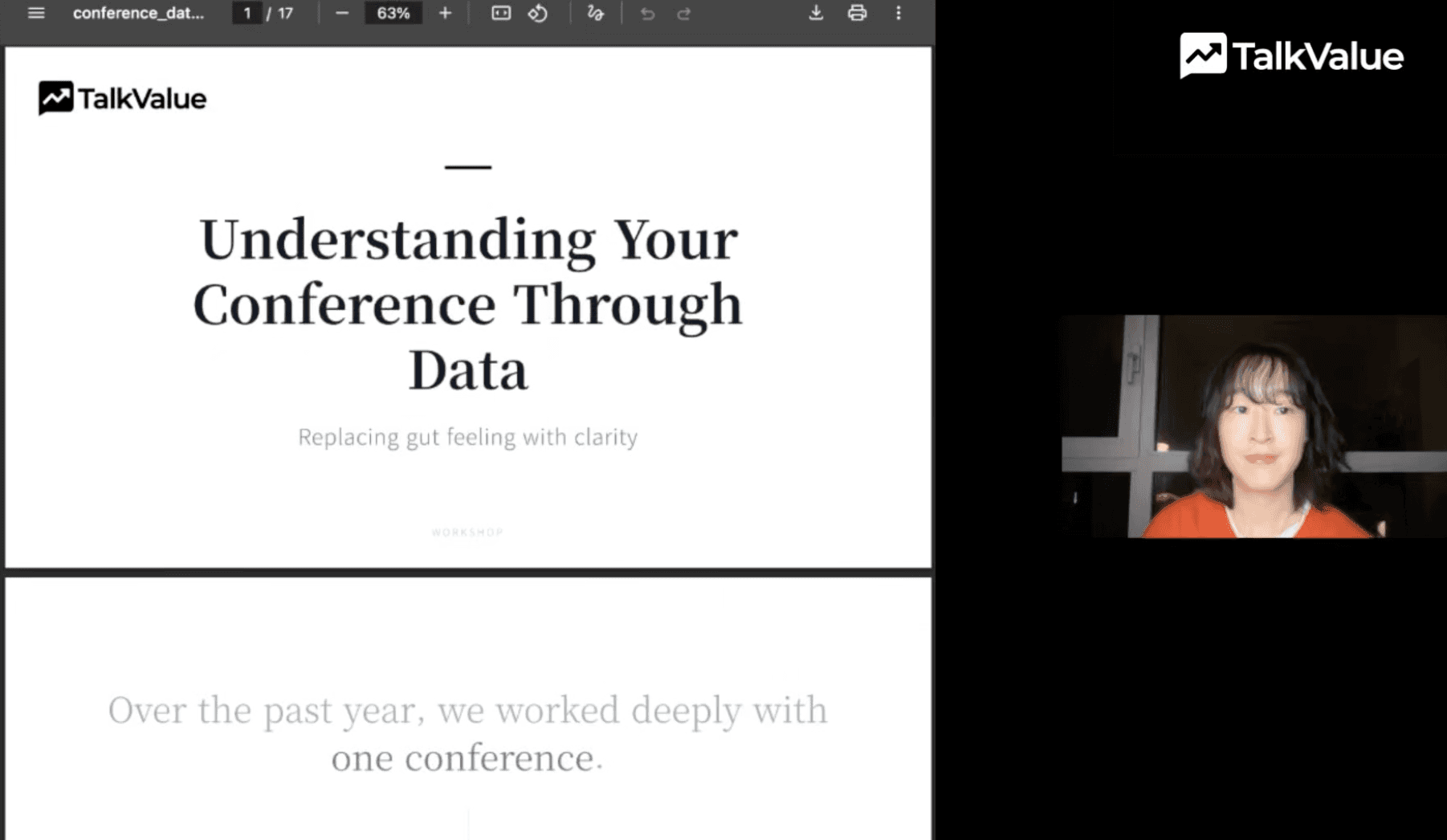
Understanding Your Conference Through Data: Do You Really Know Who's Coming to Your Conference?


what you'll learn
Files
Lesson details
Stop Guessing Your Audience:
How Event Teams Can Use GPT to Understand Attendees
Introduction
Every event team has a story about their attendees.
“We're community-driven.”W
“Our people come back every year.”
“Our audience is loyal.”
These stories feel true. They’re backed by a decade of relationships, hallway conversations, and a general sense of who shows up.
But here’s the problem:
Feeling true and being true are very different things — especially when you're trying to grow.
This is the lesson we learned working deeply inside one conference’s operations, marketing, and data over the past year. And it’s the lesson we want to share with you.
You don’t need a data team.
You don’t need Python.
You don’t need dashboards.
You need:
The right questions
Your own data
A thinking partner that never gets tired of crunching numbers
That thinking partner is ChatGPT.
The Client Story
A Conference That Thought It Knew Its Audience
When we first started working with this conference, their goal was simple:
Sell more tickets.
Our first question back was equally simple:
Who are your existing customers?
Their answer will sound familiar.
“We're special in this industry. People come because this is their community. This is their people.”
It felt right — not just as a brand story, but as a genuine belief shared across the team.
So we asked again, more concretely:
Who exactly are they?
How many actually come back?
How do they behave when they do?
That’s when things got interesting.
There was a strong narrative.
But there wasn’t a shared, data-backed definition of the customer.
The challenge wasn’t data volume. They had years of:
Registration records
Payment exports from https://whova.com
Attendee lists
The challenge was customer clarity.
The Workflow
Simpler Than You Think
Once we reframed the problem from “data analysis” to “customer clarity,” the workflow became surprisingly straightforward.
Step 1 — Unify your data
We collected multi-year attendee registration data and payment exports from Whova.
The data lived in different formats across different years. This part takes manual effort — and that’s okay. Budget for it.
We structured it into two datasets.
Dataset 1 — Payment History
Source: Whova
Includes:
Timestamps
Ticket types
Amounts paid per attendee
(Example: 2025 purchase data)
Dataset 2 — Attendee Matrix
A spreadsheet where:
Each unique email = one row
Each year = one column
Example:
2021 | 2022 | 2023 | 2024 | 2025 | |
|---|---|---|---|---|---|
1 | 0 | 1 | 0 | 1 | |
0 | 1 | 1 | 1 | 0 |
1 = attended
0 = did not attend
Privacy Note
If you're concerned about importing real customer emails:
Replace them with:
Internal customer IDs
Random numeric identifiers
GPT only needs a consistent unique identifier. It doesn’t need to know who the person is.
Step 2 — Set up GPT as your data strategist
Open:
Start a new chat and paste this system prompt:
This establishes GPT’s role.
From this point forward, GPT understands its job.
Step 3 — Import your datasets
Upload both datasets.
Add a short context note, such as:
Which dataset covers which years
Which dataset is the source of truth for revenue
Any missing data or anomalies
GPT will ask follow-up questions if needed.
Providing context upfront saves time.
Step 4 — Start with your assumptions
This is the step most teams skip.
Before asking GPT to “analyze everything,” write down what you believe to be true.
Examples:
“Our conference is community-driven.”
“Returning attendees are our most loyal customers.”
“Returning attendees spend more.”
Then ask GPT to test those assumptions.
What the Data Actually Said
Assumption #1
“We are community-driven.”
We asked GPT to analyze returning attendee trends from 2021 to 2025.
The chart came back in about 20 seconds.
The result:
Returning attendee ratio = ~20–25% every year.
Flat.
It wasn’t growing.
The event wasn’t community-fueled.
It was community-plateaued.
Growth depended almost entirely on net new attendees.
Which means:
If net new acquisition slows down, the event shrinks.
That’s a very different strategic reality from:
“People come back because this is their community.”
Assumption #2
“Returning attendees spend more.”
Next we analyzed Average Purchase Value (APV).
Definition:
APV = total amount a single attendee spends on tickets + extras
The result was surprising.
Net new attendees had a higher APV than returning attendees.
To be fair:
Earlier in the year, the team had implemented initiatives to increase returning attendee spending.
And it worked.
Returning attendee APV had grown nearly 4× compared to the previous year.
That was a real win.
But even after that improvement:
Net new attendees were still spending more per head.
Two assumptions.
Both wrong.
Both extremely valuable to discover.
The Real Takeaway
You Don’t Have a Data Problem
Most conferences think they have a data problem.
They believe they need:
Data scientists
Complex dashboards
Expensive analytics tools
In reality, most events already have the data.
It’s sitting inside:
Registration platforms
Payment exports
Old spreadsheets
CRM systems
What’s missing isn’t data.
It’s clarity.
A structured way to ask better questions.
GPT doesn’t replace your thinking.
It amplifies it.
The prompts we used weren’t technical.
They were:
Practical
Direct
Based on assumptions the team already had
You can copy them.
You can adapt them in minutes.
The mistake isn’t having wrong assumptions.
The mistake is never checking them against data.
Key Takeaways
Start with assumptions, not with data.
Assumptions give direction. Without them, you get lost in numbers.You probably already have enough data.
Multi-year registration records + payment exports are enough to begin.GPT is a thinking partner, not a magic answer machine.
Output quality depends on the quality of your questions.Flat retention is a growth risk.
If returning attendee ratio isn’t growing, your event is fragile.Segment APV reveals hidden priorities.
If net new attendees spend more, marketing strategy should reflect that.
Next Steps — Try This This Week
Export the last 2–3 years of registration data from your event platform
Export your most recent payment history
Write down two assumptions about your attendees
Open https://chatgpt.com, paste the system prompt, upload your data, and start asking questions
Document what the data confirms — and what it challenges
About This Workshop
This workshop was presented live by TalkValue as part of our Lessons Series.
Practical education for event professionals navigating the AI era.
Next in the series:
EventPath — understanding how your event influences attendees long after they’ve gone home.
Share lesson:
About Author
7+ years of B2B marketing and sales experience in the US, Singapore, Japan and Korea.
Be notified of new videos & live workshops as soon as they drop