
For decades, senior event leaders have been conditioned to evaluate registration platforms through a lens of features, functions, and tactical execution. The common belief is that the 'best' platform is the one that checks the most boxes for ticketing, badge printing, and session management. This approach, however, perpetuates a critical strategic gap. It treats registration as a logistical starting line rather than what it truly is: the single most important data inflection point in the entire event revenue cycle.
By focusing on tactical features, organizations overlook the structural fragmentation that silently sabotages growth. Attendee data becomes trapped in siloed systems—one for ticketing, another for the event app, a third for CRM—creating a distorted view of attendee behavior, cohort value, and monetization potential. This article challenges the feature-first evaluation model. It reframes the discussion around a more vital question: which platform architecture not only executes registration but also provides the decision infrastructure needed to see, understand, and act on revenue opportunities?
We will analyze the market not just by listing tools, but by diagnosing a structural industry problem. The focus is not on what platforms do, but on how they either contribute to or solve the data fragmentation that directly suppresses attendee lifetime value, sponsor ROI, and overall portfolio growth. This is a strategic analysis for leaders who recognize that sustainable event revenue is not found in a better check-in process, but in a unified understanding of the entire commercial journey.
The Illusion of the All-in-One Solution and the Reality of Data Disconnect
The promise of an "all-in-one" platform is compelling. A single system to handle registration, marketing, onsite logistics, and analytics appears to solve the fragmentation problem by its very nature. However, for most large-scale exhibition organizers, associations, and corporate event teams, the reality is far more complex. Legacy systems, specific departmental needs, and the constant emergence of best-in-class point solutions mean that a truly unified, single-vendor stack is often an operational fantasy.
The result is a fractured data landscape where critical insights are lost in translation. Registration data from a platform like Cvent or Bizzabo doesn't seamlessly inform post-event sales cadences in Salesforce. Engagement metrics from a mobile app like Whova remain disconnected from the attendee's initial ticket tier, obscuring their true lifetime value. This disconnect is not a minor inconvenience; it is a direct inhibitor of revenue. Without a reconciled view of attendee cohorts, organizations cannot accurately measure sponsor ROI, personalize upsell offers, or forecast future attendance with confidence. The structural gap is the lack of a unifying layer that reconciles data across these disparate systems to provide decision clarity.
Moving from Tactical Features to a Strategic Decision Infrastructure
A strategic approach requires shifting the evaluation criteria away from a checklist of features toward an assessment of a platform's role within a broader decision infrastructure. Does the platform function as a closed system, trapping valuable data? Or is it an open, extensible component that can feed into a central clarity engine? This is the fundamental question that separates tactical tools from strategic assets. The following analysis of leading platforms is framed through this lens, examining how each contributes to or alleviates the core challenge of data fragmentation and its impact on revenue.
1. TalkValue: The Central Decision Engine
TalkValue operates on a different strategic plane. It is not another registration tool to add to the stack, but a decision infrastructure designed to unify the data from the tools an organization already uses. Positioned as an AI-native agency and toolkit, it addresses the structural problem of data fragmentation head-on. By integrating with platforms like Eventbrite, Cvent, and CRMs, it creates a single, reconciled source of truth. This allows leadership to move from fragmented visibility to clear, cohort-level decision-making that directly impacts revenue.
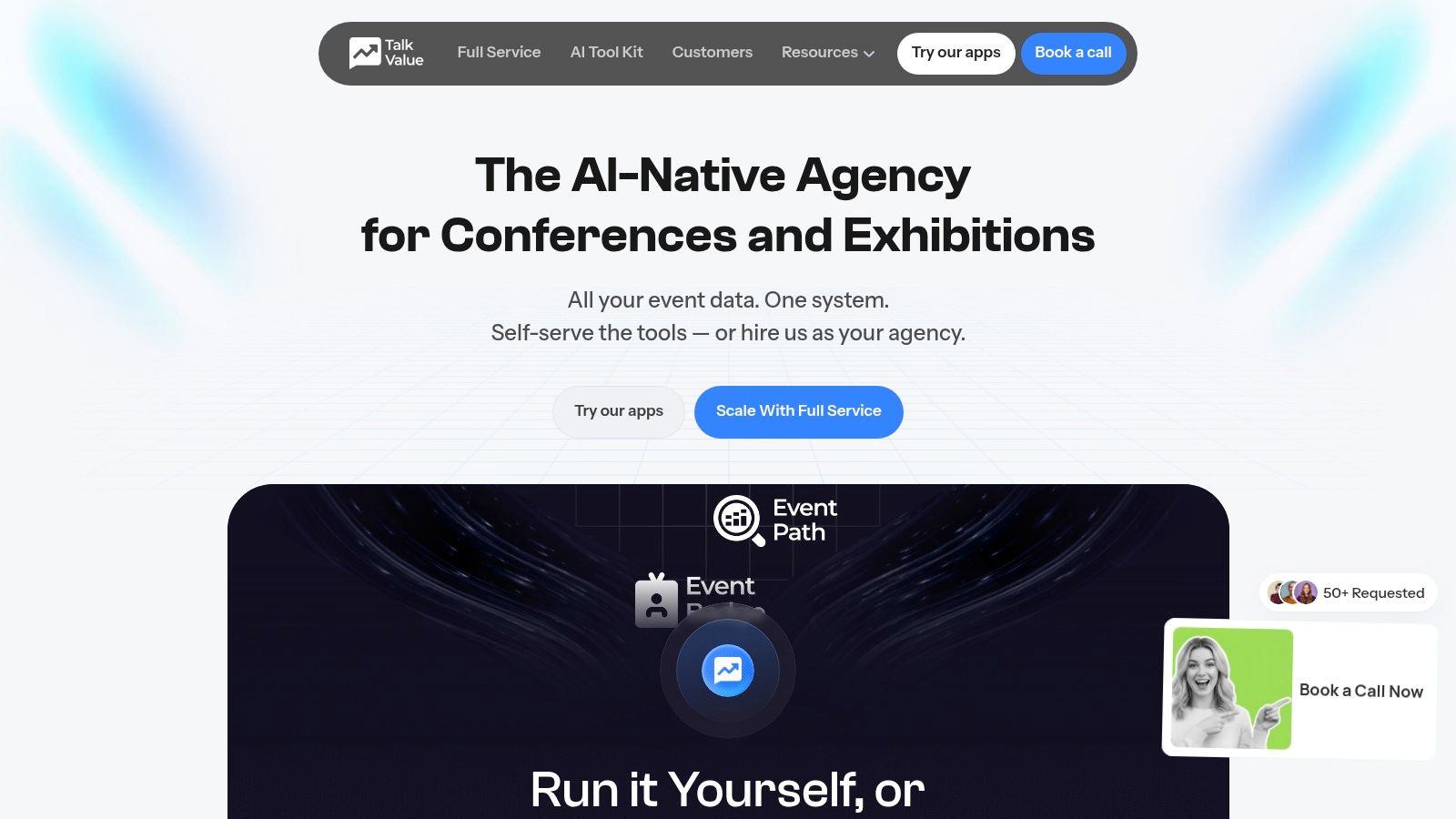
Its core function is to transform disconnected data points into a cohesive system that drives automated, intelligent actions. This reconciliation enables strategic workflows that are otherwise impossible: triggering personalized outreach based on an attendee's session history and ticket type, providing sponsors with verified engagement metrics, and automating follow-ups that convert event interactions into sales pipeline. For example, by unifying data, organizers have achieved a 40% higher average revenue per person (ARPP) from repeat attendees and a 70% reduction in manual staff workflows. These outcomes are not the result of a better feature, but of a better decision framework.
Key Strategic Implications
TalkValue’s model—offering a self-serve Growth AI Toolkit or a full-service agency engagement—provides flexibility for different organizational structures. It is engineered for leaders who measure success in revenue growth, monetization efficiency, and long-term attendee retention.
Best For: Exhibition organizers, association leaders, and event portfolio directors focused on measurable revenue outcomes and operational leverage.
Strategic Alignment: The platform includes an AI + Events Knowledge Center, which provides strategic playbooks for building repeatable, growth-oriented processes. This positions it as a partner in strategic capability-building, not just a software vendor.
Revenue Impact: By automating sponsor visibility and lead generation follow-ups, it provides exhibitors with demonstrable ROI, strengthening monetization and retention.
Limitations and Considerations
The model's value is predicated on the existence of data to unify. Organizations with a very simple, single-platform setup may not immediately leverage its full power. Furthermore, its strategic nature means pricing is not a simple-per-registrant fee; it requires a discovery process to align the solution with specific revenue goals, which may not fit teams seeking an immediate, off-the-shelf tool.
Website: https://trytalkvalue.com
2. Eventbrite: The Public Discovery Marketplace
Eventbrite is a powerful attendee acquisition channel disguised as a registration platform. Its primary strategic value lies not in its feature set, but in its massive, built-in marketplace. For public-facing events like festivals, consumer workshops, and community gatherings, listing on Eventbrite provides immediate access to a broad audience, solving the "top-of-funnel" discovery problem.
However, from a data infrastructure perspective, it often functions as a data silo. While excellent for initial registration, the attendee data it collects is basic and lives within the Eventbrite ecosystem. For B2B organizers focused on long-term value, this creates a challenge. The data must be manually exported and reconciled with other systems (CRM, marketing automation) to build a complete picture of the attendee journey. Its strength in public discovery comes with a trade-off in data depth and integration for complex corporate events.
Key Details & Use Cases
Best For: Public-facing events where attendee acquisition and speed-to-market are the primary strategic drivers.
Pricing: A percentage-based fee on paid tickets, which is transparent but can become a significant revenue share for high-priced events.
Limitations: Limited customization for registration forms and branding. The data it provides is often insufficient for deep B2B cohort analysis without significant manual reconciliation. Learn more about step-by-step event planning.
Website: https://www.eventbrite.com
3. Cvent: The Enterprise-Grade Operational Backbone
Cvent is an enterprise-grade ecosystem designed for the operational complexities of large-scale conferences and exhibitions. Its strategic strength lies in its ability to manage intricate registration logic, multi-track sessions, and complex attendee pathways within a single, robust environment. For organizations where risk mitigation, compliance, and detailed logistical control are paramount, Cvent serves as a powerful operational backbone.
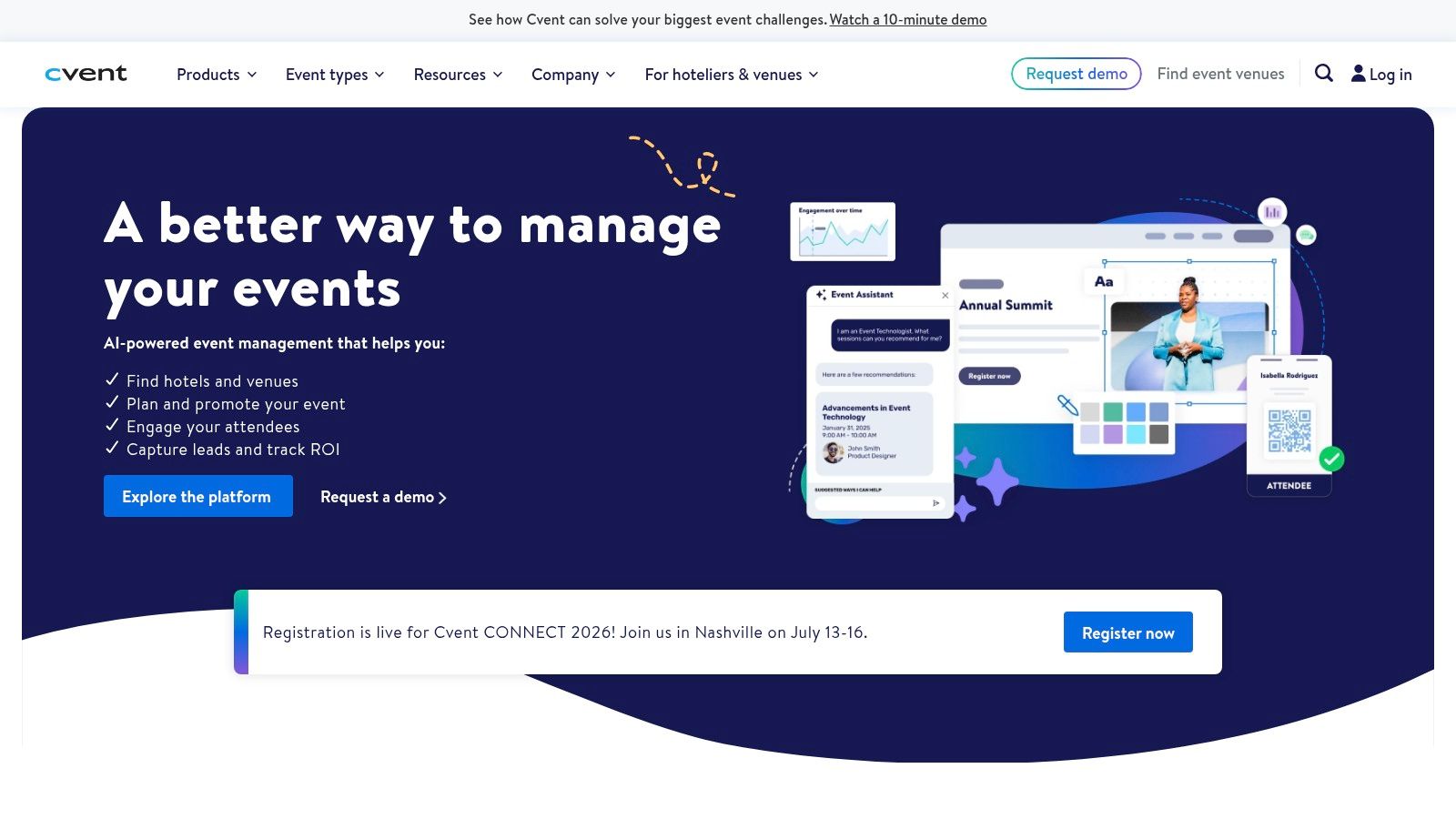
The platform's comprehensive nature, however, can also reinforce the data silo problem at an enterprise scale. While it centralizes a vast amount of event-specific data, integrating this information with external systems like a corporate CRM or business intelligence platform requires dedicated technical resources. The depth of its features can create a steep learning curve, and its premium, quote-based pricing positions it as a significant investment. The key strategic question for a Cvent user is not what the platform can do, but how the rich data within it will be liberated to inform broader business decisions.
Key Details & Use Cases
Best For: Large conferences and exhibitions requiring deep, configurable control over complex logistics and registration paths.
Pricing: A premium, quote-based model reflecting its enterprise focus.
Limitations: The platform's complexity and cost can be prohibitive for mid-sized organizations. Data integration with non-Cvent systems is powerful but often requires a dedicated implementation project. See how AI can be applied to event planning.
Website: https://www.cvent.com
4. Bizzabo: The Cohesive Brand Experience Platform
Bizzabo is designed for organizations that view events as a central pillar of their brand and marketing strategy. Its strength is in providing a cohesive, end-to-end experience, from a branded event website and registration to attendee engagement and analytics. It aims to solve the fragmentation problem by being the single platform that governs the entire event lifecycle, making it an attractive proposition for mid-to-large-scale conferences.
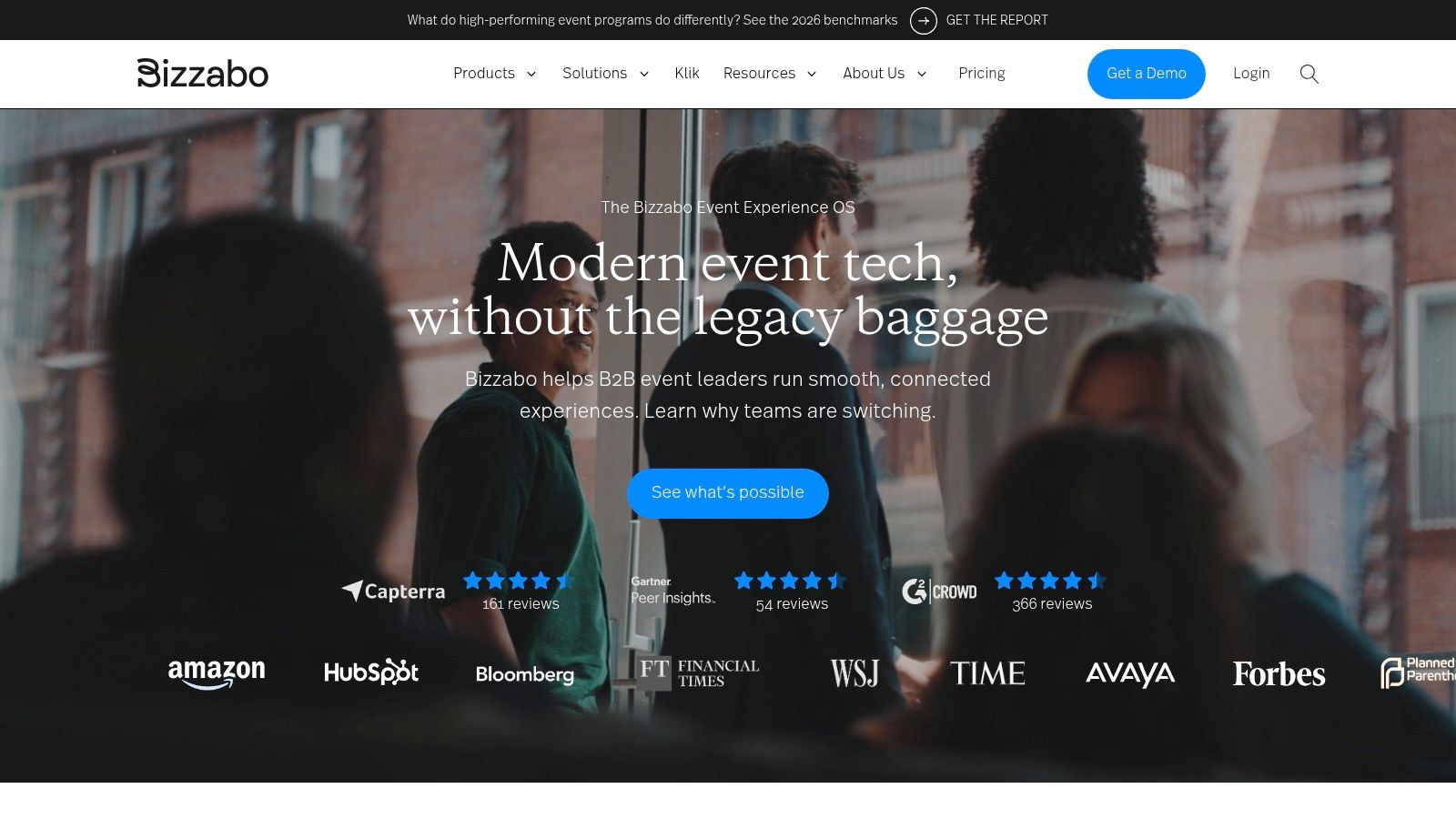
The platform's onsite solutions, like its "Bizzabox" hardware, create a seamless connection between the digital registration and the physical check-in experience. This tight integration is a significant operational advantage. However, like any "all-in-one" solution, its effectiveness depends on the organization's willingness to commit fully to its ecosystem. For companies with existing investments in other specialized tools, Bizzabo can either replace them or become another high-value data silo that requires a separate integration strategy to unlock its full revenue potential.
Key Details & Use Cases
Best For: Brand-led corporate events and conferences where a unified attendee experience from first touch to post-event is a strategic priority.
Pricing: Premium, quote-based pricing for enterprise and mid-market customers.
Limitations: The comprehensive ecosystem and associated cost may be excessive for simpler events. Full value is realized through deep adoption, which may conflict with existing tech stacks.
Website: https://www.bizzabo.com
5. Swoogo: The Portfolio Management Specialist
Swoogo addresses a specific strategic need: managing a large portfolio of events with efficiency and brand consistency. Its 'unlimited events' licensing model is its core distinction, providing predictable costs for corporate event teams and agencies running dozens or hundreds of events per year. The platform is built around a flexible registration and site builder, allowing for rapid deployment of new events using templates.
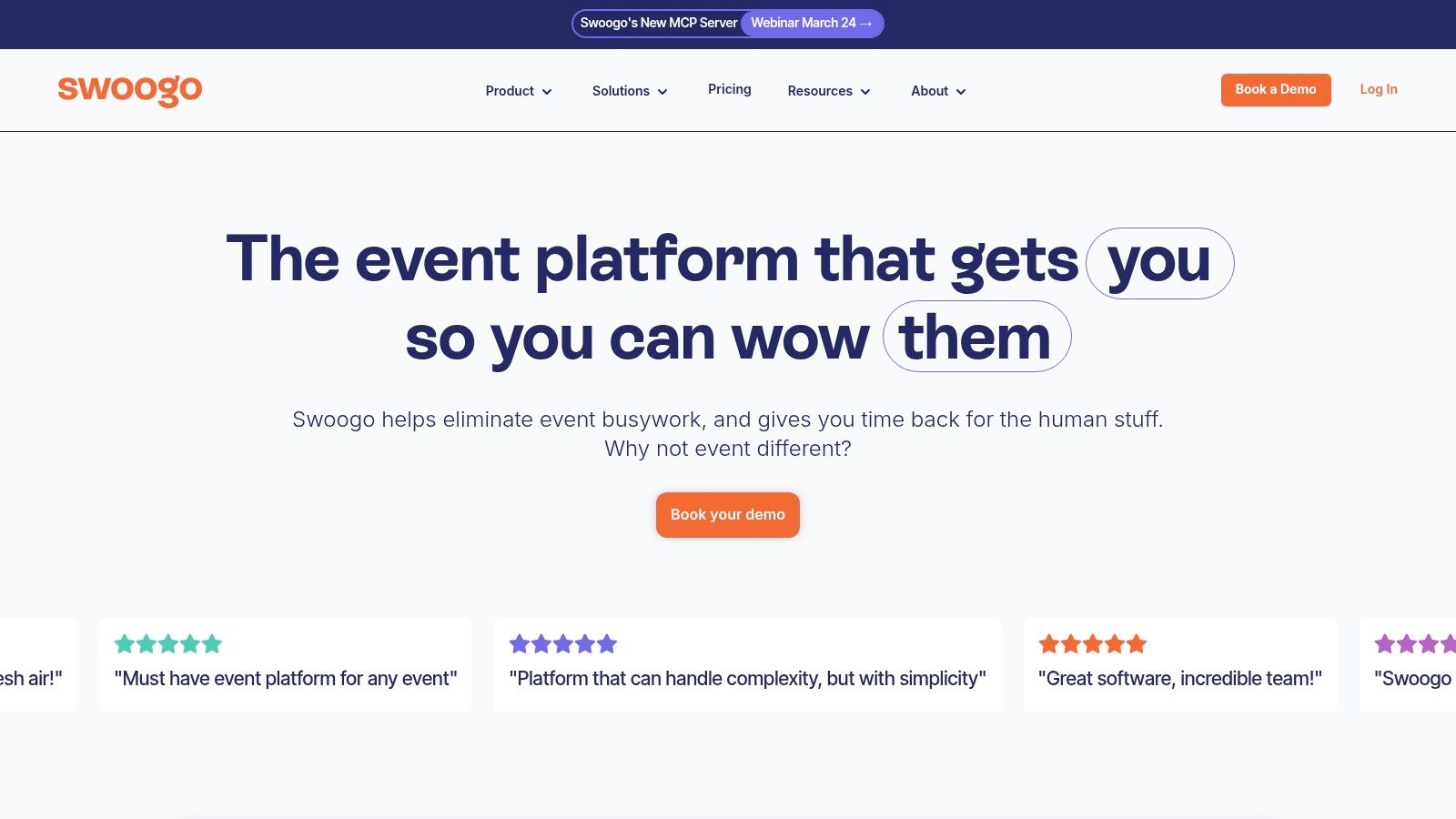
Swoogo's registration-first approach gives organizers significant control over the user journey. From a data perspective, it is more of a specialized component than an all-encompassing system. It excels at the registration function but relies on integrations to connect its data to a broader marketing and sales ecosystem. For an organization using Swoogo, the strategic imperative is to ensure a robust pipeline exists to move registration data into a CRM or central analytics platform where its value can be aggregated and analyzed across the entire event portfolio.
Key Details & Use Cases
Best For: Corporate teams and agencies managing a high volume of diverse events, from webinars to conferences.
Pricing: Quote-based annual licenses that permit unlimited events, offering cost predictability.
Limitations: As a registration-focused platform, it requires integration with other tools for a full event app or virtual experience. The quote-based model requires direct sales engagement.
Website: https://swoogo.events
6. Stova: The Consolidated Enterprise Suite
Stova is the product of consolidating several established event technology companies (Aventri, MeetingPlay), giving it a deep foundation in complex corporate and association events. Its platform is engineered for enterprise-scale requirements, offering a highly configurable registration engine alongside modules for housing, speaker management, and exhibitor resources.
Strategically, Stova functions as a comprehensive operational suite for high-stakes events. Its breadth allows organizers to manage most lifecycle components within a single vendor relationship. This can simplify procurement and data governance. However, this consolidation also places the onus on Stova to provide a cohesive user experience and seamless data flow between its various acquired modules. For leaders, the key is to validate that the "integrated" suite truly functions as a unified system, not just a bundle of separate products, to avoid internal data fragmentation.
Key Details & Use Cases
Best For: Large corporate and association conferences with complex operational needs, including housing and multi-day logistics.
Pricing: Customized, quote-based pricing positioned for the enterprise market.
Limitations: The platform's complexity and cost are geared toward large-scale events. Implementation requires significant planning and resources.
Website: https://stova.io
7. Whova: The Community Engagement Hub
Whova's strategic value proposition is centered on attendee engagement. It bundles registration with a powerful mobile event app, creating a single ecosystem designed to foster networking and community. For associations and academic conferences where the primary goal is connecting people and facilitating discussion, Whova provides an effective, out-of-the-box solution.
The tight integration between its registration system and mobile app ensures that attendee data flows seamlessly into the engagement environment. However, this strength also defines its limitation from a data infrastructure perspective. Whova is an excellent tool for managing the in-event experience, but the data generated (e.g., connection requests, poll responses) largely remains within its own ecosystem. To leverage this engagement data for long-term member retention or personalized marketing, it must be exported and reconciled with other business systems, presenting a common data fragmentation challenge.
Key Details & Use Cases
Best For: Associations and conferences prioritizing attendee networking and community engagement via an integrated mobile app.
Pricing: Quote-based, often with a base fee plus per-attendee costs.
Limitations: Less flexible for complex registration logic. The value of its engagement data is limited unless integrated with a central CRM or data warehouse.
Website: https://whova.com
8. Accelevents: The Mid-Market All-in-One
Accelevents is positioned as a versatile, all-in-one solution for the mid-market, offering a balanced suite of tools for in-person, virtual, and hybrid events. Its key strategic advantage is its transparent, tier-based pricing, which provides upfront clarity on costs and features. This is a significant benefit for teams that need to budget accurately without lengthy sales cycles.
The platform provides a solid foundation for registration, event websites, and badge printing. It is a capable workhorse for a portfolio of recurring, mid-sized events. From a data perspective, it offers a good starting point for centralization. However, its capabilities for deep, multi-system integration and complex analytics may not match those of enterprise-focused suites. It solves the immediate operational needs of the mid-market but may require a more sophisticated data strategy as an organization's revenue ambitions grow.
Key Details & Use Cases
Best For: Mid-market organizers and teams managing recurring events who value transparent pricing and a balanced hybrid feature set.
Pricing: Publicly listed subscription tiers, offering predictability.
Limitations: May lack the depth for very large-scale, complex events with specialized registration and integration requirements.
Website: https://www.accelevents.com
9. PheedLoop: The Cost-Effective Integrated Platform
PheedLoop offers a comprehensive, all-in-one suite with a focus on cost-effectiveness. It bundles registration, a mobile app, on-site services, and virtual components, appealing to associations and conference organizers seeking to consolidate vendors. Its transparent and lower-than-average fee structure is a major strategic draw for budget-conscious organizations.
The platform's broad feature set covers the entire event lifecycle. This integrated approach simplifies operations but, like other all-in-one systems, runs the risk of creating a data island. While it capably manages data within its own environment (e.g., linking registration to lead retrieval), the key to unlocking its long-term revenue impact lies in integrating that data with the organization's central business systems. Its feature breadth may also present a notable learning curve for new teams.
Key Details & Use Cases
Best For: Associations and B2B events needing an end-to-end platform with a transparent, budget-friendly pricing model.
Pricing: A low platform fee (around 1.9%) with public pricing calculators for clear cost estimation.
Limitations: The sheer number of features can be overwhelming. While customizable, design freedom may be less than specialized builders.
Website: https://pheedloop.com
10. RingCentral Events (formerly Hopin Events): The Virtual & Hybrid Delivery System
RingCentral Events, which absorbed the Hopin Events platform, is focused on delivering a mature virtual and hybrid experience. Its strategic strength is its polished user interface for online attendees and robust streaming capabilities. For organizations where the quality of the digital broadcast and engagement is a primary concern, it provides a reliable, enterprise-backed solution.
The platform handles the front-to-back workflow for virtual-first events, from landing pages and registration to post-event analytics. From a data infrastructure standpoint, its registration capabilities are more suited for straightforward ticketing than complex, multi-track physical events. It excels as a content delivery and digital engagement system. The strategic challenge is to ensure that the rich behavioral data generated during the virtual event (e.g., session dwell time, polls) is integrated with a central data platform to inform the complete attendee profile.
Key Details & Use Cases
Best For: Organizers prioritizing a high-quality virtual or hybrid broadcast experience for webinars and digital conferences.
Pricing: Quote-based, requiring contact with the sales team.
Limitations: Less focused on complex in-person registration logic. Lack of transparent pricing complicates initial budget planning.
Website: https://www.ringcentral.com/rc-events
11. RegFox: The Flexible, Low-Cost Registration Specialist
RegFox stands apart by focusing exclusively on flexible, low-cost registration. It appeals to organizers who need granular control over the sign-up process—with complex conditional logic and merchandise upsells—without the overhead of an all-in-one suite. Its strategic value lies in its exceptional cost efficiency and modularity.
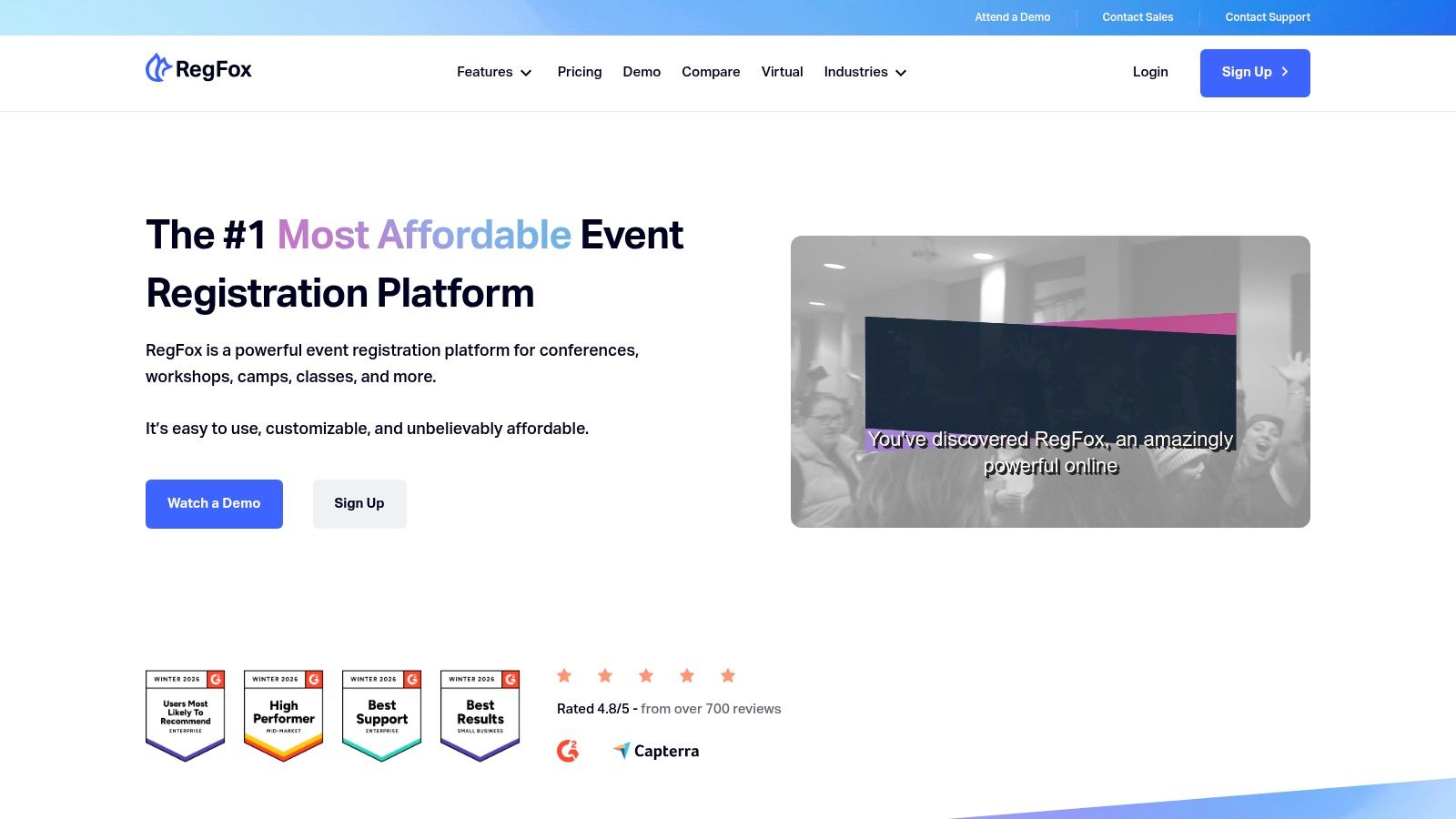
The platform's transparent, low per-registrant fee provides predictable and minimal costs. This "unbundled" approach makes it a powerful component in a custom-built tech stack. By design, RegFox is not an all-in-one solution. It embraces the reality of a multi-vendor ecosystem. For leaders using RegFox, the strategy is explicit: pair its best-in-class registration engine with other specialized tools for event apps, badging, or marketing, and ensure a central system is in place to unify the data from these components.
Key Details & Use Cases
Best For: Organizers prioritizing registration form control and low platform fees, who are comfortable building their own tech stack.
Pricing: A low, flat fee of $0.99 per attendee, providing exceptional cost transparency.
Limitations: It is not a complete event management platform and requires integration with third-party tools for a full experience. Learn how to promote your event.
Website: https://www.regfox.com
12. Eventzilla: The SMB-Focused Self-Serve Tool
Eventzilla provides a balanced, straightforward registration platform for small to medium-sized businesses. Its strength lies in simplicity and speed of deployment. It enables organizers to launch an event with custom-branded pages, ticketing, and essential communication tools without the complexity of enterprise systems.
The platform is designed for self-serve efficiency, making it a budget-friendly choice for smaller conferences, workshops, and training sessions. Its pricing is clear and plan-based, eliminating financial uncertainty. From a data perspective, it provides the core information needed for event execution. However, it is not built for deep, cross-platform data integration or advanced analytics. It solves the immediate tactical problem of registration for SMBs, but organizations with growing revenue ambitions will eventually need to layer a more sophisticated data strategy on top of it.
Key Details & Use Cases
Best For: Small to mid-sized conferences and workshops where a straightforward setup and predictable costs are the main priorities.
Pricing: Offers tiered plans, including a free option for free events, with clear per-ticket fees.
Limitations: Feature depth for complex registration logic and deep analytics may not meet the demands of large-scale enterprise events.
Website: https://www.eventzilla.net
From Tactical Selection to Strategic Infrastructure
The analysis of these platforms reveals a consistent theme: the selection of a registration tool is no longer a simple tactical choice. It is a strategic decision that dictates an organization's ability to generate revenue from its events. While platforms like Cvent and Bizzabo offer powerful, integrated ecosystems, and specialists like RegFox provide cost-effective modularity, they all exist within a broader data landscape. The most significant challenge is not a lack of features, but the structural fragmentation of data across these systems.
This fragmentation has a direct and measurable impact on revenue. Without a unified view of an attendee's journey—from their initial registration tier to their in-app session engagement and post-event survey responses—organizations are operating with critical blind spots. Monetization opportunities are missed, sponsor value is difficult to prove, and attendee retention strategies remain generic and ineffective. The belief that one perfect platform will solve this is a fallacy.
The strategic solution is not to find a better tool, but to build a better decision framework. This requires an orchestration layer, a central nervous system that can ingest, reconcile, and activate data from your entire event tech stack. By shifting focus from the features of a single platform to the architecture of your data infrastructure, you move from simply managing events to building a predictable, growth-oriented event business. This infrastructure provides the clarity needed to see cohorts, understand their value, and make decisions that connect directly to financial outcomes. The most important question for a senior leader is not "Which registration platform should we buy?" but "How will we unify our event data to drive revenue growth?"
Ready to move beyond tactical tools and build a unified, revenue-generating infrastructure? Explore how TalkValue provides the strategic orchestration to connect your data, automate workflows, and unlock predictable growth from your event portfolio. Book a discovery call today.


FAQ