
In the global events industry, the pursuit of the "best event registration software" has become a standardized ritual. Senior decision-makers—from exhibition organizers to association leaders and portfolio directors—are routinely presented with tactical comparisons of features, pricing tiers, and user interface aesthetics. This process, while familiar, is predicated on a dangerously flawed assumption: that event registration is a logistical function to be optimized, rather than the central nervous system of an event’s entire revenue architecture. The common practice is to select a tool that executes a task, when what is required is an infrastructure that drives strategic decisions.
This conventional, tool-focused approach creates a structural gap that quietly undermines profitability. Attendee data—the most valuable asset an event produces—is captured in one system, marketing automation runs in another, CRM data lives in a third, and financial reconciliation happens somewhere else entirely. This fragmentation is not a minor inconvenience; it is a direct inhibitor to revenue growth. Without a unified, reconciled view of the customer journey, from initial impression to final conversion and in-event behavior, strategic blind spots flourish. Mispriced tickets, untraceable marketing ROI, missed upsell opportunities, and declining attendee retention are not isolated problems; they are symptoms of a broken decision-making framework.
This article challenges the feature-first selection process. It reframes the search for registration software as a strategic mandate to build a unified clarity engine. For leaders operating under revenue pressure, the critical question is not "Which tool has the most features?" but "Which infrastructure provides the decision clarity to predictably grow revenue?" We will analyze how leading platforms approach this challenge, moving beyond superficial lists to assess their ability to unify data, illuminate cohort behavior, and connect operational choices to monetization and long-term business growth. The objective is to shift the conversation from tactical procurement to strategic investment in a decision-making framework that underpins the entire event portfolio.
1. TalkValue: The Decision Infrastructure Approach
TalkValue reframes the entire concept of event registration, positioning it not as a software function but as the foundational layer of a strategic growth engine. It is designed as an AI-native decision infrastructure for conferences and exhibitions, built to resolve the core industry challenge of data fragmentation. Rather than adding another tool to the stack, its purpose is to unify disparate data streams from existing platforms—like CRM systems, marketing automation tools, and even other registration platforms—into a single, reconciled source of truth. This approach moves beyond logistics management to provide the clarity needed for strategic decision-making and measurable revenue impact.
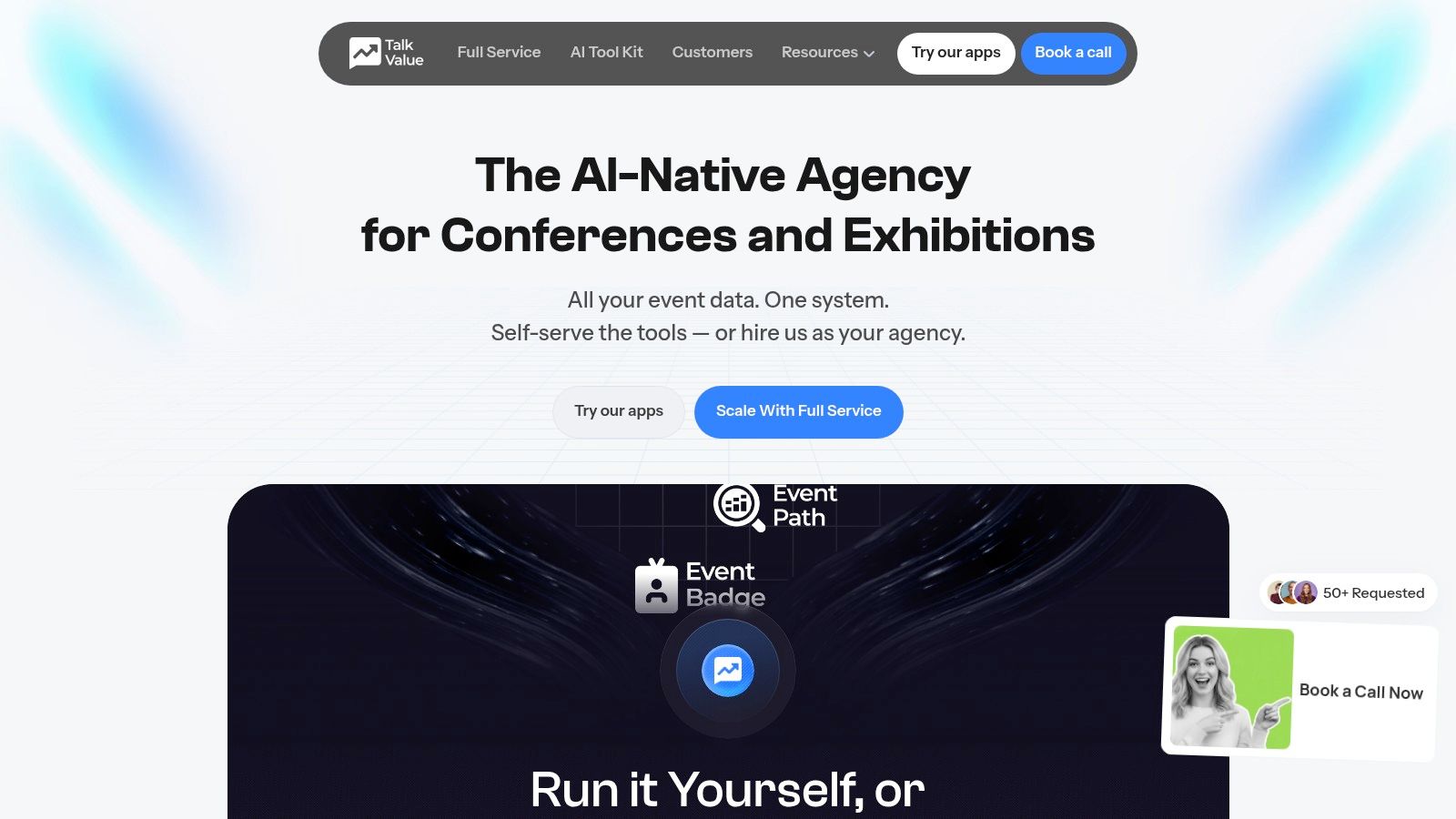
The platform’s architecture is natively built on AI, not as a bolted-on feature, but as the operating system for continuous intelligence. This infrastructure powers automated workflows for registration, check-in, and attendee networking, but its primary function is to surface insights that inform strategy. By reconciling marketing spend with ticket-tier revenue and attendee cohort behavior, it provides direct visibility into profitability. This has delivered quantifiable results, including a 40% higher average revenue per paid attendee (ARPP) and a 70% reduction in manual staff workflows for its clients, positioning it as a strategic choice for leaders focused on ROI.
For organizations aiming to build internal strategic capabilities, TalkValue provides extensive resources. The AI + Events Knowledge Center and the step-by-step event planning guide offer frameworks for implementing AI-first event strategies, moving beyond tactical execution.
Key Strengths:
Unified Decision Framework: Consolidates scattered data from multiple event and business systems to provide a single, actionable view of the event portfolio.
Quantifiable Revenue Impact: Backed by documented case studies demonstrating measurable gains in revenue per attendee, operational efficiency, and attendee engagement.
Flexible Engagement Model: Offered as both a self-serve Growth AI Toolkit for internal teams and a full-service agency model for strategic execution.
Integration-Centric Architecture: Designed to connect with and enhance the value of existing systems (Eventbrite, Luma, HubSpot) by creating a central intelligence layer.
Considerations:
Pricing is not publicly listed; a strategic conversation is required to determine fit and cost, which differs from a transactional software purchase.
The effectiveness of the infrastructure is contingent on the quality of underlying source data, necessitating an initial focus on data reconciliation and integration.
Website: trytalkvalue.com
2. Cvent: The Enterprise-Grade Operational Hub
Cvent is an established enterprise-grade platform that functions as a comprehensive operational hub for large-scale corporate conferences and major trade shows. Its strategic value lies in its capacity to manage extreme complexity, making it a reliable choice for organizations where compliance, intricate data management, and scalability are paramount. The system is engineered to handle complex registration workflows involving conditional logic, numerous attendee types, and tiered pricing structures, while adhering to stringent financial and data security protocols. This makes it the default infrastructure for many large, multi-day conferences with diverse stakeholder requirements.
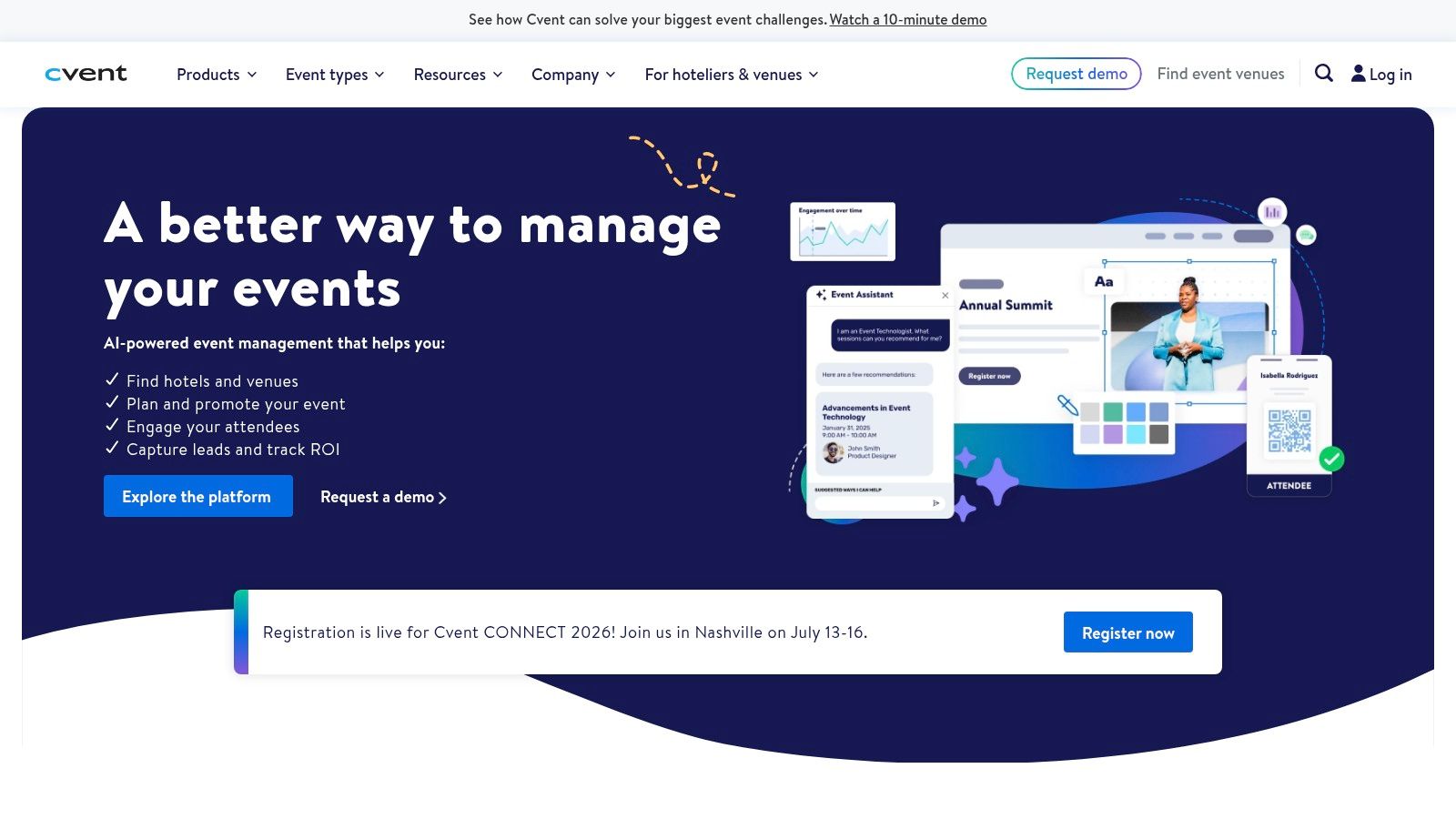
The platform’s strength is its proven ability to operate at scale. Organizers can manage thousands of participants with confidence, relying on its robust payment processing and detailed reporting capabilities. A key component of its ecosystem is the OnArrival solution for onsite check-in, which supports high-volume badge printing and can operate with limited connectivity, ensuring operational continuity. Cvent’s extensive integrations with major CRM and marketing automation systems are a significant advantage for organizations striving for a more unified view of the attendee journey. Exploring how these capabilities fit within the broader landscape of event technology solutions provides a fuller strategic context.
Key Considerations
Aspect | Details |
|---|---|
Ideal Use Case | Large, complex multi-day conferences, exhibitions, and corporate events requiring deep customization and robust financial controls. |
Strengths | Proven scalability, powerful onsite check-in (OnArrival), and extensive integration ecosystem. |
Limitations | Pricing is quote-based and represents a significant investment, making it less accessible for smaller event portfolios. The platform's breadth necessitates a considerable learning curve. |
Website |
3. Stova: The Portfolio Intelligence Engine
Stova, formed from the consolidation of Aventri, MeetingPlay, and eventcore, is positioned as an end-to-end event platform designed for organizations managing a diverse portfolio of events. Its strategic proposition is the creation of a unified data environment that delivers portfolio-level analytics, making it a compelling choice for enterprises seeking a holistic view of their entire event program's performance. Stova is engineered to manage complexity, with configurable registration supporting tiered pricing and audience-specific rates, all feeding into a central analytics engine for strategic oversight.
The platform bridges the pre-event and onsite experience through solutions like its Fast Pass QR-based check-in, which integrates directly with its mobile app. This integration is crucial for capturing a complete data narrative from the first touchpoint to the final session. What distinguishes Stova is its Event Intelligence Suite, which provides business intelligence-grade analytics across an entire event portfolio. This enables leaders to move beyond single-event reporting to make strategic decisions on marketing investment, resource allocation, and long-term engagement based on aggregated, cross-event data.
Key Considerations
Aspect | Details |
|---|---|
Ideal Use Case | Organizations managing a multi-event portfolio that require unified data, strong onsite integration, and portfolio-level analytics for strategic decision-making. |
Strengths | Integrated mobile and onsite experience (Fast Pass), strong portfolio-level analytics for business intelligence, and enterprise-grade security and permissions. |
Limitations | Pricing requires a sales consultation. The platform's depth may necessitate dedicated training and onboarding for new teams. |
Website |
4. Bizzabo: The Event Experience Operating System
Bizzabo positions itself as an "Event Experience OS," aiming to provide a connected platform for in-person, virtual, and hybrid events. It is a strong contender for teams that manage a portfolio of recurring events and prioritize deep alignment with marketing objectives. The platform’s architecture is designed to unify registration, marketing automation, attendee engagement, and reporting within a single system, providing a clear line of sight from initial promotion to post-event analysis. This makes it particularly effective for marketing-led event teams focused on demonstrating ROI and lead generation.
A key differentiator is Bizzabo's emphasis on predictable, annual subscription plans that often include unlimited events, a model that appeals to organizations with a full event calendar. The platform also offers robust onsite solutions, including rentable "Bizzabox" hardware for check-in and smart wearables like Klik to track engagement and enhance sponsor value. Its strong native integrations with major CRMs and marketing automation platforms (Salesforce, HubSpot, Marketo) ensure that event data feeds seamlessly into broader business intelligence efforts. Understanding how to integrate such tools with emerging technology is critical; exploring the strategic applications of AI for event planning can provide valuable context.
Key Considerations
Aspect | Details |
|---|---|
Ideal Use Case | Mid-to-large-sized organizations running a recurring portfolio of in-person, hybrid, or virtual events with a strong focus on marketing and sponsorship ROI. |
Strengths | Predictable annual pricing model, strong onsite technology (Bizzabox, Klik), and deep marketing stack integrations. |
Limitations | Minimum annual and multi-user commitments may be a barrier for organizations with infrequent events. Add-on services and hardware can increase the total cost of ownership. |
Website |
5. Swoogo: The Flexible Registration-First Platform
Swoogo carves out its position as a registration-first platform built for flexibility, making it a popular choice among B2B marketing teams and associations. Its strategic strength lies in highly customizable registration workflows that allow for unlimited conditional logic and precise brand control. This makes it an effective system for organizations managing a high volume of repeatable events, such as roadshows, webinars, or member meetings. The platform’s unique pricing model, based on user licenses rather than per-registrant fees, offers predictable costs for teams with an extensive event calendar.
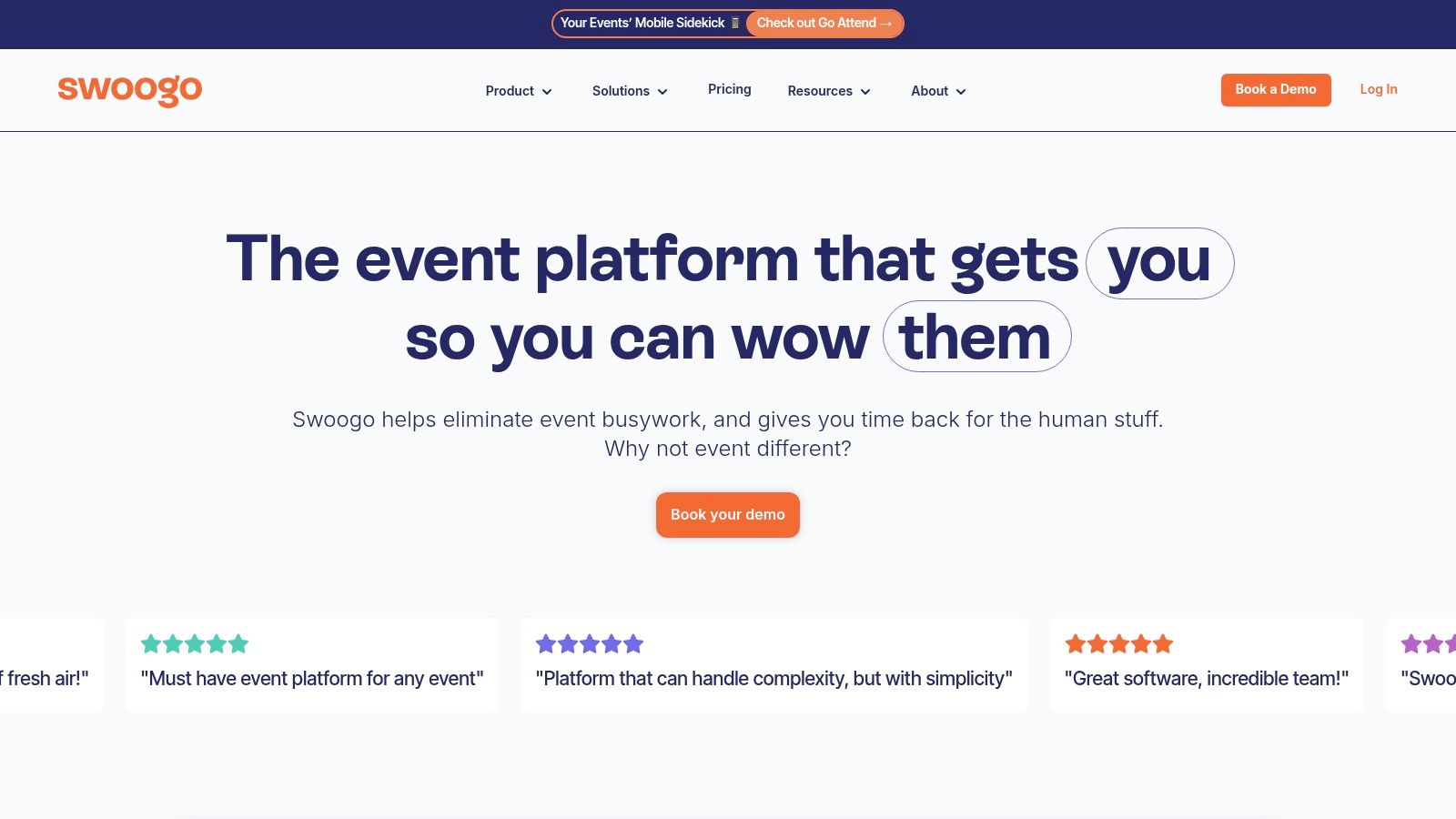
A key differentiator for Swoogo is its emphasis on deep CRM integration, particularly with Salesforce, HubSpot, and Marketo. This focus ensures that event activity translates directly into the marketing and sales funnel, a critical factor for demonstrating event ROI. Event managers can easily clone past events, ensuring consistency in data capture and reporting for recurring programs. While it offers a robust registration engine, organizations should note that it requires a separate payment gateway, and some onsite features are sold as add-ons, which can impact the total cost and integration complexity.
Key Considerations
Aspect | Details |
|---|---|
Ideal Use Case | B2B marketers and associations running a high volume of repeatable events (e.g., webinars, roadshows, seminars) requiring strong CRM integration. |
Strengths | Cost-predictable user-based pricing with unlimited events, deep native CRM integrations, and strong cloning features for efficient event series management. |
Limitations | Requires bringing your own payment gateway (e.g., Stripe, Braintree). Some onsite tech and advanced enterprise features are add-ons or quote-based. |
Website |
6. Accelevents: The All-in-One Mid-Market Solution
Accelevents provides an all-in-one event platform that balances robust functionality with transparent, mid-market pricing. It has established a strong position by offering an integrated solution for registration, ticketing, and exhibitor management without the enterprise-level cost structure. This makes it a compelling option for conference and trade show organizers who require powerful exhibitor tools and onsite capabilities but operate with more constrained budgets. The platform supports both online and offline payment processing and allows organizers to control custom registration fields to capture specific attendee data.
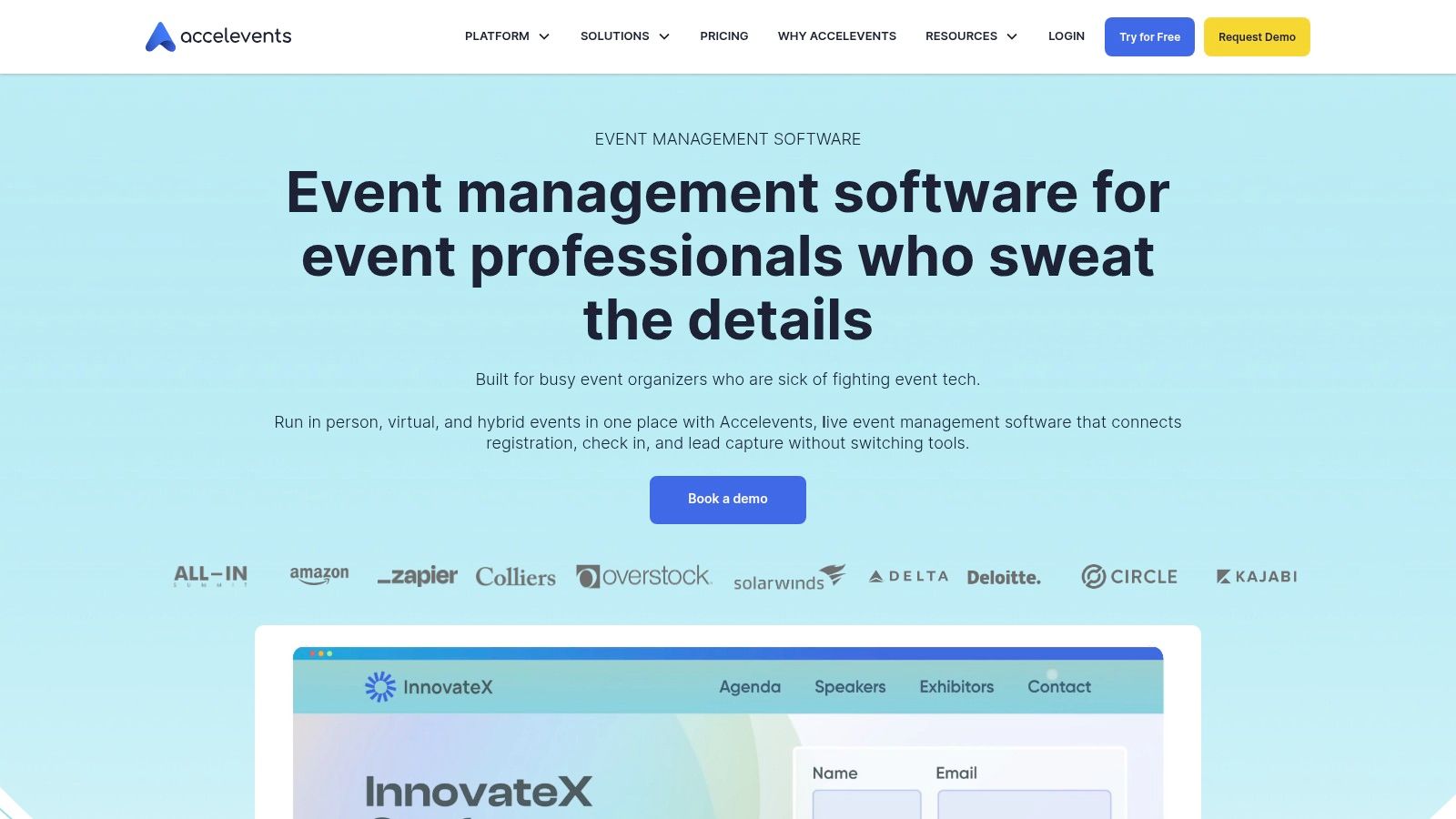
One of its key advantages is the built-in exhibitor portal, which simplifies booth sales, lead capture, and sponsorship management—areas that often require separate tools. Accelevents bundles this with onsite solutions for check-in and badging, ensuring a fluid attendee experience from registration to entry. For organizers managing an event portfolio, its cross-event reporting offers valuable analytics on performance and attendee behavior over time. The inclusion of 24/7 live support is a significant operational benefit, particularly for teams requiring immediate assistance during critical event phases.
Key Considerations
Aspect | Details |
|---|---|
Ideal Use Case | Mid-sized conferences, trade shows, and exhibitions that require strong exhibitor and sponsor management tools on a clear budget. |
Strengths | Transparent pricing with unlimited events on higher tiers, solid out-of-the-box exhibitor workflows, and dependable 24/7 live support. |
Limitations | Per-ticket platform fees are applied at checkout. Advanced features like SSO and a fully white-labeled app are reserved for higher-tier or custom plans. |
Website |
7. Eventbrite: The Mass-Market Discovery Platform
Eventbrite is firmly established as a mass-market ticketing and registration platform, excelling with its simple, self-serve flows and a powerful attendee marketplace. It is a suitable choice for public-facing conferences, festivals, and community events that benefit from high visibility and rapid setup. The platform's core strategic value lies in its discoverability network, which actively promotes public events to a vast user base, often driving incremental registrations that organizers might not have captured otherwise. This makes it a compelling option for those prioritizing ticket sales velocity and audience reach.
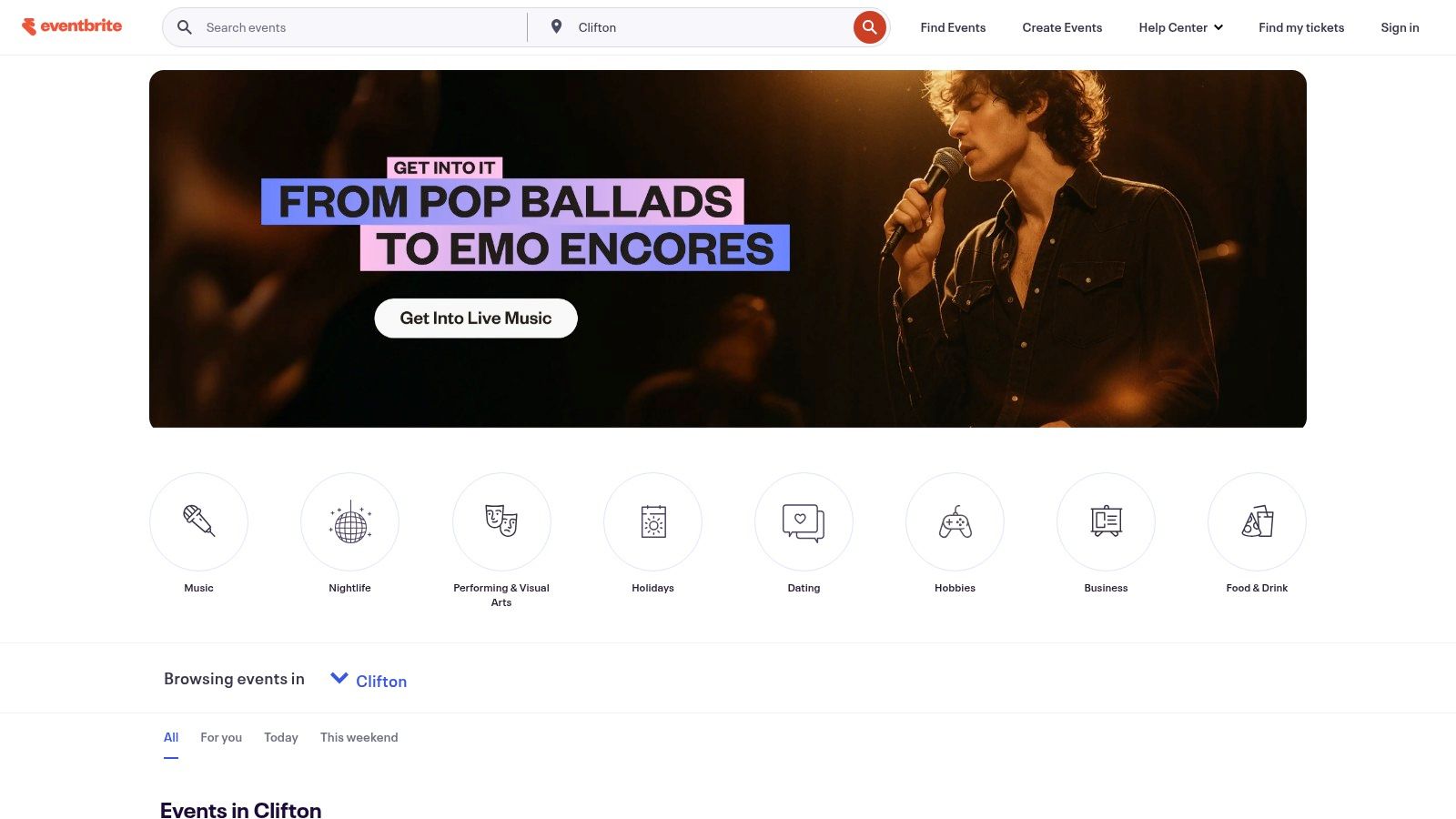
The platform offers a straightforward user experience for both organizers and attendees. Setting up an event is quick, with features like embedded checkouts and promo code management readily available. Its mobile Organizer app provides solid onsite support for check-in and at-the-door sales. However, while its analytics are functional for top-line tracking, strategic leaders often struggle to connect ticket sales data to overall revenue impact or gain deep cohort insights. The consumer-facing branding can also overshadow an organizer's brand identity, a critical consideration for premium events.
Key Considerations
Aspect | Details |
|---|---|
Ideal Use Case | Public-facing community events, workshops, festivals, and smaller conferences that benefit from attendee discoverability. |
Strengths | Fast self-service setup, excellent attendee marketplace for discoverability, and reliable mobile check-in app. |
Limitations | Per-ticket fees can become costly for high-priced events. The consumer-facing branding can sometimes overshadow the organizer's own brand identity. |
Website |
8. Whova: The Attendee Engagement-Focused Platform
Whova has built a strong reputation in the event management space, particularly for its ability to create a cohesive attendee experience from registration through post-event engagement. Its strategic strength lies in the tight integration between its registration system, a highly-adopted event app, and on-site management tools. This makes it an excellent choice for organizers prioritizing attendee networking and a smooth, digitally-native journey, especially for professional conferences and association meetings where community interaction and lead generation are primary objectives.
Whova's registration functionality is designed with practical revenue generation and operational efficiency in mind. Organizers can create group ticket bundles, offer post-registration add-ons, and track sales attributed to specific promotional links. A key differentiator is its focus on a streamlined check-in process, which supports Apple and Google Wallet passes to speed up entry. This integrated approach ensures registration data flows directly into the event app for networking and the check-in system for badging, maintaining data consistency across the event lifecycle.
Key Considerations
Aspect | Details |
|---|---|
Ideal Use Case | Professional conferences, association events, and tradeshows focused on high app adoption, attendee networking, and integrated exhibitor lead retrieval. |
Strengths | Deep integration between registration, app, and check-in workflows. Strong revenue features like ticket bundles and add-ons. |
Limitations | Pricing is quote-based, and organizer-side fees are only visible within the dashboard. Advanced design customizations are more constrained than in open-ended builders. |
Website |
9. Zoho Backstage: The Integrated Ecosystem Solution
For organizations already invested in the Zoho ecosystem, Zoho Backstage offers a compelling and budget-friendly event management solution. It is positioned as an excellent choice for small to medium-sized businesses and associations that need a functional, integrated platform without an enterprise-level price tag. Its key appeal lies in its transparent pricing, which includes a 0% ticketing commission on its paid plans, making it a strong option for cost-conscious teams focused on maximizing ticket revenue. The platform provides a solid foundation with an integrated website builder and native connections to the broader Zoho suite.
This deep integration is a significant strategic advantage for existing Zoho users. Organizers can connect event data directly with Zoho CRM for sales follow-up and use Zoho Flow for custom automation, creating a unified system for managing the entire attendee lifecycle within a familiar environment. Higher-tier plans expand functionality to include exhibitor management with floor planners and lead capture tools, adding value for small trade shows and conferences.
Key Considerations
Aspect | Details |
|---|---|
Ideal Use Case | Small to mid-sized events, workshops, and conferences, especially for organizations using other Zoho products like CRM or Meeting. |
Strengths | Transparent and affordable pricing with 0% ticketing commission on paid plans. Strong native integration with the Zoho software stack. |
Limitations | Advanced enterprise features, such as fully white-labeled mobile apps or support for very large-scale events, are reserved for the highest-tier plans. |
Website |
10. ExpoPlatform: The Exhibition and Trade Show Specialist
ExpoPlatform is engineered specifically for the demands of exhibitions, trade shows, and B2B marketplace events. It stands out by centering its registration workflows around exhibitor and sponsor value, making it a strong contender for organizers in the expo sector. The system is built to manage complex, multi-step registration pipelines where audience segmentation is critical. It allows organizers to create distinct registration paths for attendees, exhibitors, speakers, and press, ensuring each group provides and receives the relevant information needed for a successful trade fair.
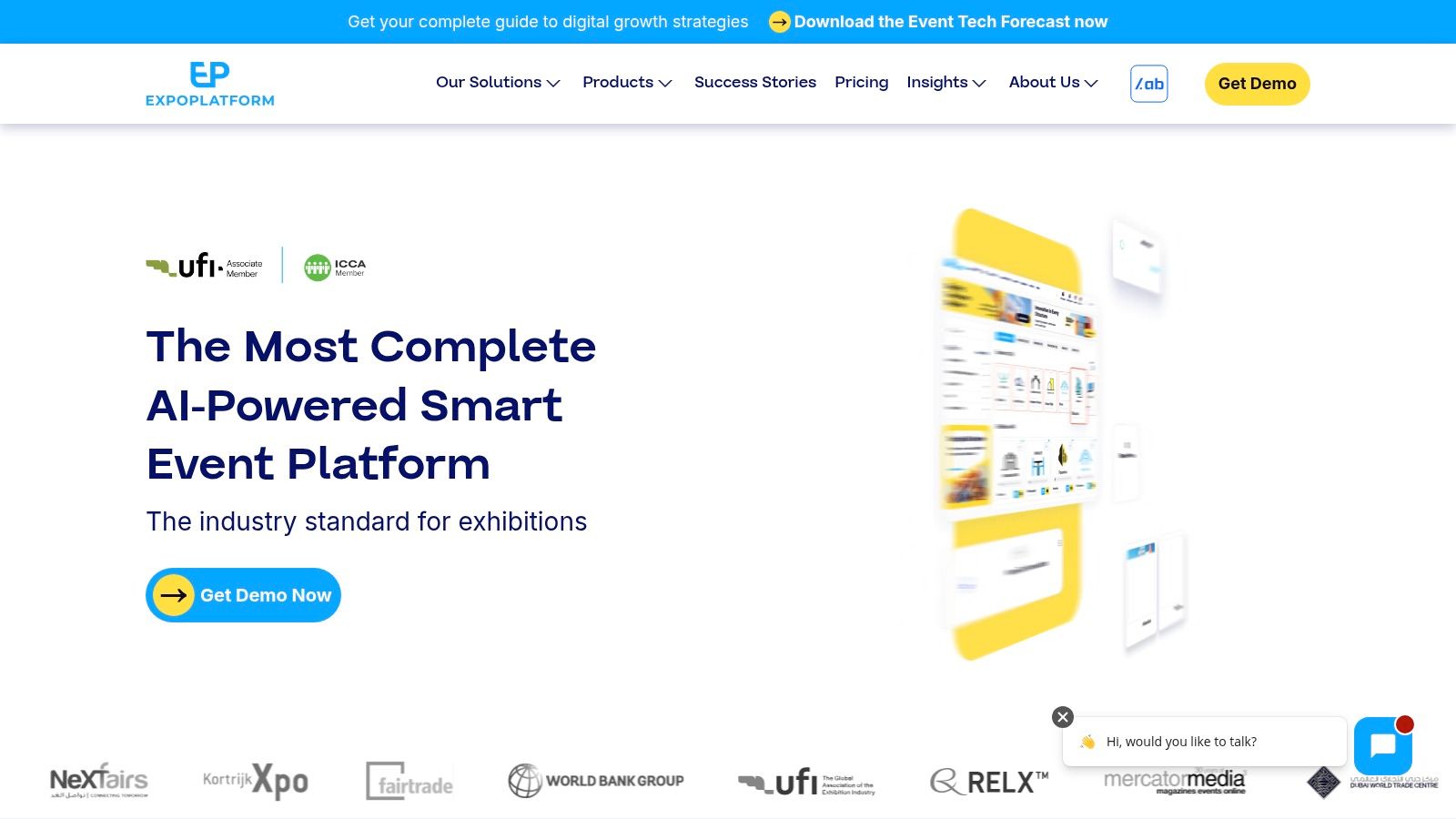
The platform’s exhibitor-first approach is its key differentiator. The registration process directly feeds its matchmaking, lead retrieval, and marketplace functionalities, providing sponsors and exhibitors with immediate value and clear ROI opportunities. Features like customizable forms with conditional logic and varied pricing tiers are standard, but they are purpose-built to support the business objectives of a B2B fair. The system’s design prioritizes creating a valuable data set that helps connect buyers and sellers, which is the core purpose of any trade show.
Key Considerations
Aspect | Details |
|---|---|
Ideal Use Case | B2B trade shows, exhibitions, and marketplace-style events where exhibitor value and audience segmentation are key. |
Strengths | Exhibitor-first workflows, flexible form builder, and deep audience segmentation tailored for B2B event objectives. |
Limitations | Pricing is quote-based and may be more than simple ticketing tools. It might be too feature-rich for small meetings. |
Website |
11. RegFox: The Cost-Efficient and Controllable Option
RegFox carves out its niche by focusing on affordability and control, making it one of the best event registration software choices for organizers prioritizing cost-efficiency and brand ownership. Its pricing model stands in sharp contrast to percentage-based platforms, offering a low, capped fee per registrant that is highly economical for higher-priced tickets. This approach gives organizers predictable costs and the freedom to pass all fees directly to the attendee. It is a powerful option for non-profits, community events, and businesses that need to maximize revenue from each ticket sold.
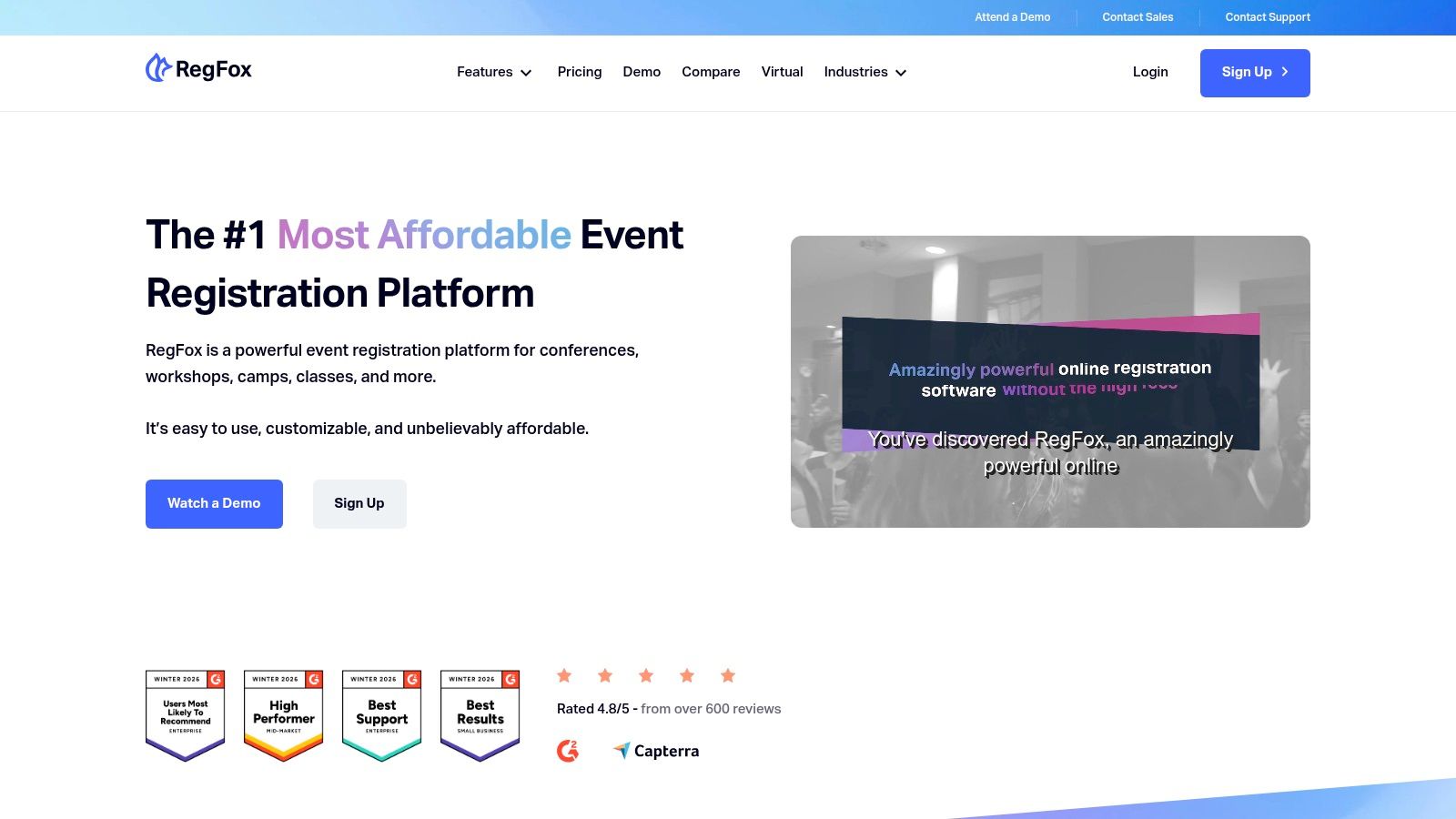
The platform’s strength lies in its highly customizable registration forms. A visual page builder with robust conditional logic allows event managers to create a tailored data-capture experience, ideal for collecting detailed information or managing add-ons. Organizers get direct access to their funds with weekly payouts and can connect their own payment processors for greater financial control. While it lacks the all-in-one ecosystem of an enterprise suite, its focused approach on flexible, cost-effective registration makes it a standout tactical tool.
Key Considerations
Aspect | Details |
|---|---|
Ideal Use Case | Organizers of workshops, fundraisers, and mid-sized conferences who need powerful form logic and predictable, low registration fees. |
Strengths | Very affordable capped-fee pricing model, flexible page builder with strong conditional logic, and direct financial control with weekly payouts. |
Limitations | Lacks the extensive marketing and onsite event management features of larger platforms. The ecosystem of integrations is smaller than enterprise competitors. |
Website |
12. vFairs: The Managed Service Platform
vFairs offers a versatile platform for virtual, hybrid, and in-person events, making it a strong contender for organizations seeking a unified solution across different formats. Its core strategic strength lies in its high-touch, project-managed support model. This approach is particularly valuable for event teams that need dedicated assistance in configuring complex registration flows or managing the technical delivery of a large-scale production. Rather than a pure DIY tool, vFairs acts more like a service partner, guiding organizers through setup and execution.
The platform’s registration module is robust, supporting flexible tiers and group options. A key differentiator for its in-person offering is the integrated onsite badging system, which includes on-demand printing and QR-enabled lead capture for exhibitors, connecting the physical and digital experience. While its origins are in virtual events, this expansion into in-person services makes it a complete option for organizers planning a portfolio of event types. For teams without deep technical resources, the dedicated project manager is a significant benefit, ensuring complex event concepts are executed properly.
Key Considerations
Aspect | Details |
|---|---|
Ideal Use Case | Organizations running virtual, hybrid, and in-person events that value a high-touch, managed service model over a self-serve tool. |
Strengths | Dedicated project management and support, broad capabilities across all event formats, and integrated onsite solutions like badging and lead capture. |
Limitations | Pricing is custom and generally higher than DIY software, making it less accessible for smaller budgets. The managed service model means less self-serve autonomy. |
Website |
Top 12 Event Registration Software Comparison
Product | Core features ✨ | Quality ★ | Price / Value 💰 | Target 👥 | Standout / USP 🏆 |
|---|---|---|---|---|---|
TalkValue 🏆 | ✨ Unified event data, automated reg/check‑in/networking, Growth AI Toolkit + agency | ★★★★★ Continuous event intelligence; documented ROI | 💰 Quote-based; ROI-driven (e.g., 40% ARPP, 7k+ check‑ins) | 👥 Conferences, event ops, B2B marketing, sponsors | AI-native growth engine + playbooks 🏆 ✨ Tech + training for measurable revenue & ops gains |
Cvent | ✨ Configurable registration, OnArrival badging, payments, deep integrations | ★★★★ Enterprise-grade, scalable | 💰 Quote/high — enterprise pricing | 👥 Large, multi-day conferences & trade shows | ✨ Robust onsite, compliance & support for complex events |
Stova | ✨ Custom reg, Fast Pass QR check‑in, Event Intelligence, portfolio mgmt | ★★★★ Enterprise capabilities, BI analytics | 💰 Quote-based | 👥 Portfolio managers, enterprises running many events | ✨ Portfolio-level analytics + integrated onsite workflows |
Bizzabo | ✨ Reg + marketing OS, onsite badge kits, wearables, integrations | ★★★★ Strong marketing→registration alignment | 💰 Annual plans — predictable for recurring events | 👥 Recurring event teams, marketing-led conferences | ✨ Sponsor hardware & marketing integrations to boost ROI |
Swoogo | ✨ Highly customizable reg, unlimited events (user pricing), CRM sync | ★★★★ Repeatable builds, strong reporting | 💰 User-based; cost-predictable for many events | 👥 B2B marketers, associations, repeat event teams | ✨ Cloning + advanced form logic for repeatable workflows |
Accelevents | ✨ Reg, exhibitor tools, kiosk/self check‑in, 24/7 support | ★★★★ Solid out‑of‑the‑box exhibitor workflows | 💰 Published tiers; mid‑market pricing | 👥 Mid‑market conferences & exhibitors | ✨ Clear pricing + strong exhibitor/lead capture features |
Eventbrite | ✨ Self‑serve ticketing, discovery marketplace, mobile check‑in | ★★★ Fast setup, high discoverability | 💰 Per‑ticket fees; platform marketplace fees apply | 👥 Public events, community orgs, SMBs | ✨ Large attendee marketplace for discoverability |
Whova | ✨ App + reg + check‑in, lead capture, wallet passes, group bundles | ★★★★ High app adoption; integrated workflows | 💰 Quote-based | 👥 Conferences, associations, exhibitor programs | ✨ Tight app↔onsite linkage and revenue features (bundles/add‑ons) |
Zoho Backstage | ✨ 0% ticket commission options, site builder, Zoho integrations | ★★★★ Cost‑conscious, integrated with Zoho stack | 💰 Subscription or pay‑per‑event; value-focused | 👥 SMBs, Zoho customers, associations | ✨ Best value within Zoho ecosystem; no ticket commission option |
ExpoPlatform | ✨ Exhibitor-first reg, invoicing, audience segmentation | ★★★★ Tailored for trade shows & expos | 💰 Quote-based; scales with exhibitors | 👥 Trade shows, B2B fairs, exhibitors | ✨ Visitor segmentation & exhibitor-centric monetization tools |
RegFox | ✨ Visual page builder, conditional logic, low capped per‑reg fees | ★★★★ Affordable, flexible checkout | 💰 Low, capped per‑registrant fees; pass fees option | 👥 Cost-conscious organizers, small‑medium events | ✨ Very affordable for high‑ticket events; strong data capture |
vFairs | ✨ Virtual/hybrid/in‑person, badge printing, project management | ★★★★ Broad format support; managed delivery | 💰 Custom/higher; managed service fees | 👥 Teams needing high-touch production & customization | ✨ High‑touch PM + end‑to‑end support across event formats |
From Tool Selection to Strategic Investment: A Decision Framework for Growth
Choosing from our list of the best event registration software is more than a simple procurement task; it is a strategic decision that defines the very foundation of your event's growth potential. We have walked through a dozen distinct platforms, from enterprise giants like Cvent and Stova to specialized, nimble solutions like Swoogo and RegFox. Each offers a different approach, whether it's Bizzabo's focus on in-person experiences, Whova's strength in community engagement, or vFairs' robust virtual environment capabilities.
However, the critical takeaway is not found in a side-by-side feature comparison. The most significant challenge for conference and exhibition organizers is moving beyond isolated functionalities. A seamless registration process is expected, but it's the data behind that process that holds the key to profitability. The true value emerges when registration data is not merely collected but is actively reconciled, analyzed, and turned into a decision-making asset.
Moving Beyond Features to a Unified Growth Engine
The journey from a tactical tool to a strategic asset requires a shift in perspective. Instead of asking, "Which tool has the best registration form?" the more potent question is, "Which platform provides the clearest, most unified view of my attendee journey and its impact on revenue?"
Consider these core strategic pillars when making your decision:
Data Reconciliation: Your event registration software must not be an island. True power comes from its ability to integrate seamlessly with your CRM and marketing automation systems. This creates a single source of truth, allowing you to see which marketing campaigns drove the most valuable attendees, not just the most sign-ups.
Cohort Visibility: Top-tier platforms allow you to move beyond counting heads. They provide the clarity to segment attendees into meaningful cohorts. For example, which ticket-tier cohort had the highest engagement? Which industry segment produced the most qualified leads for sponsors? This visibility is essential for pricing strategy, content planning, and proving ROI to exhibitors.
Monetization and Retention: The ultimate goal is a repeatable and increasingly profitable event model. The right software infrastructure helps you understand attendee behavior to drive retention and identify new monetization opportunities. It transforms static registration data into a dynamic engine for growth, informing decisions that increase attendee lifetime value year after year.
A Decision Framework for Your Next Move
As you finalize your choice, don't get lost in an endless sea of features. Ground your decision in a clear framework based on your organization's specific needs and strategic objectives.
Assess Your Scale and Complexity: Are you running a single annual conference or managing a global portfolio of exhibitions? Enterprise solutions like Cvent or ExpoPlatform are built for complexity, while tools like Accelevents or Eventbrite offer simplicity and speed for smaller events.
Define Your Core Business Model: Is your revenue primarily from ticket sales, sponsorship, or exhibitor fees? A platform like Bizzabo might excel at demonstrating sponsor value, whereas Zoho Backstage offers an integrated business suite for organizations already within that ecosystem.
Prioritize Data Unification: If your primary challenge is a fragmented view of your audience, prioritize platforms that offer robust, native integrations or an API-first approach. This is where AI-native platforms like TalkValue begin to differentiate, focusing on reconciling disparate data streams into a cohesive intelligence layer.
Ultimately, selecting the best event registration software is an investment in your organization's clarity and decision-making capability. The right platform moves you from simply managing event logistics to strategically engineering event growth. It provides the infrastructure to not only execute a successful event but to build a more predictable, scalable, and profitable business.
The platforms we've reviewed offer powerful tools, but many still leave you with fragmented data and unanswered revenue questions. At TalkValue, we built our AI-native platform to solve this specific challenge, unifying your event, marketing, and sales data into a single clarity engine for growth. If you are ready to connect attendee behavior to business outcomes and make decisions that drive profitability, book a conversation with TalkValue to see how our infrastructure can unlock new revenue for your portfolio.


FAQ