For years, the industry has viewed mobile event apps through a narrow lens: attendee engagement. A digital agenda, a networking tool, a channel for push notifications. This is a universally accepted, yet fundamentally limited, perspective. Senior event leaders operating under ROI pressure know that true strategic value is not measured in session ratings or gamification points. It is measured in revenue growth, sponsor retention, and long-term community value. The structural gap in most event portfolios is not a lack of features; it is the disconnect between fragmented app data and actionable revenue decisions. We treat these apps as tactical add-ons rather than what they are: critical infrastructure for monetization and growth.
This article challenges that assumption. We move beyond a simple feature-by-feature comparison of the best mobile event apps to reframe them as strategic assets. Our central argument is this: when you cannot reconcile mobile engagement data with registration cohorts, sponsor ROI, and overall business objectives, you are operating with a significant blind spot. This blind spot obscures monetization opportunities, hinders retention strategies, and ultimately suppresses long-term portfolio growth. The core problem is not which app to choose, but the absence of a decision framework that unifies disparate data into a coherent revenue narrative.
This analysis is for leaders who need to connect their event technology stack to clear financial outcomes. We will examine the leading platforms not by their feature lists, but by their capacity to contribute to a unified decision-making infrastructure. The goal is to move from tactical deployment to strategic clarity, transforming event data from a noisy byproduct into a powerful engine for predictable growth.
1. AI Tool Kit for Events
TalkValue’s AI Tool Kit for Events operates on a different premise than traditional mobile event apps. It is not an all-in-one platform designed to replace your existing systems, but rather a decision infrastructure that unifies them. It serves as an intelligent layer connecting major registration and marketing platforms like Eventbrite, Luma, Whova, and HubSpot. This creates a single source of truth for attendee and sponsor data, designed for event leaders who must eliminate data silos and automate complex operational workflows to achieve scalable growth.
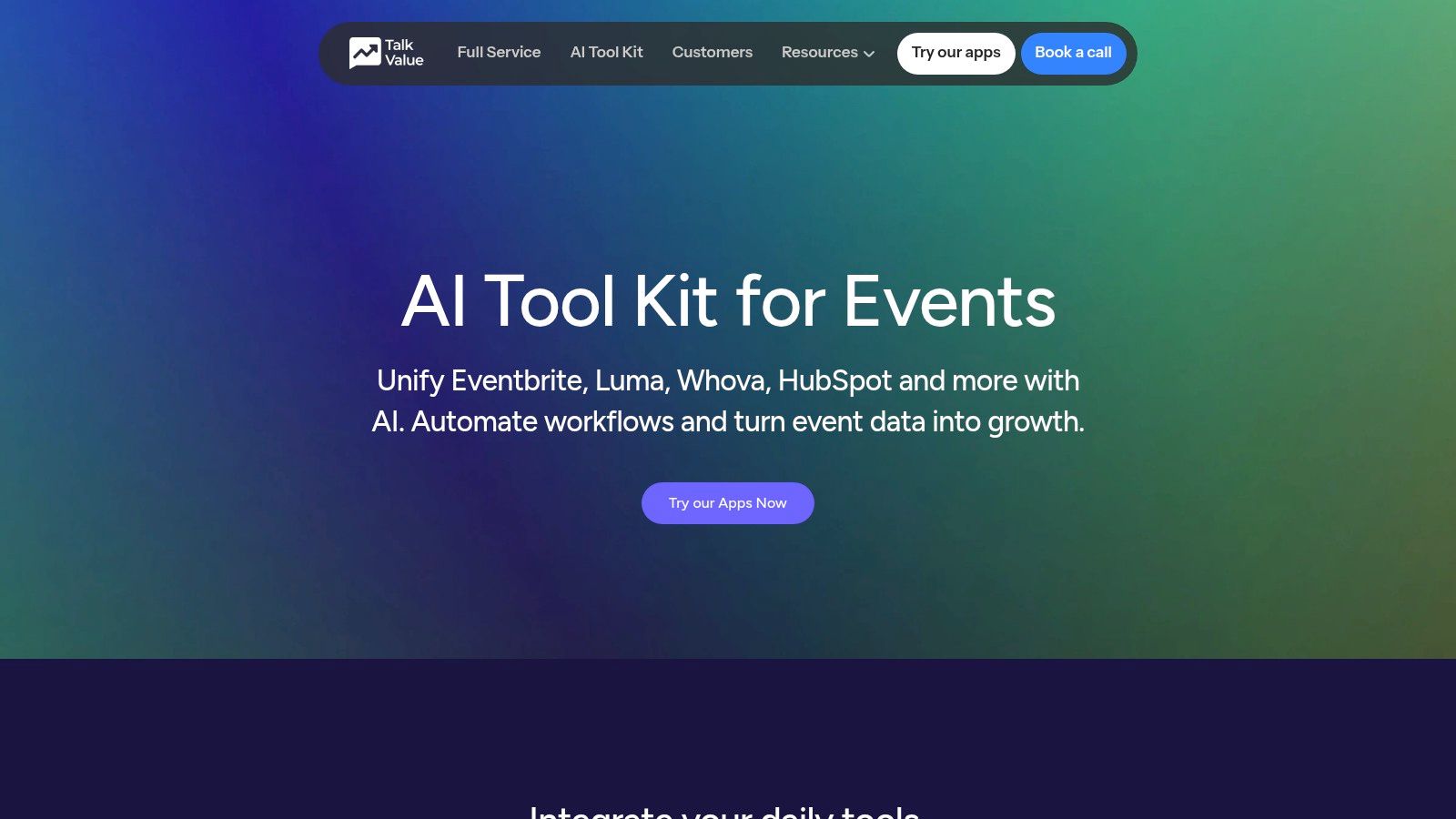
The system is engineered to provide a connected framework for driving measurable financial outcomes. By automating critical processes—from registration and on-demand badge printing to targeted networking and sponsor engagement—the toolkit measurably reduces operational overhead and manual errors. This automation is a core pillar, freeing up teams to focus on high-value strategic activities. For example, its on-demand badge printing has been shown to reduce staff workflows by up to 70%, a significant efficiency gain that directly impacts the bottom line for large-scale conferences. By reconciling data across platforms, it delivers cohort visibility that makes revenue opportunities clear.
Strategic Implications and Core Capabilities
Unified Data Operations: The system aggregates attendee data from disparate sources, providing clean, consolidated information that enables strategic segmentation and personalized monetization strategies.
Workflow Automation: Automates end-to-end event tasks, including check-in, lead capture for sponsors, and post-event outreach, creating operational leverage and reducing costs.
Flexible Service Models: Organizations can choose a self-serve Growth AI Toolkit for direct control or opt for full-service agency support for hands-off execution and strategic guidance.
Demonstrable Revenue Impact: Case studies show tangible results, such as a 40% increase in average revenue per loyal attendee, achieved by using unified data to inform retention and upsell strategies.
Integrated Knowledge Center: The platform includes an AI + Events Knowledge Center with strategic playbooks. This resource helps teams adopt AI-first event practices, and you can explore some of these strategies in their guide to using AI for event planning.
Practical Considerations
The AI Tool Kit is optimized for conferences, exhibitions, and B2B events where attendee data, sponsor ROI, and operational scale are primary concerns. Its strength lies in integrating multiple systems, which requires initial strategic alignment. However, for teams seeking to modernize operations and directly connect event activities to revenue, its data-reconciliation framework offers a distinct advantage over conventional mobile event apps.
Website: AI Tool Kit for Events
2. Cvent Attendee Hub (Cvent)
Cvent Attendee Hub is an enterprise-grade solution designed for organizers managing complex, large-scale conferences and exhibitions. It stands out by providing a single, unified platform that handles the entire event lifecycle. From initial registration through on-site check-in and post-event analytics, Cvent offers a cohesive ecosystem that minimizes the risks associated with integrating multiple, disparate tools. This "one-stack" approach is its primary strategic value proposition, offering a consolidated view of the event within its own walls.
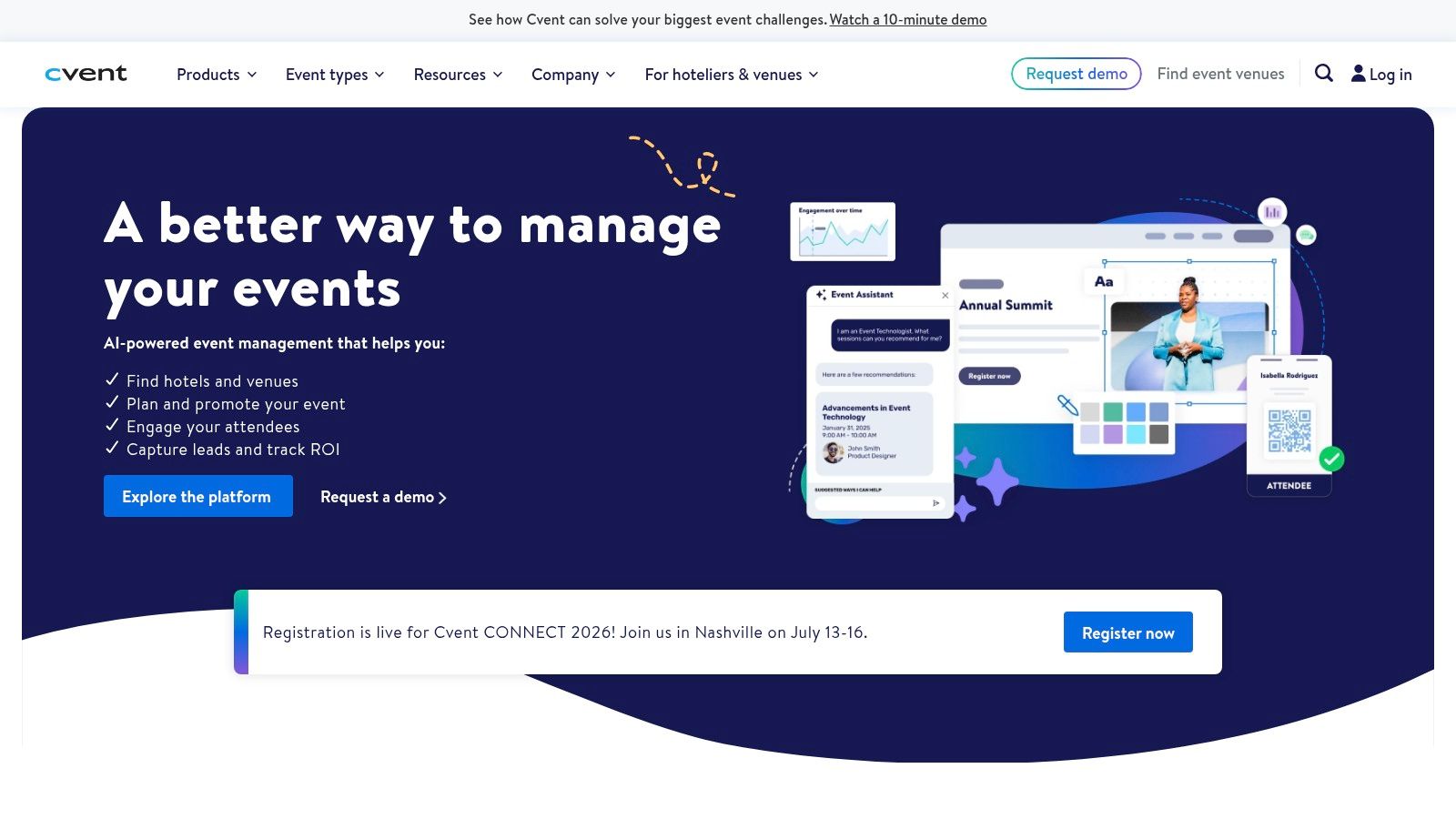
The platform is particularly strong for events with multiple tracks, extensive exhibitor lists, and a need for deep engagement metrics. The mobile app itself supports personalized agendas, session-level registration, and live interaction to keep attendees involved. For organizers, the deep integration with Cvent’s other modules, like exhibitor lead capture and access control, provides a rich data set for internal analysis. Understanding these engagement patterns is crucial, and you can get a better handle on a framework to understand event success metrics here.
Pros & Cons
Pros:
End-to-End System: A single vendor for registration, mobile app, on-site services, and analytics reduces integration complexity.
Predictable Budgeting: Cvent publishes its per-event pricing tiers, allowing for clearer budget forecasting for large-scale events.
Deep Analytics: Provides comprehensive data on attendee behavior, session attendance, and engagement across the entire event.
Cons:
Cost at Scale: The price can become substantial as attendee numbers grow, with overage fees for exceeding tier limits.
Vendor Lock-In: Committing to a single stack can limit flexibility and make it difficult to integrate best-in-class tools from other providers.
Website: https://www.cvent.com
3. Webex Events (formerly Socio)
Webex Events, the platform that evolved from Socio, is Cisco’s entry into the end-to-end event management space. It brings enterprise-grade security and reliability to a suite that covers the entire event lifecycle, from registration to virtual production and post-event analytics. Its key differentiator is its integration within the broader Webex ecosystem, making it a natural choice for organizations already invested in Cisco's collaboration tools. The platform offers a single solution for virtual, hybrid, and in-person event formats.
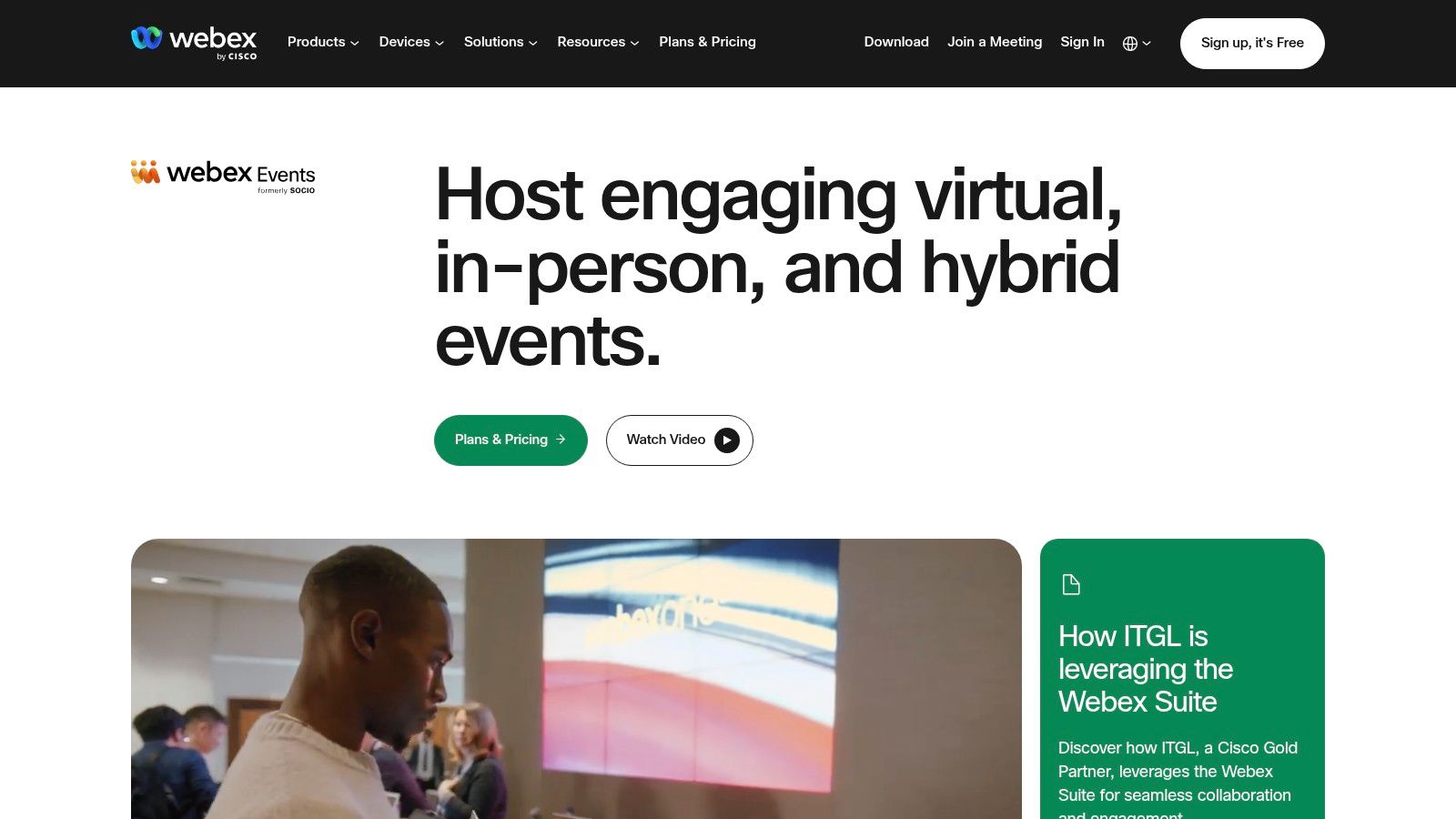
The mobile application itself is a strong contender among the best mobile event apps, with features like branded event communities, agenda management, and networking tools. For organizers, the real power lies in the unified backend. Studio tools for producing hybrid content, integrated lead retrieval for exhibitors, and a robust analytics dashboard provide a cohesive command center. Executing a seamless blended experience is critical, and you can find a guide with hybrid event best practices here.
Pros & Cons
Pros:
Enterprise Security: Backed by Cisco, the platform offers the security and compliance that large corporations require.
Actively Maintained App: The mobile app has a strong presence on app stores and receives consistent updates.
Integrated Ecosystem: Deep connections with Webex Meetings can simplify tech stacks for existing customers.
Cons:
Complex Pricing: Pricing is quote-based and navigating the different Webex tiers and add-on costs can be challenging for budget planning.
Entitlement Navigation: Understanding the distinctions between Webex Events, Meetings, and Webinars can be confusing for administrators.
Website: https://www.webex.com/events
4. Bizzabo (Event Experience OS + Klik)
Bizzabo combines its Event Experience OS with Klik, a smart wearable technology, to deliver an experience tailored for large-scale conferences focused on in-person analytics and sponsor ROI. While Bizzabo offers a complete mobile event app, its standout capability is the behavioral data captured through its Klik SmartBadges. These wearables enable passive session check-ins, attendee networking, and detailed lead capture for exhibitors, all without requiring constant mobile phone interaction.
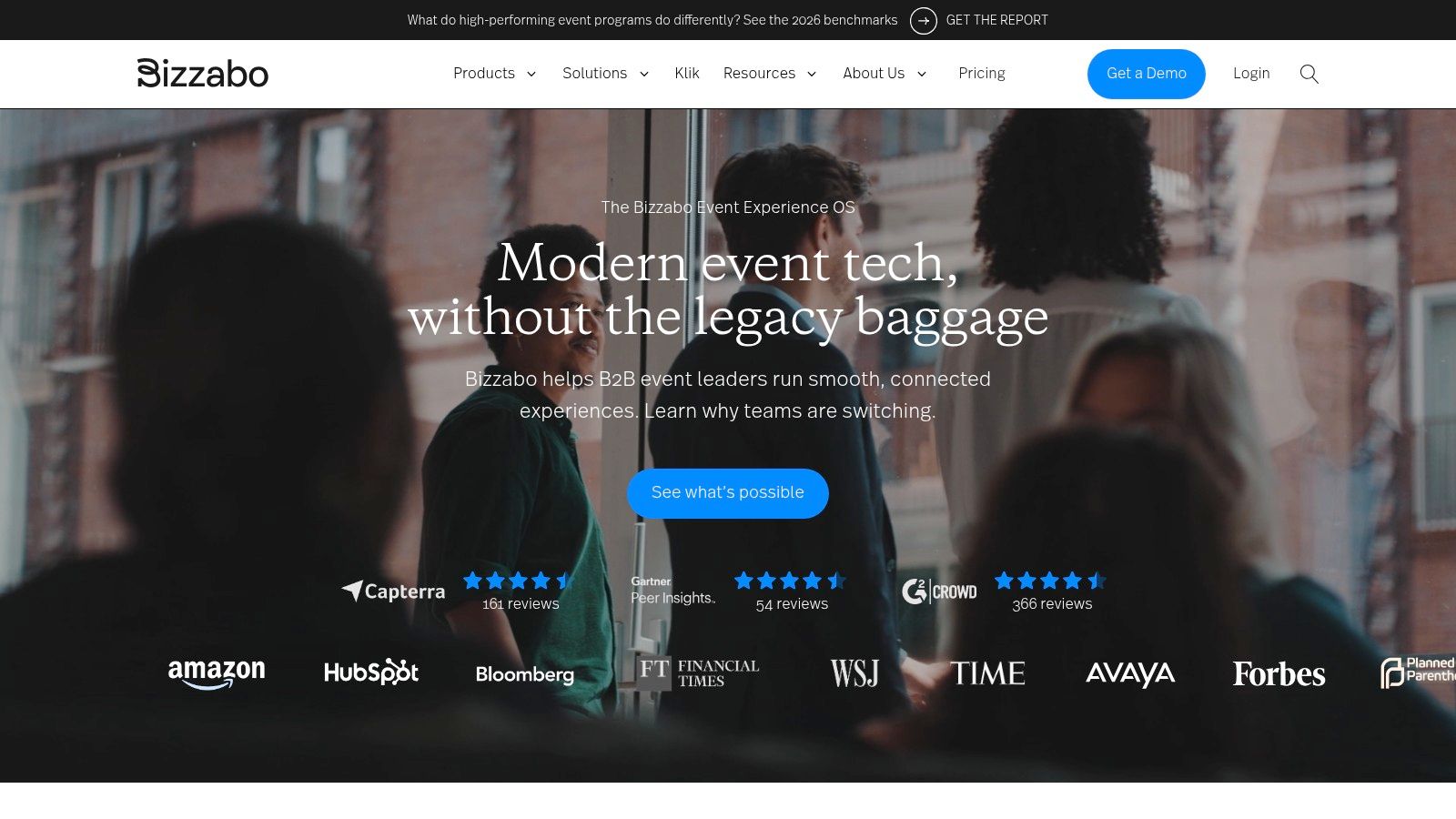
For organizers of flagship corporate events and trade shows, this system generates powerful on-site data, including venue heatmaps showing attendee traffic and real-time engagement metrics. The combination of an intuitive mobile app and passive wearable tech provides a rich dataset that demonstrates tangible value to sponsors and informs future event strategy. Choosing the right components for your event is a key decision; you can explore a broader overview of available event technology solutions here to see how different tools compare.
Pros & Cons
Pros:
Standout On-Site Analytics: Klik wearables provide deep, passive data collection on attendee movement and networking interactions.
Strong Sponsor ROI: The lead capture and activation opportunities across both the app and wearables offer a clear value proposition for exhibitors.
Proven at Scale: Bizzabo is used by major brands for their largest events, demonstrating its performance under pressure.
Cons:
Premium Pricing: Pricing is provided through custom quotes and is generally positioned at the higher end of the market.
Operational Logistics: Deploying and managing wearables adds a layer of operational complexity compared to app-only solutions.
Website: https://www.bizzabo.com
5. Swapcard
Swapcard is a mobile and web event platform built around AI-led discovery, strong exhibitor ROI, and continuous community engagement. Its standout feature is an AI assistant embedded directly into the app to help attendees navigate complex agendas, find relevant exhibitors, and connect with peers. This focus on intelligent matchmaking and a modern user experience makes it a compelling choice for organizers aiming to reduce on-site friction and prove value to sponsors.
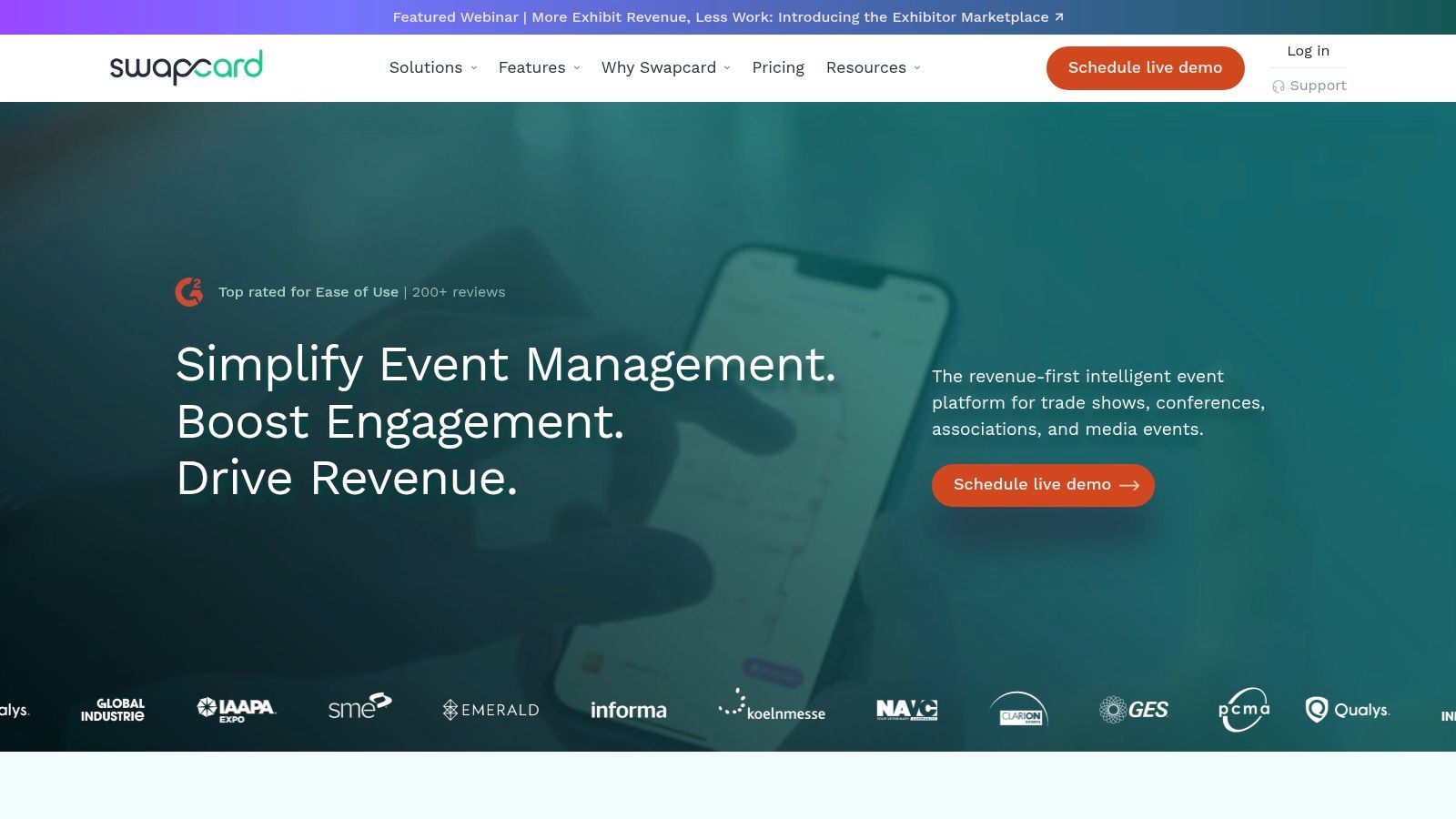
The platform shines in events where attendee networking and exhibitor connections are primary goals. Features like an exhibitor marketplace, integrated meeting scheduling, and lead capture tools are designed to drive measurable interactions. For organizers, the monetization placements and sponsor visibility tools provide clear revenue streams. This approach makes it one of the best mobile event apps for trade shows and conferences where generating high-quality connections is key. Organizers looking to improve their event's social fabric can find more networking event ideas to boost engagement here.
Pros & Cons
Pros:
AI-Driven Discovery: The AI matchmaking and assistant actively help attendees find relevant content and people, improving the event experience.
Exhibitor-Focused ROI: Strong tools for lead capture, monetization, and an exhibitor marketplace give sponsors clear, tangible value.
Frequent Updates: The platform receives consistent feature updates, particularly around its core AI and engagement capabilities.
Cons:
Quote-Based Pricing: Pricing is not transparent, requiring a sales conversation, which can slow down the evaluation process.
AI Reliance: The heavy dependence on AI features may require hands-on management from organizers to ensure it functions as intended.
Website: https://www.swapcard.com
6. Whova
Whova has established itself as one of the most widely used mobile event apps, particularly for small to midmarket conferences and academic gatherings. Its strength lies in a reliable, easy-to-set-up platform focused squarely on attendee networking and essential event logistics. For organizers who need a dependable app without the complexity of an enterprise system, Whova offers a straightforward solution with native iOS and Android apps, plus web access for a consistent experience.
The platform excels at connecting people. Core features include robust attendee-to-attendee messaging, profile sharing, and community forums that encourage interaction. It also provides standard tools like personal agendas, interactive maps, and live polls. Sponsors get dedicated visibility, and organizers benefit from simple check-in and announcement capabilities. A notable policy is its default post-event access window, which typically keeps the app available to attendees for three months, extending the event's community life.
Pros & Cons
Pros:
Broad Familiarity: Many attendees have used Whova before, reducing the learning curve and improving adoption rates.
Solid Cross-Device Coverage: The combination of native mobile apps and a functional web app ensures attendees can engage from any device.
Clear Post-Event Access: The standard three-month access window is a clear benefit that helps continue networking after the event.
Cons:
Opaque Pricing: Pricing is provided on a request-a-quote basis, making it difficult to budget without direct contact.
Promotional UX: The user experience can include promotional nudges that some users find intrusive, reflecting a focus on its own marketing.
Website: https://whova.com
7. EventMobi
EventMobi provides a full-featured mobile event app that is a popular choice for associations and mid-sized B2B events. It successfully balances a professional, branded attendee experience with accessible pricing and modular add-ons. Unlike enterprise systems that often require a full suite commitment, EventMobi allows organizers to start with a strong mobile app foundation and add registration, badging, or hybrid tools as needed. This flexibility makes it one of the best mobile event apps for organizations that need a powerful tool without the complexity of an end-to-end platform.
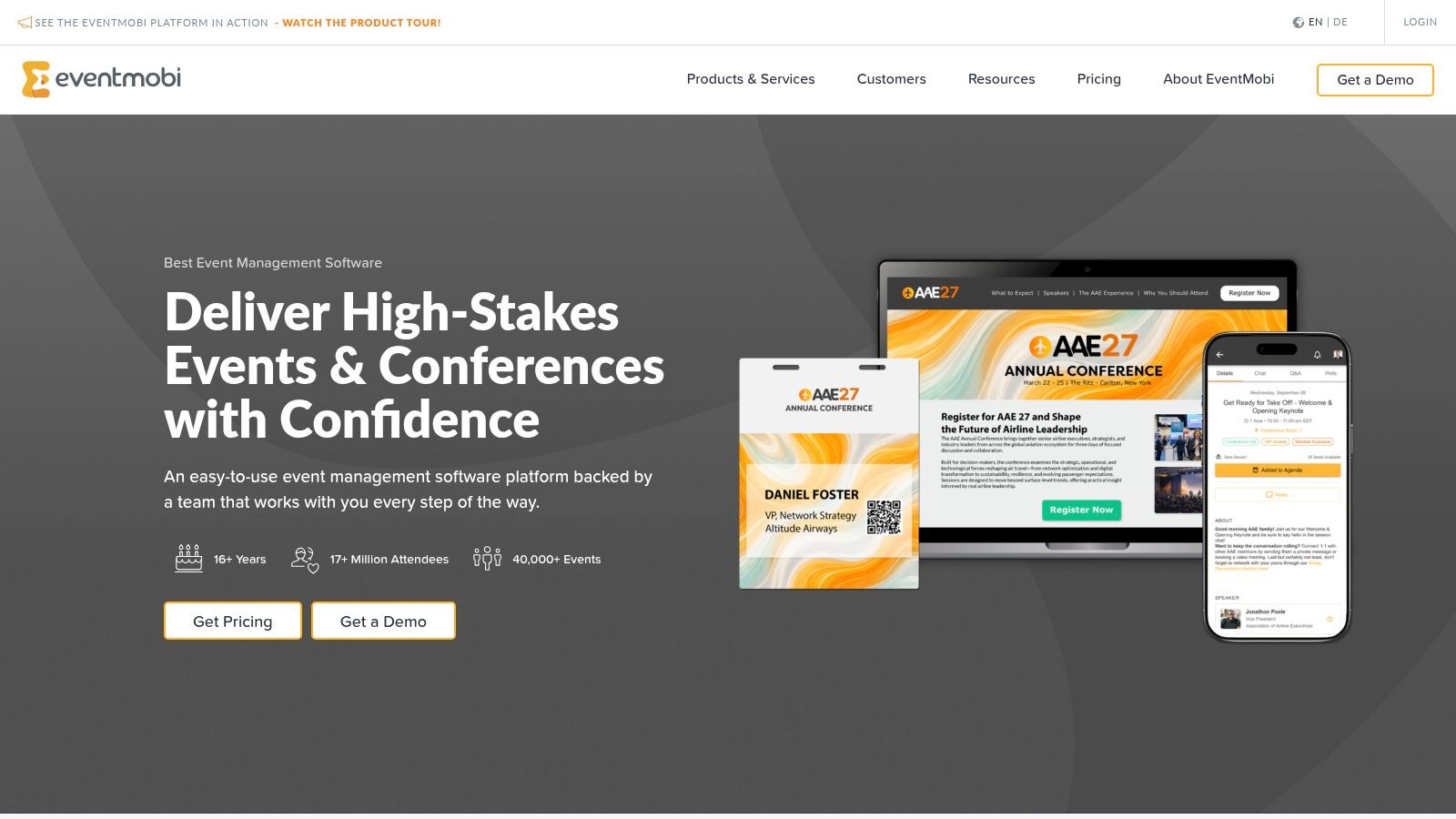
The platform is designed for engagement, offering robust tools like personalized agendas, interactive maps, and gamification to keep attendees involved. Organizers appreciate the direct sponsor placement opportunities and detailed analytics on attendee interactions. EventMobi’s transparent pricing model, with published starting prices for single-event or annual plans, is a significant advantage for budget-conscious planners. The ability to manage on-demand content for hybrid or virtual components also ensures the platform remains relevant for modern event formats.
Pros & Cons
Pros:
Transparent Pricing: Publishes starting prices and offers both single-event and annual options, aiding budget planning.
Association-Friendly: Well-suited for associations with common sponsor visibility needs and member engagement goals.
Modular Approach: Allows organizers to add features like registration and check-in without buying a full, complex suite.
Cons:
Pricing Complexity: Adding advanced bundles and modules can increase the final price, so confirming the required feature mix upfront is critical.
Module-Dependent Features: Certain advanced functionalities are only available as part of additional modules, which may lead to unexpected costs.
Website: https://www.eventmobi.com
8. SpotMe
SpotMe is an enterprise mobile event platform with a strong foothold in highly regulated industries like life sciences and finance. It is built for organizations that prioritize compliance, security, and deep data integration over simple, off-the-shelf functionality. Its key value lies in creating a controlled, branded digital environment where every interaction can be tracked and synchronized with core business systems, such as a CRM or marketing automation platform. This makes it one of the best mobile event apps for capturing compliant, first-party data at scale.
The platform excels at complex event workflows, particularly for medical congresses and large corporate meetings where appointment scheduling and compliant content delivery are essential. Its mobile app offers a universal lead capture system that works with various methods, consolidating all exhibitor lead data within a single, secure interface. This bi-directional integration with systems like Salesforce, Veeva, and Marketo ensures that lead and engagement data flows seamlessly, providing a clear view of attendee behavior.
Pros & Cons
Pros:
Strong Lead Capture: The integrated lead capture system is a significant advantage for exhibitors needing to collect and qualify leads directly within the event app.
Enterprise Integrations: Mature, bi-directional integrations with major CRMs are built-in, making it ideal for data-driven organizations.
Security & Compliance: Its architecture is well-suited for regulated industries that require strict data governance and security protocols.
Cons:
Enterprise-Focused Pricing: The platform uses a quote-based model aimed at large enterprise budgets, making it less accessible for small to mid-sized businesses.
Niche Positioning: Its strengths are most apparent in specific industries, which may mean its feature set is overly specialized for general corporate events.
Website: https://spotme.com
9. Brella
Brella is a mobile and web event app with a singular focus: driving high-quality, pre-scheduled meetings between attendees. It’s designed for deal-making conferences, investment summits, and partner events where the primary ROI is measured by the number and quality of 1:1 interactions. Its entire user experience is built around an AI-powered matchmaking engine that suggests relevant connections and facilitates a personal meeting schedule, making it one of the best mobile event apps for networking-centric formats.
Unlike all-in-one platforms, Brella's strength lies in its purpose-built interface for discovering and booking meetings. The platform also supports sponsors and exhibitors by integrating their profiles directly into the matchmaking flow, providing measurable lead generation opportunities. While it includes standard features like agenda management, every component is secondary to its core function of connecting the right people. This specialization makes it a powerful choice when an event’s success hinges on curated networking outcomes rather than general content consumption.
Pros & Cons
Pros:
High Meeting Acceptance: The AI matchmaking and clean UI are known for producing high meeting request and acceptance rates.
Strong Sponsor Value: Delivers clear, measurable ROI for sponsors by facilitating direct meetings with qualified attendees.
Optimized Networking UX: The user experience is straightforward and laser-focused on scheduling, which attendees find easy to adopt.
Cons:
Custom Pricing: Pricing is quote-based and can be higher than general-purpose apps, reflecting its specialized value.
Niche Focus: Less emphasis on broader conference features like gamification or complex session-level interactivity.
Website: https://www.brella.io
10. Grip
Grip is an AI-powered networking and event platform specifically built for trade shows and hosted-buyer programs where measurable meeting outcomes are paramount. It centers its entire functionality on connecting the right people to drive pipeline and revenue. The platform offers white-label mobile apps, but its core strength lies in its intelligent matchmaking engine, which recommends valuable connections and facilitates pre-scheduled meetings between attendees, exhibitors, and sponsors. This focus makes it one of the best mobile event apps for B2B exhibitions.
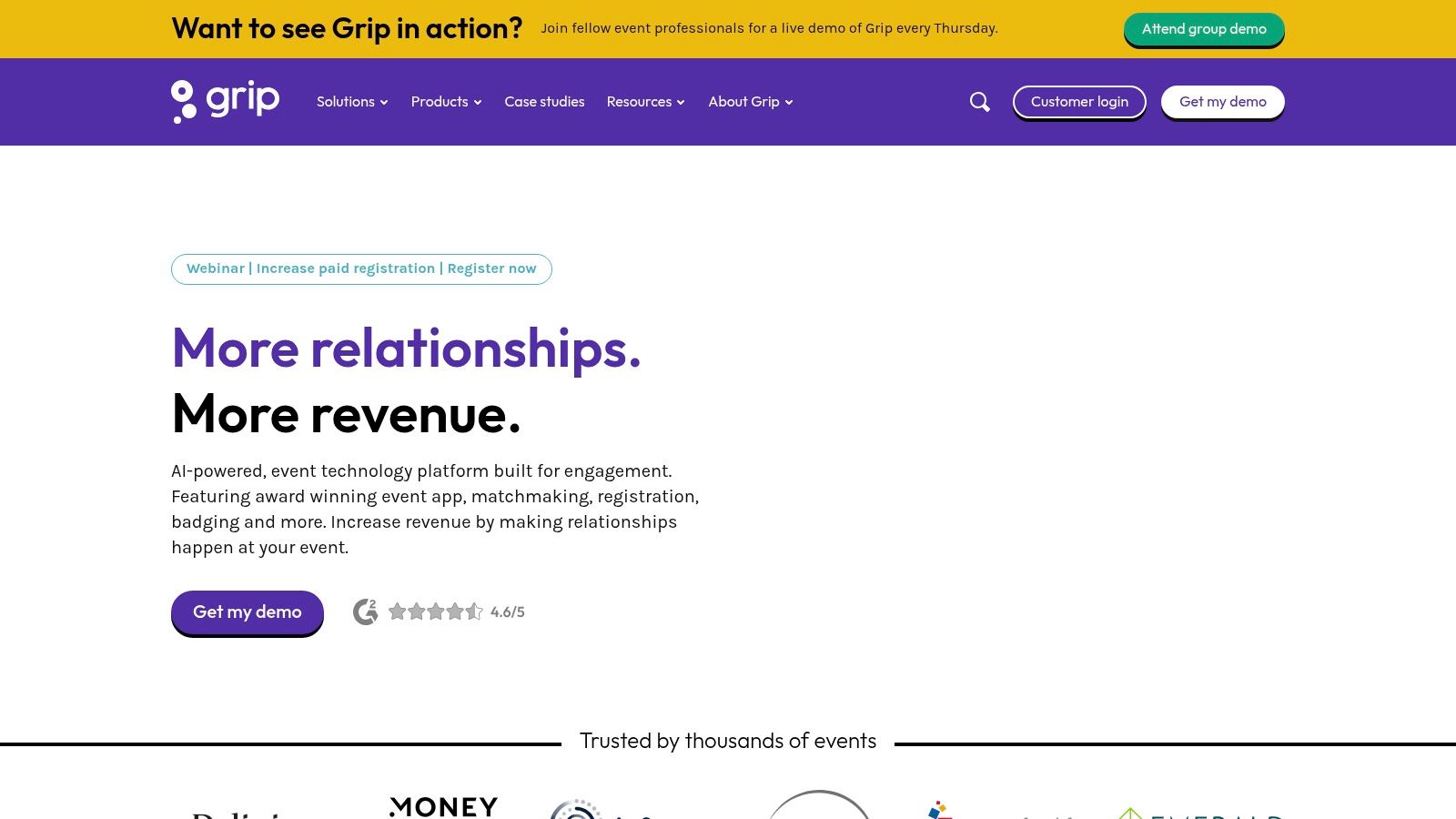
The platform is designed to generate tangible ROI for exhibitors through integrated lead retrieval and robust monetization frameworks. Organizers can offer sponsored meeting recommendations or premium exhibitor packages that increase visibility within the matchmaking system. This direct link between app functionality and revenue generation is Grip's key differentiator. While it includes standard features like personal schedules and floor plans, its true value is unlocked at events where the primary goal is a high volume of qualified business meetings.
Pros & Cons
Pros:
Purpose-built for Meetings: The AI is tuned to deliver meeting and pipeline KPIs, making it ideal for revenue-focused events.
Exhibitor Monetization: Offers clear frameworks for creating exhibitor upgrades and sponsored placements that drive organizer revenue.
Strong Matchmaking: The core engine is effective at suggesting relevant connections, increasing the value for all participants.
Cons:
Opaque Pricing: Pricing is not public and is typically quote-based, often involving annual and per-event service fees.
Niche Focus: It is less suited for community-building or content-driven conferences that do not prioritize one-on-one meetings.
Website: https://www.grip.events
11. PheedLoop (PheedLoop Go)
PheedLoop offers an all-in-one event platform with a capable mobile app, PheedLoop Go, that integrates with its registration, on-site services, and exhibitor management tools. The platform positions itself as a value-focused alternative for event organizers who need a connected system for both on-site execution and mobile attendee engagement. Its primary distinction is its transparent, modular pricing model, which allows organizers to build a custom stack without committing to an enterprise-level, all-or-nothing package.
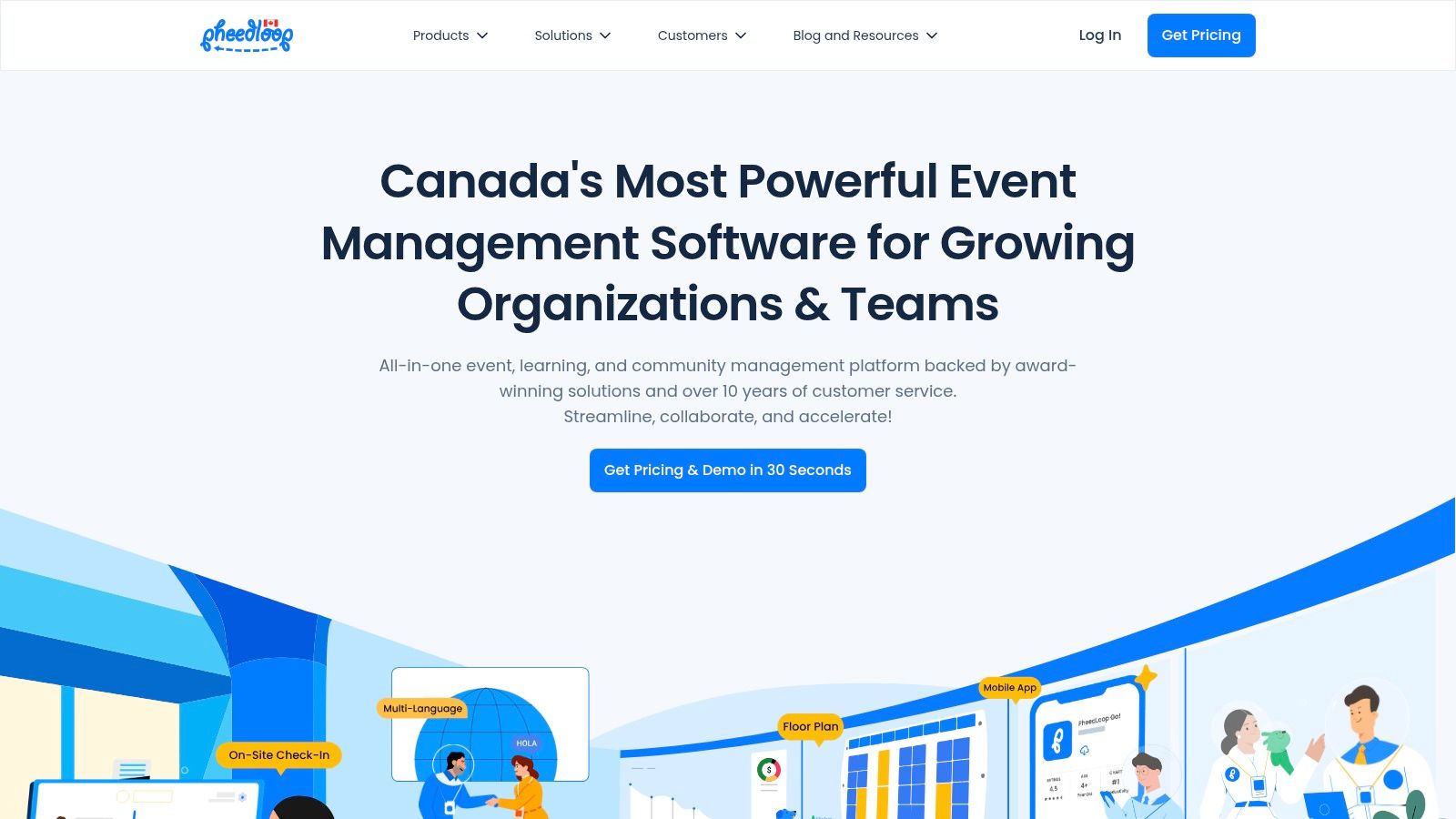
This makes it a strong contender among the best mobile event apps for small-to-mid-sized conferences that are outgrowing simple apps but are not ready for the complexity and cost of a full enterprise suite. The mobile app includes standard features like personalized agendas, interactive maps, and in-app gamification. For organizers, the session check-in, attendance tracking, and lead retrieval functions are managed within the same backend, simplifying operations. The company also maintains a public record of frequent app updates and performance fixes.
Pros & Cons
Pros:
Transparent Pricing: PheedLoop publishes its modular pricing online, making it easy to calculate costs for specific features.
Continuous Improvement: The platform receives frequent updates, with a public roadmap that demonstrates active development.
Integrated On-Site Tools: Offers a cohesive system for mobile app engagement and on-site functions like self-serve check-in.
Cons:
Configuration Time: Setting up advanced features requires navigating and configuring several backend modules, which can be time-consuming.
Tier Verification: Some historical free or low-cost tiers for small events may have changed, so current terms should always be verified.
Website: https://pheedloop.com
12. Guidebook
Guidebook is a no-code mobile app builder that prioritizes simplicity and attendee experience, especially for in-person events. It excels in environments where reliability is key, such as university campuses and corporate training. Its main strength lies in its ability to deliver crucial information like schedules and maps even when internet connectivity is spotty, thanks to robust offline access. For event teams needing to launch a branded app quickly without technical overhead, Guidebook offers a straightforward, self-service platform.
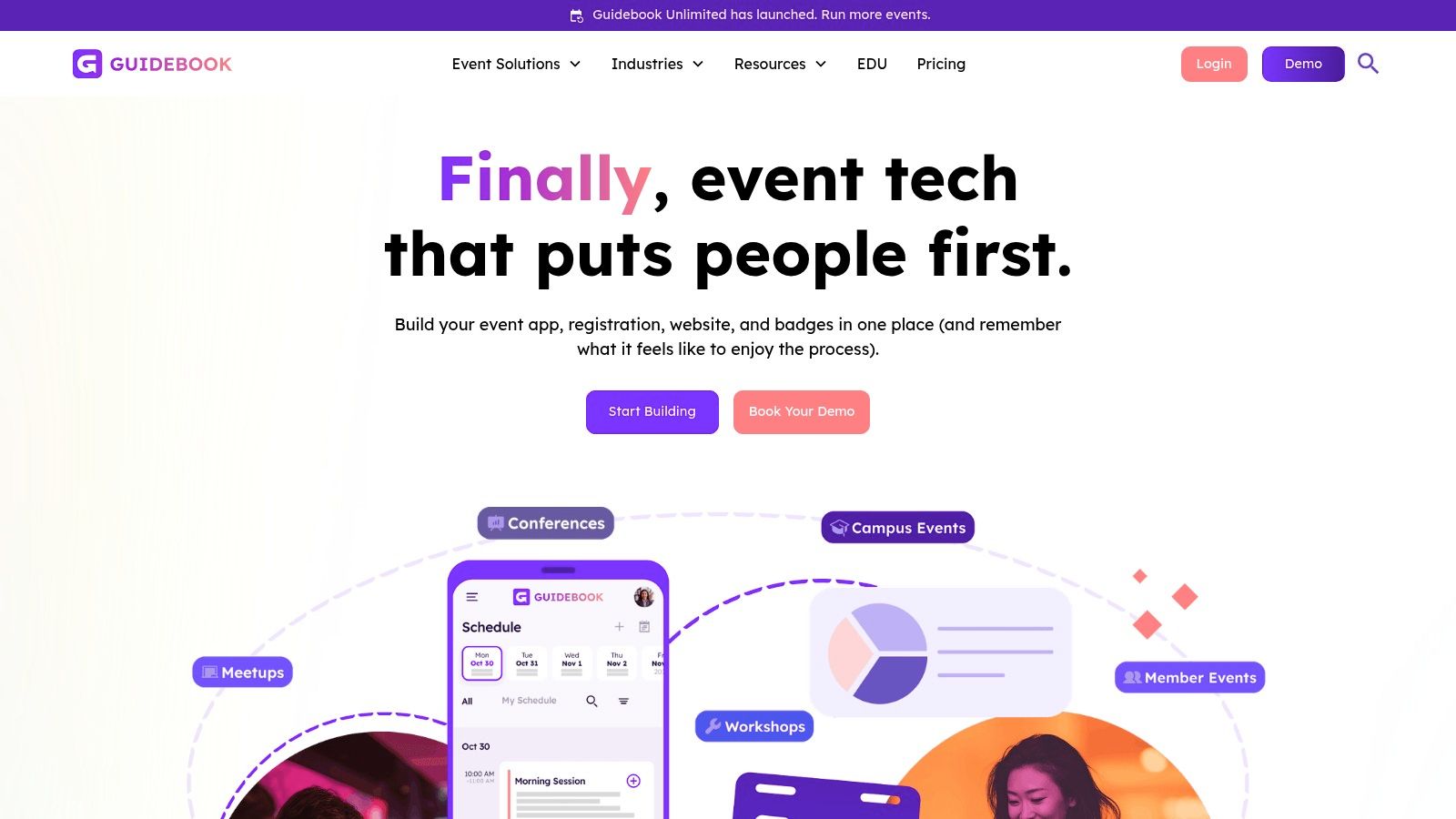
The platform is designed for fast deployment. Organizers can clone guides for recurring events, which saves significant setup time for event series. Key features include interactive venue maps, push notifications, and attendee lists with opt-in messaging. While it may not offer the deep, enterprise-level workflows of more complex systems, its focus on core attendee needs makes it one of the best mobile event apps for straightforward conferences where user adoption and ease of use are paramount.
Pros & Cons
Pros:
Offline Reliability: Schedules, maps, and content are accessible without an internet connection, a major benefit for attendees.
Fast Deployment: The no-code builder and cloning features allow for rapid creation and launch of branded apps.
Clear Attendee UX: The interface is intuitive, focusing on easy navigation and finding essential event information.
Cons:
Fewer Enterprise Features: Lacks advanced modules for hosted-buyer matchmaking or complex registration logic.
Quote-Based Pricing: Pricing is not publicly listed and requires a sales quote, making initial budget estimates less direct.
Website: https://www.guidebook.com
Top 12 Mobile Event Apps — Feature Comparison
Solution | Core features ✨ | UX & quality ★ | Value / Pricing 💰 | Target audience 👥 | Key differentiator 🏆 |
|---|---|---|---|---|---|
AI Tool Kit for Events | Data unification + end-to-end automation; self-serve + agency; Knowledge Center ✨ | ★★★★★ — proven impact: +40% ARPP, 50% outreach replies, 70% staff cut | 💰 Flexible: self-serve to full-service; high ROI | 👥 Mid→large conferences & growth-led teams | 🏆 AI-native single source of truth + measurable revenue lifts |
Cvent Attendee Hub (Cvent) | Branded web/mobile app; registration → on-site → analytics ✨ | ★★★★ — enterprise-grade, robust but heavy setup | 💰 Published per-event tiers; can be costly at scale | 👥 Complex, multi-track enterprise conferences | 🏆 One‑stack vendor with legal pricing clarity |
Webex Events (Cisco) | Registration, ticketing, studio for hybrid, on-site badging; Webex integrations ✨ | ★★★★ — enterprise security & maintenance (Cisco) | 💰 Quote-based; entitlements and add-ons can be complex | 👥 Enterprise rollouts & Webex customers | 🏆 Cisco ecosystem security + hybrid studio tools |
Bizzabo (Event OS + Klik) | Mobile app + Klik wearables for passive check-ins, heatmaps, lead capture ✨ | ★★★★ — strong on-site analytics and sponsor UX | 💰 Premium, custom pricing; wearables add ops cost | 👥 Flagship conferences focused on sponsor ROI | 🏆 Passive wearables-driven analytics & lead capture |
Swapcard | AI matchmaking, in-app AI assistant (Sherlock), exhibitor marketplace ✨ | ★★★★ — modern UX; frequent AI updates | 💰 Quote-based; Starter cap (1k) may limit small growth | 👥 Exhibitor-driven events & community focus | 🏆 Embedded AI assistant for discovery & scheduling |
Whova | Native iOS/Android + web, messaging, check-in, sponsor placements ✨ | ★★★ — familiar UX; easy setup for small teams | 💰 Quote-based; generally SMB-friendly value | 👥 SMB → midmarket conferences | 🏆 Ease of use, broad familiarity & post-event access |
EventMobi | Branded app, registration, badging, hybrid tools, analytics ✨ | ★★★★ — reliable for associations & mid‑B2B events | 💰 Published starting prices; single-event & annual options | 👥 Associations and mid-sized B2B events | 🏆 Transparent starter pricing & association fit |
SpotMe | Enterprise apps, universal lead capture, bi‑directional CRM integrations ✨ | ★★★★ — mature integrations; compliance-ready | 💰 Quote-based; enterprise budget profile | 👥 Regulated industries (life sciences), enterprise | 🏆 Compliance + deep CRM/marketing automation integrations |
Brella | AI matchmaking + 1:1 meeting scheduling; sponsor lead tools ✨ | ★★★★ — clean, networking-first UX | 💰 Quote-based; premium for meeting-centric events | 👥 Deal-making / networking-centric conferences | 🏆 Purpose-built meeting UX driving sponsor value |
Grip | AI matchmaking, white-label apps, exhibitor monetization & lead retrieval ✨ | ★★★★ — focused on meetings→pipeline | 💰 Quote-based; annual + per-event models common | 👥 Trade shows & hosted-buyer programs | 🏆 Monetization frameworks that convert meetings to revenue |
PheedLoop (PheedLoop Go) | Mobile app + registration, badge printing, modular add-ons ✨ | ★★★★ — active updates; value-focused | 💰 Transparent modular pricing; documented add-ons | 👥 SMB → midmarket events seeking integrated value | 🏆 Clear modular pricing and frequent product releases |
Guidebook | No-code builder, offline maps/schedules, fast cloning for series ✨ | ★★★ — reliable offline UX; fast deployment | 💰 Quote-based; simple admin saves time | 👥 Campuses, associations, series & offline-first events | 🏆 No-code, offline reliability and quick cloning workflow |
From Tactical Tool to Strategic Infrastructure: Making the Right Decision
Selecting from the many capable options on this list of the best mobile event apps moves beyond a simple feature comparison. It is a strategic choice that directly influences your event's financial performance, attendee loyalty, and long-term growth. As we’ve explored with platforms from Cvent to PheedLoop, the market offers a wide spectrum of solutions. The fundamental challenge, however, is not finding an app with more features; it is achieving decision clarity across your entire event ecosystem.
The core problem for many organizers is data fragmentation. A standalone registration platform, a separate networking app, and another system for sponsor engagement create information silos. This setup obscures a unified view of attendee behavior, masks valuable monetization opportunities, and makes it nearly impossible to gauge the true financial health of your event portfolio. You are left managing disjointed reports, unable to connect the dots between registration cohort, in-app behavior, and post-event retention. This is the revenue blind spot.
Moving Beyond the All-in-One vs. Best-of-Breed Dilemma
This blind spot leads to a common strategic crossroads: commit to an all-in-one platform or assemble a collection of specialized apps?
All-in-One Platforms (e.g., Cvent, Bizzabo): These systems promise simplicity by consolidating features into a single ecosystem. The trade-off can be a loss of flexibility, vendor lock-in, and a higher price tag for modules you don't need. You get one version of the truth, but it’s confined to that platform's walls, often disconnected from your central CRM.
Best-of-Breed Stacks (e.g., combining Brella, Whova, and another registration tool): This approach gives you top-tier functionality for specific tasks. However, it introduces significant integration overhead and data reconciliation challenges. Without a central system to unify the data, you end up with a more powerful but equally fragmented picture.
The most effective path forward is not choosing between these two flawed options. It is building a strategic infrastructure that reconciles data from the tools you already rely on. The goal is to create a single, reliable source of truth that connects your CRM, registration system, and your chosen mobile event app, transforming them into a cohesive revenue engine.
A New Framework for Decision-Making
This is the core philosophy behind our AI Tool Kit. It is designed to act as a clarity engine, unifying fragmented data streams and workflows. Instead of forcing a full platform migration, it integrates with your existing technology, from Eventbrite and HubSpot to specialized apps like Whova or Swapcard. It transforms your mobile event app from an isolated engagement tool into a fully integrated component of your revenue and retention strategy.
The next step in your evaluation process should not be to chase more features. Instead, assess your decision-making gaps. Ask yourself:
Can I easily see which attendee cohorts are most engaged and most profitable?
Do I have a clear view of sponsor ROI that connects booth traffic to real business outcomes?
Is my team able to make informed decisions based on reconciled data from all our event tools?
By focusing on data reconciliation and strategic alignment, you can finally connect your mobile event activities directly to business growth. This shifts the conversation from "Which app has the best polling feature?" to "Which system gives us the clarity needed to increase revenue and retention?" It's a move from tactical tool selection to building a strategic asset.
The TalkValue AI Tool Kit serves as a strategic layer that unifies data from your existing event apps and CRMs, giving you a single source of truth for revenue and attendee behavior. It provides the decision clarity needed to turn engagement data into measurable growth. Explore how a unified growth engine can connect your event strategy directly to your bottom line.


FAQ