
For decades, the event industry has operated on a simple commercial premise: selling visibility. Organizers package physical space and digital real estate—booths, banners, and logos—and sponsors purchase exposure. This model, rooted in an era of limited data, treats dynamic, high-intent gatherings as static media properties, leaving an immense amount of revenue unrealized.
When success is measured primarily by sold-out exhibition floors or tiered sponsorship packages, it is easy to overlook the structural dysfunction beneath the surface. The industry’s prevailing approach to monetization is no longer just dated; it is a direct impediment to long-term revenue growth and partner retention. The core challenge is not a lack of data, but a fundamental failure to connect it to commercial strategy.
The Structural Flaw in Conventional Event Monetization
The conventional framework for advertising at events is structurally unsound. It is built on the anachronistic practice of selling inventory—a logo on a lanyard, a banner in an app, or a booth on a floor plan. This approach is a holdover from a pre-digital operating model, where audience understanding was ambiguous and reach was a blunt instrument.
This is not a minor operational inefficiency; it is a strategic gap that actively suppresses revenue potential. The breakdown occurs in the profound disconnect between disparate data systems. Attendee firmographics are stored in registration platforms, engagement metrics are siloed within event applications, and sponsor interactions are logged in separate CRM instances.
This fragmentation makes it functionally impossible for organizers to see, value, and commercialize the single most valuable asset they control: highly specific, intent-driven audience cohorts. Without a unified, dynamic view of attendee behavior, organizers are forced to sell what they can easily count, not what sponsors truly value.
The Disconnect Between Data and Commercial Strategy
Lacking a reconciled view of their audience, organizers revert to selling inventory. They can inform a sponsor how many individuals might see their logo but cannot definitively demonstrate who those individuals are, which content they consumed, or what business challenges they are actively seeking to solve.
This absence of clarity compels a reliance on generic, tiered packages—Gold, Silver, Bronze—defined by the quantity of assets rather than the quality of audience access. This legacy model triggers a cascade of negative revenue consequences:
Asset Devaluation: Without granular audience intelligence, a premium digital ad slot is priced uniformly. Its actual value, however, is exponentially higher when served to a C-level executive from a sponsor’s target account list versus a general attendee. This discrepancy represents lost margin.
Weakened Commercial Negotiations: When audience value cannot be substantiated with data, negotiations default to price. Organizers are pressured into discounts and margin-eroding concessions instead of constructing value-based partnerships founded on strategic alignment.
Diminished Partner Retention: Sponsors unable to attribute clear ROI to their specific business objectives—such as pipeline acceleration or target account penetration—are less likely to renew. They are left to estimate impact, undermining the perceived value of the investment.
The path forward requires a fundamental re-framing: from selling space to monetizing precisely defined audience access. This transition is predicated on a unified data infrastructure that reconciles disparate information into a coherent decision-making engine. By embracing this modern framework, organizers can unlock the true commercial value of their audiences and architect new, defensible revenue streams. If you are interested in making this transformation, you can explore our guide on the role of AI for event planning.
Viewing the Event as a Portfolio of Monetizable Assets
To move beyond the limitations of "Gold, Silver, Bronze" packages, organizers must adopt the mindset of a media executive managing a portfolio of high-value assets. This is not a semantic adjustment but a foundational shift in commercial perspective. An event is not a monolithic product; it is a dynamic media platform comprising hundreds of distinct, monetizable touchpoints.
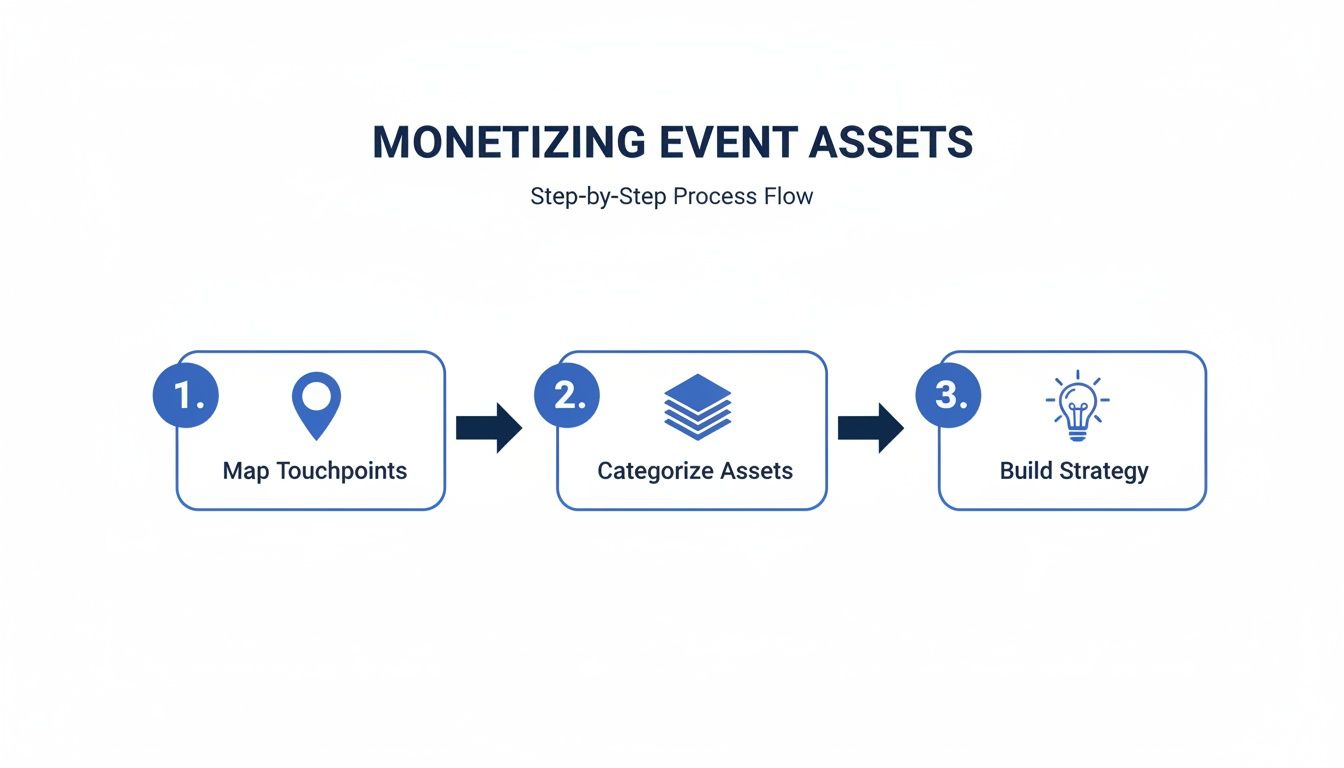
Each of these touchpoints—from the initial registration confirmation email to the post-event on-demand content—is an asset with a unique audience, purpose, and value proposition. The strategic work begins with mapping and categorizing this entire inventory, laying the groundwork for a sophisticated revenue architecture.
Mapping the Complete Attendee Journey
The first step is a comprehensive audit of the entire attendee journey, which extends far beyond the physical event dates. Every interaction represents a potential channel for a sponsor to deliver a targeted, timely message to a specific audience segment.
Consider the extensive range of assets at an organizer’s disposal:
Pre-Event Digital Channels: This inventory includes registration confirmation emails, "know before you go" guides, and social media announcements. Sponsors place a premium on reaching a qualified, engaged audience before the event begins, influencing agendas and securing meetings.
On-site Physical and Digital Real Estate: This traditional category requires modernization. It encompasses everything from large-format digital signage and prime booth locations to branded physical items and session room naming rights, all of which can be tied to specific audience flow and behavior.
Experiential and Content Opportunities: These high-engagement assets include sponsored workshops, expert-led roundtable discussions, and exclusive networking lounges. Here, sponsors achieve deep, meaningful interaction that transcends passive brand impressions.
In-App and Mobile Touchpoints: The event app is a powerful media channel, not merely a logistical tool. Assets include splash screens, targeted push notifications based on user profiles, sponsored agenda tracks, and gamification prizes aligned with sponsor objectives.
Post-Event Engagement: This is the most frequently overlooked yet highly valuable asset category. On-demand session recordings, highlight reels, and follow-up surveys allow sponsors to extend the conversation with a proven, interested audience long after the event concludes.
Categorizing Assets by Strategic Value
Once the inventory is mapped, the critical next step is to categorize each asset not by its cost but by the strategic value it delivers to a sponsor. This reframes the commercial conversation from generic "visibility" to specific business outcomes. A robust method is to categorize each asset across three strategic dimensions: broad reach, deep engagement, and targeted intent.
For example, sponsoring the Wi-Fi login page offers broad reach to nearly every attendee, making it ideal for a large-scale brand awareness campaign. In contrast, hosting a specialized technical workshop provides deep engagement with a very specific, high-intent audience—perfect for a sponsor focused on lead quality and establishing thought leadership.
This strategic mapping transforms a simple inventory list into a sophisticated, defensible commercial portfolio. It allows organizers to stop selling commoditized packages and start architecting custom solutions that align directly with a sponsor's true business objectives, whether that is C-level lead generation, new product launches, or market education. To refine this process further, you can explore these essential event management best practices that help structure your strategic planning from day one.
When an event is viewed through this portfolio lens, the organizer’s role evolves from a vendor of space to a strategic partner in a sponsor’s success. This shift is the most critical step toward unlocking sustainable revenue growth and demonstrating the undeniable commercial power of live events.
From Visibility to Decision Clarity: A Unified Framework
To execute a sophisticated advertising strategy, organizers require clarity. The transition from selling generic visibility to offering strategic audience access necessitates a decision framework grounded in unified data. The challenge is not a lack of data, but the inability to reconcile disparate sources into a single, coherent source of commercial truth.
Attendee details reside in registration platforms, behavioral signals are captured in event apps, and sponsor interactions are logged in CRMs. This data fragmentation makes it nearly impossible to answer a sponsor's most critical question with confidence: "Who, precisely, will my investment reach?"
A unified decision framework resolves this structural problem. It involves integrating these siloed data sources to create a single, cohesive intelligence layer that drives commercial strategy.
From Raw Data to Actionable Cohorts
When data from registration systems, event applications, and CRM platforms are unified, raw attendee information transforms into something far more powerful: actionable audience cohorts. These are not broad demographic segments but specific, intent-driven groups defined by verified identity and observed behavior.
Imagine the strategic value of isolating a cohort such as: ‘VPs of Marketing from fintech companies with over 1,000 employees who attended the AI keynote and downloaded the corresponding white paper.’ This level of precision is the foundation of modern advertising at events.
This clarity enables the design and pricing of hyper-targeted advertising opportunities that are difficult for sponsors to refuse. Organizers are no longer selling a banner ad; they are selling guaranteed access to a precise group of high-value prospects at the exact moment of their engagement. This systematic process turns event assets into a revenue engine by connecting them directly to a nuanced audience strategy.
Mapping Cohorts to Commercial Assets
With a clear view of audience cohorts, the final step is to map these groups to the portfolio of advertising assets. This shifts the monetization model from a simple one-to-many broadcast to a more effective, multi-faceted engagement strategy.
For example:
Cohort: C-level executives from enterprise technology firms.
Asset: Sponsorship of the exclusive VIP networking lounge.
Value Proposition: Guaranteed, direct engagement with top-tier decision-makers in a controlled, high-value environment, facilitating strategic relationship-building.
Cohort: Junior developers with a declared interest in Python.
Asset: A targeted in-app push notification promoting a relevant technical workshop.
Value Proposition: Driving highly qualified traffic to an educational session, ensuring a full room of engaged, relevant attendees for the sponsor.
This approach fundamentally alters the nature of sponsor conversations. Instead of negotiating price, the discussion becomes a collaborative exercise in strategic planning. Organizers can demonstrate—with data—exactly who a sponsor will reach and prove why a particular asset is the most efficient channel to achieve a specific business outcome.
This shift dramatically increases both the perceived and actual value of advertising at an event. Sponsors are not just buying impressions; they are investing in measurable access to their ideal customers. This is a proposition that defends premium pricing, strengthens partnerships, and ensures high retention rates. This framework depends on having the right operational backbone, and many organizers find that specific event technology solutions are essential for unifying data and automating the creation of these valuable audience cohorts.
A Value-Based Model for Revenue Architecture
The "Platinum, Gold, Silver" sponsorship model is obsolete. It is a relic from an era when organizers sold what they could easily count—logo placements, booth dimensions—instead of what truly matters: strategic access to specific audiences. Adherence to this model today is a deliberate choice to leave significant revenue unrealized.
The only sustainable path forward is a value-based monetization model. This is not a rebranding of existing packages but a fundamental shift in commercial logic. It involves ceasing to sell inventory and beginning to sell strategic access to well-defined audience cohorts, with every price point substantiated by data.
Pricing Based on Audience Access, Not Asset Quantity
In a value-based model, pricing is decoupled from asset quantity. Instead, it is driven by three core factors: the specific audience an asset reaches, the depth of engagement it facilitates, and its alignment with a sponsor's strategic goals. This framework acknowledges a critical truth: not all impressions are created equal.
A banner ad in a high-traffic corridor offers broad exposure. A targeted in-app notification delivered exclusively to C-level finance executives offers something entirely different and far more valuable: direct, guaranteed access to a high-value decision-making group. Unified event data becomes the core enabler of this differential pricing strategy. When organizers know precisely who is engaging with which asset, they can confidently command a premium for opportunities that connect sponsors with their most coveted attendee segments.
Architecting Flexible, Goal-Oriented Solutions
The one-size-fits-all package is no longer viable. A value-based model empowers the creation of bespoke advertising solutions tailored to solve a sponsor's specific business challenges. The initial conversation should focus on a single question: "What is your primary objective for this event?"
For Lead Generation: A sponsor focused on pipeline development requires more than a logo. A solution might include a sponsored technical workshop, qualified lead capture at the session, and a targeted post-event email to all engaged participants. Each component is priced based on its direct contribution to delivering qualified leads.
For Brand Awareness: A company launching a new product requires maximum visibility. Its package might center on sponsoring the Wi-Fi network, prominent digital signage in key zones, and a mention in the opening keynote. Here, the value is calculated based on mass reach and brand recall among the total audience.
For Thought Leadership: An organization aiming to establish market authority would derive more value from a content-centric package. This could involve sponsoring a high-level panel, underwriting on-demand recordings of a popular content track, or featuring their research within the event platform.
This consultative approach transforms the sales function. Teams are no longer selling from a static inventory list; they are acting as strategic advisors, co-designing marketing campaigns that deliver measurable results. To track the outcomes of these campaigns, it is crucial to understand how to measure event success through a strategic lens.
Transforming Negotiations into Strategic Alignments
The most significant advantage of a value-based model is its impact on the negotiation process. When every commercial discussion is anchored in data, the conversation shifts from "How much does it cost?" to "What is the projected return on this investment?" Organizers can enter any meeting with a clear, defensible justification for their pricing.
Key Takeaway: Modern event monetization is not about selling space; it is about proving who a sponsor will reach and why that access is worth the investment. This data-first approach transforms tense price negotiations into strategic partnerships focused on mutual success.
Market trends underscore this shift. According to recent event industry statistics, a significant percentage of marketing leaders plan to increase event-related advertising spend specifically because targeted, sales-focused activations at conferences deliver a demonstrable lift in purchase intent and pipeline velocity. By embracing a value-based model, organizers are not just making their events more profitable; they are building a more resilient and defensible business by proving undeniable value to partners.
Demonstrating Strategic Value Beyond Basic Metrics
For years, sponsors tolerated a reporting model built on superficial metrics. Logo impressions and booth visitor counts were accepted as proxies for value, largely due to the absence of a more sophisticated measurement framework. That era has definitively ended. Today’s marketing leaders are under intense pressure to justify every dollar of spend with demonstrable ROI. If an event organizer cannot connect a sponsorship investment to tangible business outcomes, that revenue is at risk.
The challenge extends beyond better reporting; it requires a fundamental change in the entire value conversation. It is imperative to move past demonstrating basic visibility and begin proving tangible influence across the attendee journey. It is no longer sufficient to show that a sponsor’s logo was seen; it is necessary to construct a data-backed narrative showing how their investment directly influenced the behavior of their most important target accounts.
From Impressions to Influence
The first step is to cease viewing event touchpoints as isolated incidents. A sponsor's true impact is cumulative—the combined effect of a sponsored session, an in-app advertisement, a booth visit, and a post-event content download is what ultimately influences a buyer’s journey. Reporting must connect these dots.
This means shifting the entire conversation from counting impressions to tracing influence. For instance, instead of reporting "5,000 banner impressions," a far more powerful and strategically relevant story can be told:
Strategic Insight: Your sponsored keynote was attended by 75 VPs of Engineering, 40 of whom are from your primary target account list. Of those, 15 subsequently visited your booth for a demo, and 10 downloaded your post-event technical white paper.
This narrative completely transforms the renewal discussion from a negotiation over price into a strategic review of a successful marketing campaign that clearly influenced the sales pipeline. This level of detail makes the event an indispensable component of a sponsor’s marketing engine.
Building a Narrative with Unified Data
Delivering this caliber of strategic reporting is only possible with a unified data infrastructure. It is essential to connect an individual attendee’s profile—their company, title, and declared interests—to their specific behaviors across every touchpoint.
This unified view enables the construction of a "chain of evidence" for each key sponsor, linking their advertising spend to meaningful business activities:
Target Account Penetration: Demonstrating precisely how many individuals from a sponsor’s most-wanted accounts engaged with their brand throughout the event.
Qualified Lead Generation: Proving that attendees who engaged with sponsor activations were not random passersby but qualified decision-makers who had already exhibited relevant interest.
Post-Event Engagement: Substantiating that the relationship continued post-event, with target attendees accessing sponsored content or responding to follow-up campaigns.
By providing this level of granular insight, organizers prove undeniable value. The focus shifts from abstract brand awareness to concrete business impact, aligning the event directly with the sponsor’s revenue objectives. This is the future of advertising at events, and organizers who master this data-driven approach will not only protect existing revenue but also unlock new growth by proving their unique ability to connect sponsors with the people who matter most to their business.
Activating the Event Revenue Growth Engine

The strategic principles of portfolio management, value-based pricing, and influence reporting represent the future of advertising at events. However, their implementation depends on overcoming a significant operational hurdle: activating the strategy at scale. The primary obstacle for most event organizations is not a lack of data, but the inability to unify, interpret, and act upon it with speed and precision.
Manually connecting registration details with in-app behavioral data and CRM notes to generate a single strategic report for one sponsor is an arduous task. Scaling this process across an entire sponsor portfolio with manual tools is operationally infeasible. This operational gap forces even the most forward-thinking teams back toward selling familiar, low-value sponsorship packages, as the administrative burden of a more sophisticated approach becomes prohibitive.
The Central Infrastructure for Monetization
To close the gap between strategy and execution, a new class of infrastructure is required. This is not about adding another point solution to an already fragmented technology stack, but about implementing a central growth engine—a decision-making layer that sits at the core of an event’s commercial operations.
The function of this engine is to automate the complex, high-friction work that impedes revenue growth. It must be designed to perform four critical functions with high fidelity:
Unify Disparate Data: Seamlessly connect information from registration platforms, event apps, and CRM systems into a single, reliable source of truth.
Automate Cohort Identification: Systematically segment the audience into high-value cohorts based on verified firmographics, behaviors, and intent signals.
Manage Dynamic Inventory: Link these cohorts to specific advertising assets, enabling dynamic, value-based pricing and inventory management.
Generate Strategic Reports: Produce the influence-based reports that sponsors now require, connecting their investment to measurable business outcomes.
By automating these processes, a dedicated growth engine empowers a lean event team to execute a world-class monetization strategy without expanding headcount. It manages the immense operational complexity, freeing personnel to focus on high-value activities such as strategic planning, package innovation, and building relationships with senior-level partners.
This approach re-imagines technology not as a tactical tool, but as the strategic infrastructure for clarity. It provides the operational backbone that finally allows organizers to unlock the full revenue potential of their event portfolios.
By creating a systematic, repeatable process for monetizing audience access, organizers can build a more resilient and predictable revenue stream. This is fundamental for long-term growth and demonstrates a sophisticated understanding of how to promote an event as a premium media platform. The right infrastructure makes sophisticated advertising at events not just possible, but profitable and scalable.
Common Questions from Strategic Leaders
Even with a clear strategic vision, senior leaders often have questions about implementation. Here are answers to the most common inquiries.
How do we transition from legacy sponsorships to a data-driven model without alienating partners?
The transition should be evolutionary, not revolutionary. Begin by adding, not replacing. Select a trusted, long-term sponsor and invite them into a "beta" program to pilot cohort-based targeting. Demonstrate the superior insight and value it delivers. Use the success of this pilot as an internal case study to build momentum and external proof to validate the model. This measured approach allows you to introduce the new framework gradually, demonstrating that you are evolving to deliver better results and deeper insights, thereby building confidence rather than creating friction with key partners.
What is the single most important metric to track?
The focus should shift from a single metric to building a "chain of evidence." The most powerful narrative you can provide a sponsor is one that connects their various touchpoints—a sponsored session, an in-app advertisement, a booth interaction—to direct engagement from their specific target accounts. The goal is not merely to report impressions but to prove genuine influence on their pipeline. When you can demonstrate which individuals from their ideal customer profile attended their session, engaged with their content, and visited their booth, you have built an undeniable story of value. This proves your event delivers meaningful access, transforming their spend from a marketing expense into a strategic necessity.
Is this level of sophistication realistic for a smaller team?
Yes, provided the right infrastructure is in place. Attempting to execute a modern advertising program manually with spreadsheets and a patchwork of disparate tools is unsustainable and prone to error; it simply does not scale. The key is a central system—a "growth engine"—that automates the heavy lifting. The right technology handles the tedious, complex tasks of unifying data, building audience cohorts, and generating strategic reports. This liberates your team to focus on what truly drives revenue: strategic planning and cultivating strong sponsor relationships. It is the mechanism by which a lean team can deliver a world-class commercial program without a proportional increase in headcount.
Ready to unlock your event’s true revenue potential? TalkValue provides the AI-native system and expert guidance to turn your event data into a powerful growth engine. See how our platform can help you build and scale a modern, value-based advertising strategy.


FAQ