
For decades, the logic of business networking events has been deceptively simple: assemble influential people in one place, facilitate introductions, and trust that value will emerge. This model, centered on maximizing attendance and creating serendipitous encounters, has been the unquestioned foundation of event strategy for organizers, associations, and corporate marketing teams alike. We measure success by the fullness of the room and the volume of conversation, assuming that activity equates to progress.
But this foundational belief is flawed. It harbors a significant blind spot that quietly erodes revenue potential, sponsor retention, and long-term portfolio growth. The core problem is not a failure of logistics or a lack of engagement tools; it is a structural disconnect between event-level activity and strategic business outcomes. We are experts at generating interactions but remain surprisingly ill-equipped to translate that activity into a coherent, monetizable picture of our audience. This gap between visibility and decision-making is the single greatest barrier to unlocking the true revenue capacity of any event portfolio.
From Attendee Data to Audience Clarity: The Structural Gap
Event organizers are not short on data. We operate sophisticated ecosystems of CRM systems, registration platforms, marketing automation tools, and event apps. Each system produces a torrent of valuable information: who registered, which sessions they favorited, who they requested meetings with, and what content they engaged with post-event. Individually, these data points offer a tactical snapshot of behavior.
The structural failure lies in their fragmentation. This information lives in isolated silos, preventing a unified understanding of our most valuable asset: our audience cohorts. A registration system knows who bought a ticket. An event app knows who met with a sponsor. A CRM knows their purchase history. But rarely do these systems reconcile to provide a single, strategic view of an attendee's journey and intent.

This fragmentation directly impacts revenue. Without a reconciled view, strategic decisions are based on lagging indicators and incomplete assumptions. We cannot accurately identify our most valuable attendee segments, understand their evolving needs across multiple events, or prove the direct line between a sponsor's investment and their pipeline growth. The inability to see, segment, and activate our audience with precision means we are consistently leaving money on the table.
Consider these common consequences:
Sponsor Attrition: Sponsors churn not because the event was poorly attended, but because we cannot provide definitive proof of their ROI. We offer lead counts from badge scans instead of a clear narrative of meetings secured with their target accounts and the resulting pipeline influence.
Inefficient Monetization: Pricing for new event products, from digital content to exclusive roundtables, is based on guesswork rather than a data-informed understanding of which audience segments are willing to pay for specific value.
Stagnant Portfolio Growth: Decisions about which event themes to launch or retire are made with incomplete intelligence. We lack the visibility to spot emerging audience needs or identify cross-pollination opportunities between events in our portfolio.
The challenge is not to collect more data, but to build the strategic infrastructure that unifies it. The goal is to evolve from managing events to cultivating a high-fidelity, monetizable audience asset.
Architecting Experiences for Decision Clarity, Not Just Engagement
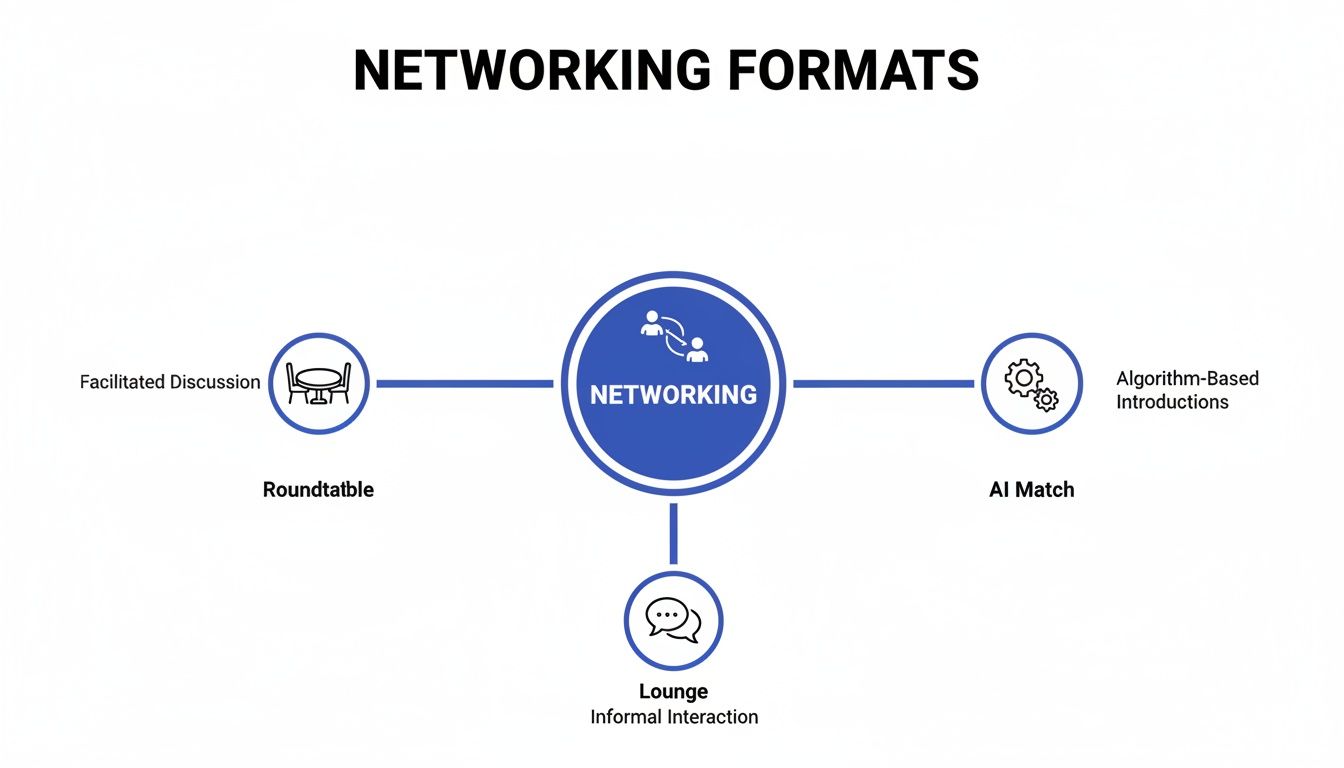
The prevailing approach to event design focuses on maximizing attendee engagement through a variety of formats—from expert-led roundtables and curated matchmaking to interactive workshops. These are essential tactical components. However, their strategic value is diluted when the intelligence they generate remains trapped within the confines of a single event.
The strategic imperative is to design experiences that not only create connections but also produce decision-grade intelligence. This requires a shift in mindset: every interaction point is an opportunity to enrich our understanding of the audience. The choice of a networking format should be driven as much by the data it yields as the experience it provides.
A high-performing event portfolio treats its technology not as a collection of disparate tools but as an integrated clarity engine. This "decision infrastructure" works silently in the background to connect behavioral dots across the entire attendee journey.
Registration data defines the initial attendee profile.
Pre-event surveys capture specific goals and challenges.
In-event app activity reveals content affinities and networking intent.
Post-event engagement signals continued interest and buying signals.
When this information is reconciled into a single source of truth, it transforms our operational capability. For instance, an attendee who registered for a fintech track, attended two sessions on regulatory compliance, and met with a cybersecurity sponsor is not just an anonymous participant. They belong to a specific, high-intent cohort that can be cultivated for future events, specialized content, or targeted sponsorship opportunities. This reconciled view moves us beyond generic personas to a dynamic, evidence-based segmentation of our audience. This is a fundamental prerequisite for building a robust and predictable revenue engine.
The Revenue Consequences of a Disconnected Strategy
The absence of a unified decision framework has direct and measurable financial consequences. Senior leaders are increasingly demanding that event portfolios justify their existence not through attendance figures, but through their contribution to broader business objectives like pipeline acceleration, customer retention, and new market entry. A fragmented data strategy makes this demonstration nearly impossible.
The primary area of impact is sponsorship revenue, which often represents the financial backbone of an exhibition or large-scale conference. In a disconnected model, the value proposition to sponsors is weak. It relies on exposure-based metrics like logo placement and booth traffic—remnants of an outdated advertising paradigm. Sponsors are investors, and modern marketing budgets are scrutinized for quantifiable returns. Without the ability to track a sponsor’s interaction from initial meeting to a closed deal in their CRM, we cannot prove our event was a critical driver of their success. The result is a perpetual cycle of negotiation, discounting, and churn.
Conversely, a reconciled data infrastructure transforms the sponsorship conversation. The offering shifts from "logo impressions" to "guaranteed meetings with qualified buyers." A post-event report can now demonstrate not just who a sponsor met, but the business value of those meetings. It can show that their sponsored roundtable on "AI in Logistics" attracted 15 directors from their target account list, leading to five qualified pipeline opportunities. This level of proof turns sponsorship from a discretionary marketing expense into a non-negotiable component of a partner's sales strategy, fostering long-term, high-value partnerships.
This principle extends to all monetization efforts. With clear cohort visibility, organizers can confidently launch premium offerings:
An exclusive, high-ticket C-level summit for a proven segment of executive attendees.
A paid digital community for a highly engaged group of professionals centered around a niche topic.
A certified training workshop that addresses a specific skill gap identified through session data.
Without a unified view, these initiatives are high-risk ventures. With it, they become data-driven strategic bets with a high probability of success. The issue is not a lack of opportunity, but a lack of the clarity required to seize it.
Building the System for Strategic Growth
The transition from tactical event execution to strategic portfolio management requires a deliberate architectural choice. It involves moving away from a patchwork of single-purpose software solutions toward an integrated system designed for reconciliation and clarity.
This is not about adding another dashboard or chasing the latest AI buzzword. It is about implementing a foundational infrastructure that enforces data consistency across the entire event lifecycle. When registration platforms, event apps, and core business systems like CRMs are seamlessly integrated, the manual, error-prone work of data reconciliation disappears. What emerges is a persistent, evolving, and unified profile for every member of your audience.
This "single source of truth" unlocks the strategic capabilities that drive sustainable growth:
Precision Activation: Marketing teams can execute highly targeted campaigns based on demonstrated behavior, dramatically improving conversion rates for future events.
Intelligent Monetization: Revenue leaders can price and position new products with a clear understanding of audience demand and willingness to pay.
Provable ROI: Sponsorship teams can deliver concrete, data-backed reports that prove the direct business impact of a partner’s investment, ensuring high renewal rates.
Strategic Alignment: Portfolio directors can make confident decisions about market expansion, content strategy, and resource allocation based on a holistic view of audience engagement.
Ultimately, the most successful business networking events are those that operate as part of a larger, coherent system for audience development and monetization. The challenge for today's event leaders is not to run better events, but to build the strategic framework that transforms event activity into a powerful, revenue-generating asset. The path to long-term growth lies in closing the gap between what happens in the room and what is understood in the boardroom.
Further reading on related topics can be found in our guides on event management best practices, step-by-step event planning, choosing the right event technology solutions, successful event advertising, and how to measure event success effectively. Trends such as those in the 2025 event predictions and event industry statistics also reinforce this strategic shift.
The TalkValue platform provides the decision infrastructure to unify your event systems, achieve audience clarity, and prove business impact. We help you transform fragmented data into a single growth engine. Explore the toolkit to understand how this framework can be applied to your portfolio.


FAQ