
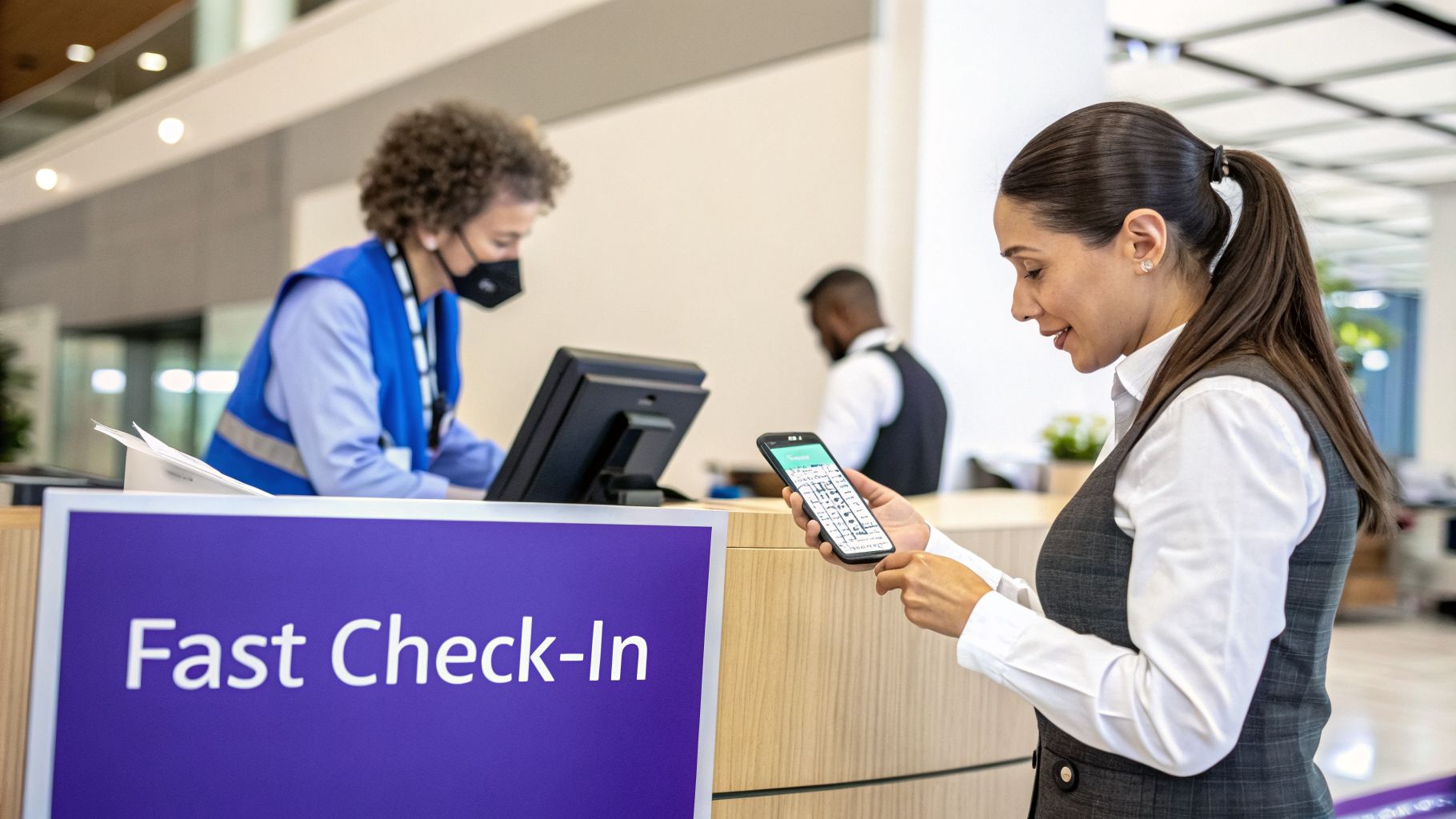
For decades, the event industry has operated on a widely accepted belief: the check-in process is a logistical function. Its primary goal is efficiency—moving attendees from the queue to the event floor as quickly as possible. We have optimized this process with QR codes, self-service kiosks, and on-demand badge printing, all in the pursuit of operational speed. We measure success in reduced wait times and smoother crowd flow. But this focus on logistics, while necessary, obscures a far more significant strategic truth.
The front door of your event is not just an entry point; it is the first and most critical moment of data reconciliation in your entire revenue ecosystem. The industry's obsession with speed has created a structural blind spot. We see check-in as a task to be completed, not an intelligence asset to be leveraged. This oversight disconnects on-site behavior from pre-event engagement, fragments our understanding of the attendee journey, and directly constrains revenue potential. For senior leaders responsible for portfolio growth and monetization, this is not a logistical problem—it is a core business problem.
The Reconciliation Gap: Why On-Site Visibility Fails to Drive Revenue
Event leaders are not operating in the dark. We are surrounded by data from CRMs, registration platforms, and marketing automation systems. We build sophisticated dashboards to track registration velocity, lead acquisition, and attendee demographics. Yet, when the event opens, this rich, pre-event data landscape collides with a chaotic, disconnected on-site reality. The moment an attendee is scanned, a critical gap emerges.
This is the reconciliation gap: the chasm between knowing who registered and understanding who is here, right now, and what that means for revenue. A simple "checked-in" status is insufficient. It fails to inform sales teams which high-value prospects have arrived, alert partnership managers when a key stakeholder is on-site, or trigger marketing systems to shift from "last chance" messaging to a "welcome" experience. The data exists, but it remains latent, trapped within the silo of the check-in app.
This failure to reconcile data in real time has profound financial consequences:
Delayed Sales Engagement: Sales teams operate blind, unaware that their top-tier prospects are physically present. The opportunity for a timely, relevant conversation is lost, diminishing the event's core value as a sales accelerator.
Inaccurate Revenue Forecasting: Without a live, reconciled view of attendance by cohort (e.g., VIP, buyer, international delegate), real-time revenue projections are impossible. Decisions on resource allocation and upsell opportunities are based on outdated registration data.
Eroded Sponsor Value: Sponsors are sold on access to specific attendee segments. When we cannot provide real-time validation of who is present, we cannot definitively prove the value delivered, weakening our position in renewal negotiations.
The problem, therefore, is not the check-in tool itself. It is the strategic framework—or lack thereof—that governs its use. By treating the entry process as a purely operational function, we forfeit the ability to activate our most valuable data at the most critical moment.
From Tactical Tool to Strategic Infrastructure
To close this reconciliation gap, we must reframe the role of the check-in system. It cannot be viewed as a standalone app for scanning tickets. Instead, it must be conceptualized as the on-site node of your central revenue intelligence system. Its purpose is not merely to validate entry but to serve as a real-time bridge between the digital world of your CRM and the physical reality of your event floor.
This requires a shift in mindset from purchasing a feature-rich tool to architecting a decision infrastructure. This infrastructure’s primary function is to provide clarity and trigger action by unifying disparate data streams. It confirms an attendee’s presence and instantly contextualizes that arrival against their entire history with your organization—their lead score in Salesforce, their membership tier, their session interests, and their past purchase behavior.
An event check in app is not merely an entry tool. It is the first point of data capture in your event’s revenue and engagement lifecycle, turning a simple arrival into a source of actionable intelligence.
When this strategic connection is established, the check-in scan ceases to be a logistical marker and becomes a powerful business trigger. It is the event that initiates a sequence of revenue-generating actions across sales, marketing, and partnership teams. This is the foundational piece of the puzzle, which you can see in our complete guide on step-by-step event planning.
The Clarity Engine: Making Data Actionable On-Site
A strategic check-in infrastructure is not about collecting more data; it's about providing decision clarity. Its value is measured by the quality of the decisions it enables in real time. For executive teams, this means moving beyond post-event reports and gaining the ability to shape financial outcomes while the event is still in motion.
This requires a system built not for logistics but for strategic visibility. It must answer the critical questions that drive revenue and retention: Which of our top 20 accounts are on the floor right now? Has the delegation from our key association partner arrived? Which attendees from the "at-risk renewal" cohort have we engaged with today? A simple check-in app cannot answer these questions. A clarity engine can.
Cohort Visibility and Revenue Prioritization
The most significant capability of a strategic check-in infrastructure is its ability to provide live visibility into pre-defined attendee cohorts. Standard check-in apps report on monolithic attendance figures. A clarity engine, by contrast, integrates with your CRM to segment arrivals based on strategic value.
This means your on-site teams no longer see a generic list of attendees. Instead, they see a dynamic, prioritized view:
Sales Teams are immediately notified when a prospect with an open, high-value opportunity checks in.
Executive Leadership can track the arrival of key analysts, investors, or board members for high-touch engagement.
Community Managers receive alerts when influential members or first-time attendees arrive, enabling targeted welcome initiatives that drive retention.
This is not a hypothetical feature. This is a fundamental requirement for any organization serious about maximizing event ROI. Without this level of granular, real-time visibility, your on-site teams are navigating with an outdated map, unable to prioritize their efforts where they will have the greatest financial impact. This is a core function of professional-grade event technology solutions.
The Foundation of a Unified Data Model
The check-in process represents the first opportunity to anchor your entire event data model in verified, on-site reality. Every subsequent data point—session attendance, lead capture, meeting participation—becomes exponentially more valuable when it is tied to a reconciled attendee profile.
An integrated check-in system is the lynchpin that connects these on-site behaviors to your core business platforms. It ensures that the intelligence gathered on the event floor flows back into the systems that manage customer relationships, drive marketing campaigns, and calculate business growth. This creates a virtuous cycle: pre-event data enriches the on-site experience, and on-site behavioral data refines your central customer record for future engagement. The result is a single, unified source of truth that drives compounding returns across your entire event portfolio.
From Disconnected Data to Unified Business Intelligence
The true power of a strategic on-site infrastructure is realized when check-in data is not merely collected but immediately and automatically disseminated to the business systems that depend on it. A standalone event check-in app creates a data island, isolating valuable on-site intelligence from the rest of the organization. Integration transforms it into a nerve center, distributing real-time insights that trigger coordinated, revenue-focused actions.
Without this integration, your check-in data is latent. You know who arrived, but this information remains disconnected from their registration history in your event platform, their lead status in your CRM, or their segment in your marketing automation tool. This fragmentation creates operational friction and missed revenue opportunities.
Building a Single Source of Truth for Attendee Behavior
The objective of integration is to establish a single source of truth for your attendee journey. When your check-in system communicates seamlessly with your CRM, registration software, and marketing platforms, every data point contributes to a cohesive, 360-degree view of the customer. A single QR code scan evolves from a simple logistical action into a catalyst for a cascade of intelligent, automated workflows.
Consider the strategic implications:
An attendee’s arrival scan instantly updates their status in your CRM from “Registered” to “Attended.”
This status change can trigger an automated workflow that notifies the assigned account owner, adds the attendee to a "Welcome" nurturing sequence, and removes them from any further "Last Chance to Register" communications.
Simultaneously, this verified attendance data enriches your central analytics model, providing your leadership team with a live, accurate view of event performance against revenue targets.
This seamless data flow transforms disparate operational tasks into a fully orchestrated and intelligent system, ensuring every touchpoint is relevant, timely, and aligned with your core business objectives.
From Data Points to Revenue Decisions
Connecting your on-site infrastructure to your core business systems is fundamentally about turning raw operational data into decisions that drive revenue. For example, when real-time check-in data streams directly into your CRM, your sales team gains a live feed of which prospects are physically present at your event. This empowers them to initiate personalized, contextual conversations while your brand and value proposition are top-of-mind.
Likewise, sponsors receive a far more compelling and defensible measure of ROI when you can provide precise, verified attendance figures for their sponsored sessions or activation zones—all tracked through integrated check-in points. This data becomes a powerful asset in demonstrating value and securing renewals at premium rates.
An integrated check-in system acts as the bridge between on-site attendee behavior and your core business objectives. It feeds live intelligence into the platforms that drive revenue, retention, and growth.
By architecting this unified data foundation, you transition from merely managing an event to orchestrating a fully measurable brand experience optimized for commercial results. For a deeper dive into how this technology works, you can learn more about using AI for event planning in our guide.
Vetting a Strategic Partner, Not Just a Software Vendor
Choosing an on-site platform is a decision with significant strategic consequences. The market is saturated with vendors promising a seamless check-in experience, but a feature-to-feature comparison is a flawed approach that overlooks the core issue. The central challenge is not operational, but strategic: Does this platform close the reconciliation gap and provide the decision clarity needed to drive revenue?
This requires vetting a strategic partner, not just a software product. You need a partner whose technology is architected to function as a reliable, scalable, and secure extension of your core business systems. The evaluation must move beyond superficial features and focus on the structural capabilities that enable true on-site intelligence.
A Framework for Strategic Evaluation
When engaging with potential partners, it is easy to become distracted by user interface design or ancillary features. The following framework is designed to steer the conversation toward the foundational pillars of a strategic on-site infrastructure: performance under pressure, data integrity, and genuine operational support.
Strategic Pillar | Key Questions for Vetting a Partner | The Hallmarks of a Strategic Platform |
|---|---|---|
Performance & Scalability | How does your architecture handle thousands of simultaneous check-ins? Can you provide performance benchmarks from events of our scale? | The architecture is proven to handle peak loads without degradation. The partner can provide clear, verifiable data from similarly sized events. |
Offline Reliability & Data Integrity | Detail your data reconciliation process when operating in a disconnected (offline) environment. How is data integrity maintained? | The platform features a robust offline mode with an automatic, conflict-free data synchronization protocol. Data is never lost, and attendee records remain consistent. |
Integration & Extensibility | Describe your API framework and your experience integrating with enterprise-level CRMs (e.g., Salesforce, HubSpot). Is integration a core competency? | The partner provides a well-documented, enterprise-grade API and can demonstrate a track record of successful, deep integrations with major business systems. |
Data Security & Compliance | How do you ensure our attendee data is secure and compliant with global regulations like GDPR and CCPA, both in transit and at rest? | The platform employs end-to-end encryption and can provide clear documentation of compliance with all relevant data protection regulations. |
Access Control & Governance | Can we configure granular, role-based access permissions that align with our internal data governance policies? | The system offers sophisticated, role-based access controls, ensuring staff members can only access the information and functions necessary for their roles. |
Strategic Support | What is your support model for mission-critical issues on event day? Who is our point of contact, and what is the escalation path? | The partner offers dedicated, live event-day support with a direct line to senior technical staff, not just a standard ticketing system. |
This framework shifts the evaluation from "What can your app do?" to "How does your platform function as a strategic asset?" The answers will differentiate true partners from mere vendors.
Beyond the Feature List: The Non-Negotiables
Scalability Under Pressure: The single most critical test is performance during your peak arrival rush. A system that works for 50 attendees must also work flawlessly for 5,000. This is an architectural consideration, not a feature. Demand proof of performance at scale.
Data Security as a Core Tenet: In an era of stringent data privacy regulations, the security of your attendee data is paramount. Your on-site partner is a steward of your customers' information. Their security posture must be impeccable and verifiable.
Intuitive Design for Temporary Staff: The most powerful platform is useless if your temporary on-site staff cannot operate it confidently with minimal training. The user experience must be intuitive and purpose-built for the high-pressure environment of a live event.
Protecting attendee data isn't a nice-to-have; it's a core responsibility. Your check-in partner is a direct extension of your brand, and they need to prove they take that responsibility as seriously as you do.
Ultimately, the right partner provides more than just software. They provide the reliable technological foundation and strategic support necessary to turn your event's front door into a powerful engine for revenue growth and business intelligence. For more on how to structure your event's key milestones, take a look at our guide to building a timeline for events.
Conclusion: From Operational Task to Revenue Engine
The event industry stands at a strategic inflection point. For too long, we have treated the on-site check-in process as a logistical necessity, focusing our efforts on incremental gains in speed and efficiency. This narrow, operational view has created a significant blind spot, disconnecting our rich pre-event data from our on-site reality and leaving substantial revenue opportunities on the table.
To move forward, senior leaders must challenge this legacy belief. The check-in process is not a gate to be managed; it is a strategic asset to be activated. By reframing the check-in system as a decision infrastructure—a clarity engine that reconciles data in real time—we close the gap between visibility and action. This transforms a simple QR code scan into a powerful trigger for sales engagement, personalized marketing, and validated sponsor ROI.
The ultimate measure of a check-in platform is not its ability to reduce queues, but its capacity to provide the decision clarity needed to drive revenue. By connecting on-site behavior to your core business objectives, you turn your event’s front door from a cost center into a powerful and measurable growth engine. For a complete overview of measurement, check out our guide on how to measure event success and demonstrate its impact.
The choice is no longer about finding a better check-in app. It is about architecting a more intelligent and profitable event.
Ready to unify your event data and turn your check-in process into a growth engine? TalkValue provides the strategic infrastructure to connect your on-site operations with your core revenue systems, creating a seamless experience from registration to post-event analysis.


FAQ