
For decades, the event industry has operated on a foundational belief: more data is better. We’ve chased after every metric, from registration numbers and session attendance to mobile app engagement and virtual booth visits. We’ve built complex dashboards and integrated analytics tools, all under the assumption that greater visibility automatically leads to better decisions and, consequently, revenue growth. Yet, for many organizations, that promise remains unfulfilled.
Despite drowning in data, leadership teams still struggle to answer the most fundamental business questions. Which attendee cohorts deliver the highest lifetime value? How does event engagement directly influence sales velocity? What is the true, attributable ROI of our sponsorship packages? The industry’s relentless pursuit of more data has created a new, more insidious problem: a structural gap between raw data and decision-ready clarity. This isn't a failure of data collection; it's a failure of reconciliation. Your event portfolio isn't a cost center, but your fragmented data makes it impossible to prove otherwise.
The Illusion of the 360-Degree View

Event and exhibition leaders are under constant pressure to operate with the same analytical rigor as their counterparts in digital marketing or sales. The C-suite expects revenue attribution, pipeline influence, and predictable ROI. In response, we’ve adopted the language of CRMs and business intelligence, aspiring to a "360-degree view" of our attendees. The common belief is that by bolting on enough analytics and connecting a few APIs, this unified view will magically emerge.
This is a dangerous misconception. The modern event technology stack—a patchwork of registration systems, marketing automation platforms, mobile apps, and virtual platforms—was not designed for reconciliation. Each tool captures a different slice of the attendee journey in a different format, creating a series of disconnected data islands. Your registration platform knows who bought a ticket. Your mobile app knows which sessions they favorited. Your CRM, like HubSpot or Salesforce, knows if they are a customer. But no single system knows how to connect these facts into a coherent narrative of behavior and intent.
Stitching this data together manually is a reactive, time-consuming exercise in forensic accounting, not a proactive strategy. The result is a distorted picture. We mistake a collection of fragmented datasets for a unified profile, leading to flawed conclusions that undermine strategic planning and devalue the event’s contribution to the business. The pursuit of a 360-degree view with a 180-degree infrastructure is the core reason strategic progress has stalled.
From Disparate Data Points to Strategic Cohorts
The structural challenge is that our systems are built to process transactions, not to understand people. They see a registration, a session scan, and a lead capture as separate events, failing to recognize them as the actions of a single, evolving individual. Without this fundamental reconciliation, true cohort analysis is impossible.
A cohort is not simply a list of attendees who share a ticket type. A strategic cohort is defined by behavior and business value: high-potential prospects who engaged with a specific content track, at-risk customers who met with your success team, or unengaged attendees from key accounts. Identifying and acting on these segments is where revenue is created and protected.
Strategic Question | Fragmented Data "Answer" | Reconciled Clarity |
|---|---|---|
Which prospects are sales-ready? | A list of leads scanned at a booth. | A cohort of non-customers who attended the pricing session and downloaded follow-up materials. |
Is our content resonating? | Session attendance numbers. | Visibility into which customer segments engaged with which content, revealing upsell opportunities. |
What is our sponsorship ROI? | A count of logo impressions. | A dashboard showing attributable meetings booked and pipeline generated for each sponsor. |
Which attendees are at risk of churn? | No clear signal. | Identification of existing customers with low engagement, flagging them for proactive outreach. |
The gap between these two columns is not a software feature; it is a revenue chasm. A lack of reconciled data prevents event leaders from segmenting their audience by intent and value. This visibility gap directly impacts revenue potential by forcing teams to make strategic decisions with incomplete, and often misleading, information. If you're still building the operational basics, our step-by-step event planning guide can help establish a firm foundation.
The Core Capabilities of a Decision-Making Infrastructure
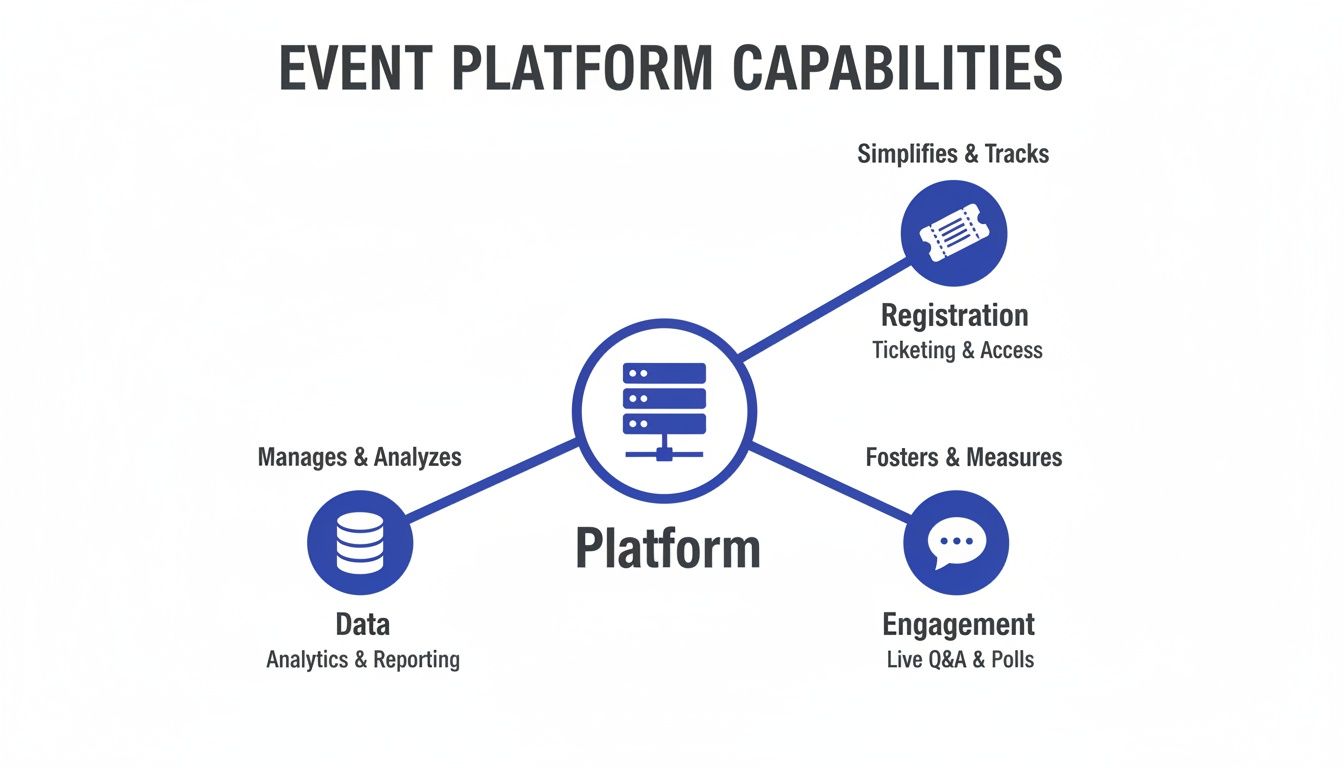
To move beyond data collection and toward decision clarity, event leaders must stop thinking about software features and start thinking about strategic infrastructure. A true event operating system is not another tool to manage tasks; it is a clarity engine designed to reconcile disparate information and surface decision-ready insights. Its value is not in automating workflows but in enabling a higher quality of strategic judgment.
The capabilities that matter are those that close the gap between data and revenue. They form the pillars of a system designed for strategic alignment, not just operational efficiency.
Unified Identity Reconciliation
The bedrock of any strategic event framework is its ability to create and maintain a single, persistent identity for every individual across every touchpoint. This is more than a simple CRM integration. It means that the anonymous visitor who browsed your event website, the prospect who registered for a webinar, the attendee who checked in on-site, and the customer in your Salesforce instance are all resolved into one unified profile. Without this, every other analytical effort is compromised. This reconciled identity is the non-negotiable foundation for measuring lifetime value and attribution.
Cross-Portfolio Cohort Analysis
With a unified identity layer in place, the platform can move beyond single-event reporting to provide cross-portfolio intelligence. Strategic leaders need to understand how audiences move between events, how engagement with a virtual summit influences attendance at a flagship conference, and how the value of specific attendee segments evolves over time. This capability allows portfolio directors to manage their events as an interconnected ecosystem, making informed decisions about content strategy, pricing, and audience acquisition that optimize for long-term growth, not just the success of a single event.
Revenue and Pipeline Attribution
A decision-making infrastructure must connect event activity directly to financial outcomes. This requires more than a simple data sync; it demands a system built to map event engagement to sales pipeline and closed-won revenue. When a sales leader asks, "How did this event influence our Q3 targets?" the answer cannot be a spreadsheet of attendance figures. It must be a dashboard showing sourced and influenced revenue, accelerated deal cycles, and customer acquisition cost per event. This capability transforms the event team from a cost center into a documented revenue driver. A deeper exploration of this topic can be found in our guide on how to measure event success.
Monetization and ROI Transparency for Partners
Sponsorship and exhibition revenue depends on an ability to prove value in a language partners understand: leads, influence, and ROI. A strategic platform provides the tools for transparent value delivery. This includes sophisticated lead management that qualifies intent, not just captures contact information, and dedicated analytics that provide sponsors with undeniable proof of their impact. By making ROI self-evident, this infrastructure shifts the conversation from a negotiation over cost to a collaboration on value, directly impacting sponsor retention and revenue growth. For portfolios with digital components, the unification of experiences detailed in the best hybrid event platforms is critical.
Evaluating a Platform as a Strategic Asset, Not a Tactical Tool
Selecting a new platform is a pivotal strategic decision, not a procurement exercise. The wrong choice saddles the organization with another data silo, reinforcing the very fragmentation that stifles growth. The right platform becomes a central nervous system for the entire event portfolio, delivering the clarity required for confident, revenue-focused leadership.
Therefore, the evaluation process must transcend feature-for-feature comparisons. A long list of functionalities is often a distraction from the fundamental architectural questions that determine a platform's strategic value. Senior decision-makers must probe deeper, challenging vendors to demonstrate not what their tool does, but what quality of decisions it enables.
The Litmus Test for a True Decision Infrastructure
To distinguish a genuine strategic platform from a collection of features, the evaluation must center on its ability to resolve the core visibility gap. The following questions provide a framework for this assessment.
Architectural Foundation: Is it built for reconciliation or just integration?
Many platforms can connect to a CRM like HubSpot. This is table stakes. The critical question is whether the platform was architected from the ground up to create a single, unified identity for each attendee. Ask vendors to explain their data model. How do they resolve a single individual's journey across virtual and in-person events, spanning multiple years? A platform that cannot answer this coherently is a tactical tool, not a strategic asset.Business Intelligence: Does it surface revenue-centric insights or just activity metrics?
Demand to see how the platform moves beyond vanity metrics. Can it produce a report showing the lifetime value of attendees from a specific marketing campaign? Can it isolate a cohort of high-value customers with declining engagement levels across the portfolio? If the analytics require manual export and manipulation in spreadsheets to answer fundamental business questions, the platform will perpetuate, not solve, your core problem.Scalability and Flexibility: Does it support portfolio evolution or enforce a rigid format?
Your event strategy will evolve. The platform must be architecturally flexible enough to support your business in two years, not just today. Can it seamlessly manage a diverse portfolio of in-person trade shows, virtual user conferences, and hybrid leadership summits from a single, unified backend? A platform optimized for only one format creates future silos. The goal is a unified operational view across all event types, as explored in our guide to event technology solutions.Partnership Model: Is the vendor a technology supplier or a strategic partner?
The most advanced platform is ineffective without a partnership focused on business outcomes. Does the vendor’s team include strategists who understand the event business, or are they solely focused on technical support? A true partner engages in conversations about revenue growth, audience engagement strategy, and data interpretation. They are invested in your success, not just your subscription.
The global event planning software market is undergoing explosive growth, with projections suggesting a rise to USD 28.13 billion by 2031, according to Fortune Business Insights. This surge is driven by an enterprise-level demand for measurable business intelligence, not more operational tools. Leaders are investing in systems that provide a competitive advantage through superior decision-making.
A Framework for Implementation: From Technology Adoption to Strategic Transformation
Implementing a new event platform is not merely a technical project; it is an organizational change initiative. The objective is not simply to replace an old tool but to embed a new decision-making discipline powered by reconciled data. A successful transition depends less on the software's features and more on a deliberate plan to align people, processes, and technology around a shared source of truth.
Without a strategic framework for migration and adoption, even the most powerful platform will fail to deliver on its promise, becoming another expensive, underutilized asset.
Step 1: Establish the Data Governance Mandate
Before any data is migrated, leadership must establish a clear governance mandate. This begins by designating the new platform as the definitive single source of truth for all attendee and event engagement data. This decision must be communicated and enforced across all departments—marketing, sales, and operations. This is a critical political and structural choice. It resolves ambiguity about data ownership and provides the authority needed to dismantle the "shadow IT" of disconnected spreadsheets and rogue point solutions that perpetuate fragmentation.
Step 2: Conduct a Strategic Data Audit, Not a Technical Inventory
The next step is to audit the existing data landscape through a strategic lens. This is not about listing every app you use. It is about mapping the flow of information and identifying the points of data fragmentation that obscure business insight. For each data source—from legacy registration systems to survey tools—the key questions are: What unique information does this hold? Where does this data fail to connect with other systems? How does this disconnection hinder our ability to measure revenue impact? This audit provides the blueprint for the reconciliation process, highlighting the most critical data streams to consolidate.
Step 3: Prioritize Data Reconciliation Over Bulk Migration
The most common implementation failure is "garbage in, garbage out"—migrating years of un-reconciled, duplicate, and incomplete data into a pristine new system. This immediately compromises the platform's analytical power. Instead of a bulk transfer, the focus must be on data hygiene and reconciliation. This involves a rigorous process of de-duplicating records, standardizing fields, and enriching profiles before migration. While this requires an upfront investment of time, a clean, reconciled dataset is the prerequisite for trustworthy analytics and credible ROI measurement. The market's immense growth, with some projecting a value of USD 94.73 billion by 2040, underscores the imperative of a solid data foundation, as detailed in this deep dive into the event management software market.
Step 4: Drive Adoption Through Strategic Enablement
Technology doesn't create change; empowered people do. Adoption cannot be achieved through a single training session on software features. It requires strategic enablement focused on the "why," not just the "how." The implementation team must demonstrate to every stakeholder—from event coordinators to the marketing team—how a reconciled view of the attendee helps them achieve their specific objectives more effectively. Showcase how it eliminates manual reporting, provides deeper audience insights, or helps prove the value of their work. This approach, which can be enhanced by new technologies as discussed in leveraging AI for event planning, transforms team members from passive users into active proponents of a new, data-informed operating model.
Redefining ROI: From Cost Savings to Revenue Engine
The conversation around the ROI of event planning software must be elevated beyond simple cost justification. While operational efficiency and the consolidation of redundant software subscriptions provide a baseline financial benefit, they represent a fraction of the true value. Focusing on these savings misses the entire strategic point.
The real return is measured in revenue growth, not cost reduction. A strategic platform is an investment in a revenue engine, and its business case must be framed in the language of financial impact. This requires a shift from measuring what the platform saves to quantifying what it generates.
The strategic ROI of a reconciled event platform is not found in a 10% reduction in administrative overhead. It is found in a 20% increase in sponsor retention, a 15% lift in high-value attendee acquisition, and the ability to attribute millions in sales pipeline directly to the event portfolio.
A Framework for Quantifying Strategic Return
To secure executive buy-in, the business case must connect the platform's capabilities to tangible financial outcomes. This framework moves beyond tactical metrics to quantify strategic value.
Direct Revenue Growth: This is the most direct measure of impact. It includes revenue generated from optimized ticket pricing driven by demand insights, increased attendance from valuable segments, and higher sponsorship revenue resulting from data-driven ROI justification. Quantify this by modeling modest, conservative improvements in each area.
Sales Pipeline Acceleration and Influence: By integrating with the CRM, the platform can provide data on the number of new leads generated, the value of sales opportunities influenced by event interactions, and the reduction in sales cycle length for attendees. Assigning a conservative dollar value to this influence is a core component of the ROI calculation.
Improved Customer Retention and Expansion: A reconciled view allows you to identify at-risk customers with low engagement or, conversely, highly engaged customers prime for upsell conversations. By modeling a small improvement in customer retention or expansion revenue among the event audience, you can demonstrate significant financial impact.
The market's valuation reflects this potential for strategic return. North America's market share, projected to reach USD 5.999 billion in 2025—a 46% increase from 2021—is not driven by organizations seeking better registration forms. It is driven by a strategic imperative to connect event investment to business growth. Further detailed market analysis and projections confirm this trend. The investment is not in software; it is in the capability to make revenue-critical decisions with confidence.
The challenge facing event leaders is not a lack of data, but a lack of a framework to translate that data into decisive action. To move forward, we must shift our focus from acquiring more tools to building a single, reconciled decision-making infrastructure.
TalkValue provides this strategic infrastructure. It is an AI-native platform designed to resolve data fragmentation, deliver unparalleled cohort visibility, and connect every event action to revenue impact.
If you are ready to close the visibility gap and transform your event portfolio into a measurable growth engine, we invite you to have a strategic conversation with our team. Explore how TalkValue can provide the clarity your business requires.


FAQ