For senior event leaders, post-event surveys have become a ritual of diminishing returns. We dutifully ask about overall satisfaction, collecting data that populates dashboards but rarely alters strategic decisions. This cycle persists because we treat surveys as a tactical post-mortem to gauge attendee happiness, assuming a satisfied attendee is a profitable one. This belief, while comforting, is a structural liability. It creates a gap between perceived success and measurable business impact, obscuring the path to sustainable revenue growth and attendee retention.
The real challenge isn't a lack of data; it's the absence of a decision framework that connects survey insights directly to monetization, renewal rates, and portfolio strategy. High satisfaction scores are a vanity metric if they don't correlate with increased attendee lifetime value, higher-tier sponsorship renewals, or predictable revenue forecasts. True strategic authority comes from deploying the right survey questions for events as a precision instrument for financial validation. This requires reframing their purpose: not just to ask if attendees liked the event, but to determine if the event produced the business outcomes that justify its existence and drive future investment.
The following list represents a strategic infrastructure designed to translate attendee sentiment into a clear, quantifiable narrative of revenue impact and long-term value. These questions are tools to help you make better business decisions, from program design and pricing to sponsor management and future growth.
1. Event Recommendation (Net Promoter Score)
The Net Promoter Score is a powerful metric that measures attendee loyalty. It operates on a simple premise: asking attendees how likely they are to recommend your event to a colleague on a scale of 0 to 10. This question acts as a rapid pulse check, providing a clear, high-level indicator of event success and its potential for organic growth.
Based on their responses, attendees are segmented into three groups:
Promoters (9-10): Enthusiastic and loyal attendees who will actively encourage others to attend.
Passives (7-8): Satisfied but unenthusiastic attendees who are vulnerable to competitive offerings.
Detractors (0-6): Unhappy attendees who can damage your brand and revenue through negative word-of-mouth.
The NPS score is calculated by subtracting the percentage of Detractors from the percentage of Promoters, yielding a score from -100 to +100. This provides a standardized benchmark to track performance over time and across your event portfolio.
Strategic Implication
For conferences and trade shows where peer recommendations are a primary driver of registration, NPS is indispensable. It cuts through complex feedback to provide a single, comparable number that signals brand health. The real power, however, is not the score itself but the follow-up. Always pair the 0-10 rating with an open-ended question like, "What was the main reason for your score?" This qualitative data is where you find the actionable insights needed to convert Passives into Promoters and mitigate the risk posed by Detractors, directly impacting future revenue and market position. Analyzing NPS by attendee cohort—such as first-time versus returning, or by ticket tier—reveals which segments are driving or draining value from your event ecosystem.
Implementation Best Practices
Timing: Deploy your NPS survey within 24-48 hours after the event concludes, while the experience is still fresh.
Automation: Use an integrated system to automate collection and connect responses to attendee profiles. B2B conferences using this method often report response rates between 35-40%.
Segmentation: Analyze NPS scores by attendee type (sponsor, speaker, first-time attendee) to uncover specific pain points or successes within different cohorts that influence revenue.
Track Trends: Monitor your NPS score across your event portfolio to measure the impact of strategic initiatives and demonstrate program value to stakeholders.
2. Content & Speaker Quality Rating
For most conferences, content is the core value proposition. This question evaluates that proposition by asking attendees to rate specific sessions, speakers, or keynotes, typically on a 5-point scale. This metric is critical for future event planning and speaker curation because it directly measures what drives attendee satisfaction, repeat attendance, and perceived ROI.
Unlike a single high-level score like NPS, session-level feedback provides granular data to understand exactly which topics and presenters resonate with your audience. You can pinpoint the content that delivers real value—justifying premium pricing and attracting sponsors—versus what falls flat and erodes your brand.
Excellent/Good: Identifies your most successful sessions and top-performing speakers, creating a roster of talent to re-engage and market.
Fair/Poor: Flags underperforming content or speakers, providing clear data to guide decisions on future programming and avoid costly mistakes.
Didn't Attend: Helps you understand which sessions lacked appeal, signaling a potential mismatch with audience interests or poor marketing.
Strategic Implication
Session ratings are the building blocks of a data-driven content strategy that directly impacts revenue. For B2B events, these metrics can be correlated with post-event conversion rates for sponsors, proving the value of session sponsorship and creating new monetization opportunities. By discovering which content tracks are highest-rated by your most valuable attendee segments (e.g., C-suite, enterprise buyers), you can refine your programming to attract and retain high-value audiences. This transforms content from an expense into a strategic asset for revenue growth.
Implementation Best Practices
Timely Deployment: Distribute session surveys via a mobile app or QR code link within 30 minutes of a session's conclusion to capture immediate, accurate feedback.
Correlate with Attendance: Use an integrated platform to connect check-in and engagement data with speaker ratings. This helps you understand if highly-rated sessions also had high attendance, validating their impact.
Segment Your Audience: Analyze ratings by attendee persona (e.g., buyer, developer, executive) to find content gaps for key personas you need to attract and retain.
Demonstrate Sponsor Value: Share aggregated, anonymized scores for top-rated sponsored sessions with your partners to prove audience engagement and justify premium sponsorship tiers.
3. Attendee Intent & Purchase Consideration
For B2B events where sponsor ROI is a critical success factor, measuring behavioral intent is non-negotiable. This question moves beyond satisfaction to qualify sales pipeline impact, asking attendees directly about their plans to act on the solutions they’ve encountered. It directly links event participation to potential revenue, providing sponsors with actionable lead intelligence.
The question typically presents a multiple-choice format, such as: "As a result of this event, which of the following applies to [Sponsor/Product Category]?"
I plan to purchase a solution in the next 3-6 months.
I want to learn more and evaluate solutions.
I will recommend this solution to a colleague.
Not applicable at this time.
This approach segments your audience by their position in the buying journey, turning a list of attendees into a prioritized list of qualified leads.
Strategic Implication
This is one of the most powerful survey questions for events focused on lead generation, as it validates the event's role as a sales accelerator. It provides the evidence needed to shift sponsor conversations from cost-per-lead to value-per-opportunity. By sharing this intent data, you prove tangible ROI and empower sponsors to conduct informed, timely follow-up, drastically improving their sales velocity and increasing the likelihood of sponsorship renewal and upsell. This transforms your role from an event organizer to a strategic partner in your sponsors' revenue generation.
Implementation Best Practices
Deploy Post-Event: Ask intent questions 2-3 days after the event. Asking during registration biases responses and misses the impact of the event itself.
Be Specific: Segment intent questions by sponsor or solution category to provide granular, relevant data for tailored follow-up.
Qualify Timelines: Add a follow-up question like, "What is your expected purchase timeline?" to provide even greater precision for sales teams.
Correlate with Behavior: Use a unified data platform to correlate intent responses with actual attendee behavior, such as booth visits, session attendance, and networking interactions, to validate lead quality.
Automate Lead Routing: Integrate your event platform with a CRM to automatically route high-intent leads to sponsor sales teams within 24 hours of the survey closing.
4. Networking Effectiveness
This question measures whether attendees achieved their networking goals, which for many is the core reason for attending. It directly assesses the event's value by asking about the quality and quantity of new relationships formed. A common approach is to ask, "How would you rate the quality of networking opportunities?" on a 1-to-5 scale, or more directly, "Did you make meaningful connections with other attendees or sponsors?"
This metric is vital for community-focused conferences, industry trade shows, and any event where peer-to-peer interaction is a key selling point. Unlike general satisfaction questions, this one hones in on a specific, high-value outcome that directly influences an attendee's decision to return and their perception of the event's ROI.
Strategic Implication
For events where business development and knowledge sharing are central, measuring networking success is non-negotiable. Poor networking outcomes lead to churn, while strong results drive retention and higher attendee lifetime value. This feedback justifies investments in networking lounges, matchmaking technology, or structured connection programs. By correlating networking satisfaction with attendee cohorts, you can identify which groups are underserved and design targeted interventions, ensuring your entire audience derives tangible value from the community you've built—a key factor in long-term revenue stability.
Implementation Best Practices
Be Specific: Instead of a simple rating, ask "How many meaningful professional connections did you make?" to quantify the impact.
Segment Your Data: Analyze responses by attendee type (e.g., first-timer vs. veteran, sponsor vs. general) to see which groups found networking most valuable and who might need more support.
Correlate Behaviors: Use a unified data layer to connect networking satisfaction with in-app messaging and meeting scheduler usage to understand what activities drive connections.
Measure Long-Term Impact: Deploy a follow-up survey 3-6 months later asking, "Did any of your event connections lead to a new business collaboration?" to prove long-term, revenue-generating value.
Validate Sponsor Value: Share positive networking feedback with sponsors as concrete evidence that your event facilitates meaningful business relationships, strengthening your renewal proposition.
5. Registration & Check-in Experience
An attendee's first physical interaction with your event is the check-in process. This moment sets the tone for their entire experience. A question like, "How would you rate the registration and check-in process?" on a simple 1-5 scale provides a direct measurement of your operational execution. It reveals friction points that can frustrate attendees before your event even truly begins.
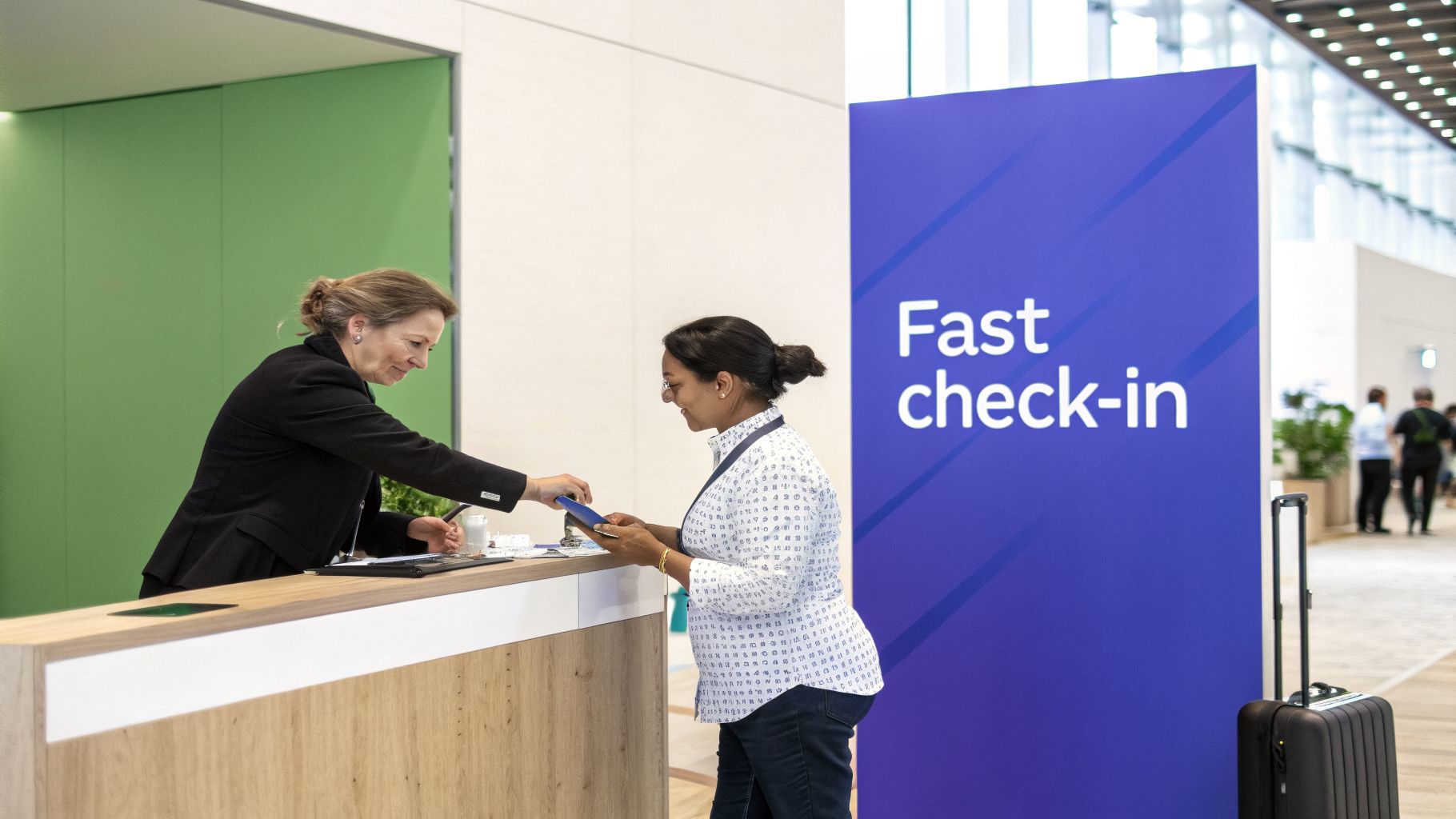
This question helps you quantify the efficiency of your front-door operations. The rating acts as a clear performance indicator, showing whether your investment in technology and staffing is creating a welcoming environment or a bottleneck. For large-scale conferences, a smooth entry is not a luxury; it's a critical component of professional event project management that directly impacts satisfaction and brand perception.
Strategic Implication
For large events, this question isolates a crucial operational touchpoint often overlooked in broader satisfaction surveys. While seemingly tactical, check-in efficiency has strategic consequences. Long wait times signal poor planning and disrespect for attendees' time, eroding the premium brand image you work to build. Correlating satisfaction ratings with hard operational data like average wait time per person and badge reprint rates turns this feedback into a business case. It proves why investments in better technology or processes are not just about convenience but about protecting brand equity and attendee goodwill, which are foundational to long-term revenue.
Implementation Best Practices
Timing is Key: Deploy this survey question within a few hours of check-in, not days later. The experience needs to be fresh for accurate feedback.
Ask for Specifics: Follow the rating question with an open-ended prompt: "What one thing could we improve about the registration/check-in process?" This uncovers specific pain points.
Segment Your Data: Analyze feedback based on the check-in method used (e.g., pre-printed badges, on-site QR code scan). This helps you identify which channels are performing best.
Benchmark Performance: Use feedback and operational data to compare your check-in efficiency against industry standards and demonstrate improvements to stakeholders.
From Data to Decision Infrastructure
This framework of strategic questions reframes your survey from a satisfaction report to a decision-making engine. The real power isn't in asking the questions, but in how you connect the answers to reveal the structural drivers of your event's performance. The most significant barrier to this strategic approach is data fragmentation. Your survey responses hold one part of the story, but your CRM, registration platform, and event app hold the rest. An attendee might rate a session highly, but did they come from a key account? Did they visit a sponsor's booth afterward? Answering these compound questions is impossible when your data lives in separate, disconnected systems.
This is where the concept of a decision infrastructure becomes central. By unifying your feedback with behavioral data, you unlock a deeper layer of understanding. A low "Networking Effectiveness" score, when connected to app data showing that a key industry segment rarely used the 1-to-1 meeting scheduler, gives you a specific problem to solve for a specific cohort. A high "Sponsor Value" score, when linked to lead retrieval numbers and sponsored session attendance, provides concrete proof of ROI that justifies future investment. This integrated view transforms vague feedback into a precise diagnostic tool, allowing you to identify the direct causes and effects that shape your event's commercial outcomes.
This elevates your role from event manager to strategic portfolio architect, capable of proving value, driving revenue, and building a loyal community that returns year after year. The journey starts with asking better questions but ends with a powerful, data-driven engine for growth.
Ready to move beyond disconnected spreadsheets and build a true decision infrastructure for your events? TalkValue provides the unified platform to connect survey feedback with behavioral data, giving you the clarity needed to drive revenue and retention. Explore how you can transform your event data into your most valuable strategic asset. Book a conversation with our team.
FAQ